The ramblings of an Eternal Student of Life     
. . . still studying and learning how to be grateful and make the best of it
 
 
Sunday, February 29, 2004
◊ 
Uncategorized ...

One of the biggest, if most basic, issues of philosophy is the relationship between goodness and truth. Both are generally desirable things (if in fact they can be called “things”; they’re not touchable, they’re both abstractions). Truth is supposed to be objective – if some proposition is true, it should be true for everyone, everywhere – whereby goodness is often subjective, judged by the needs of a particular person. What’s good for you may not be good for me. However, what’s true for you should be true for me too. Of course, the question then comes up as to what truth is. The statement that “John is everyone’s friend” may not be able to be classified as a “true statement”, because it could not practically be verified. The idea of “everyone” is too broad. How could you ever know if John is considered to be a friend by everyone currently living on the planet? You could limit the statement to “John is everyone’s friend on the football team”. Then you could test the statement, and if the whole team agrees that John is a friend, the statement enters the rank of “truth”. Otherwise it remains but an opinion, like “God is everyone’s friend”.

And as to goodness – can there be an absolute form of goodness, something that is good for every sentient observer? Or does all good depend on the characteristics of the observer, and thus generally varies based on that observer’s needs? Are there any objective goods, or is good inherently subjective?

I miss the days of college, when questions like these actually meant something. They got some interesting discussions going.Too bad that this kind of stuff just doesn’t matter too much in most everything you do after college. It would be a better world if it somehow did.

◊   posted by Jim G @ 8:13 pm       Read Comments (2) / Leave a Comment
 
 
Thursday, February 26, 2004
◊ 
Uncategorized ...

I enjoy those web sites that have lists of often-mistaken song lyrics. I’ve misinterpreted the lyrics to a whole bunch of songs in my life, often being corrected with great hubris by some know-it-all type. One of the classic misheard lines was in Credence Clearwater Revival’s “Bad Moon Risin”, where the refrain, “there’s a bad moon on the rise”, was often though to be “there’s a bathroom on the right”. Then there was that crazy line in REM’s “The Sidewinder Sleeps Tonight” that actually went “call me when you try to wake her”, but was heard in all sorts of ways, some having to do with Jamaica. My own favorite misinterpretation for that one was “come on in, tiebreaker” (imagine a baseball game with a guy on third threatening to steal … well, never mind).

I just discovered that I’ve been mishearing another line in a song for the past few months. Luckily I discovered the right line on a web site, before anyone had noticed my error. My latest blunder was Nickleback’s “You Remind Me of What I Really Am”, which I heard as “You Remind Me of What I’ve Never Had”.

Actually, though, I think that my incorrect title is more interesting than the right one. I recently started in on my “Great Minds of the Western Intellectual Tradition” CD’s, and I just got thru Plato. One of Plato’s more interesting developments of his key concept of “the forms” regards love. According to Plato, when you fall head-over-heals in love with someone, the excitement really stems from the fact that your soul is suddenly reminded of the perfect beauty and truth that it knew in a past life up in heaven, before it fell into our nasty world in order to become you. During the rush of affection and attention that happens in the early stages of love, your soul, which is homesick for the nicer world that it once lived in, believes for a short time that it is back amidst the perfect forms, and it gets all excited.

And gee, Aristotelian empiricist that I am, I thought it was all just hormones and other physical processes that developed through evolution to insure the reproduction and continuation of the species.

Well, maybe one could view it both ways. When you find someone whose looks and voice and personality and “soul” intrigues you and sets your heart racing and gets your internal chemistry flowing, your immediate reactions are a natural and scientifically explainable process. The chemical and hormonal reactions in your body alter the images in your mind, and filter out all the imperfections of reality for a while. But then there’s the soul, the mythical soul, which looks out on the world through your mind. In general, the soul does not get very excited about what it sees. Our world is not at all like where the soul came from. But then love comes along, and the picture inside the mind changes due to the magic of interpersonal chemistry. For just a little while, the soul sees something that looks a lot more like home. So it feels darn good about things. Unfortunately, the erotic chemistry doesn’t hold, the illusion fades, and the soul eventually gets back to its usual blah-ze state, just another day of quiet desperation.

(And what’s even worse is that most guys keep on pretending that sex is the ultimate thing in life and that they’re strong or rich enough to get it from their women whenever needed. Guys, once you hit your late 30s, put away the caveman pretenses and admit that sex never did fulfill what you really long for, and never will … and neither will money or power, for that matter.)

Well, this is an extremely mythical and unscientific interpretation of love and the human mind, and doesn’t have much practical value these days. And yet, I myself find a certain gut appeal to it. Even if not true, it’s an intriguing theory: the young women who caught my fancy many years ago were reminding me of something that I never had … not in this life anyway.

And given the way that love goes here in this rough-cut world, what they were reminding me of is something that I still haven’t had and probably never will. There is something compelling about the ideal of “perfect love”, even though we never realize it. Yea, if you want a really good example of what Plato meant by his “forms”, just think about your own longing for true love. That’s the mother of all the forms. So if you can suspend your disbelief for just a few moments, then indeed, let that longing remind you of what you’ve never had.

◊   posted by Jim G @ 9:00 pm       No Comments Yet / Leave a Comment
 
 
Tuesday, February 17, 2004
◊ 
Uncategorized ...

I pass this building on the way home from work, and a few months ago I noticed this attempt to inform potential visitors where the front door is. You’d think that they’d have gotten out the dictionary, or would have asked somebody beforehand. But obviously these guys paint first and ask questions later. And as to their choice of color … whoever runs this building isn’t doing much for the enlightenment of our youth, either in terms of basic spelling or in terms of exterior decorating. Hey, I’ve made spelling errors myself, but I’m not ashamed to go back and correct them. But whoever runs this building is not in any more hurry to protect the mother tongue than they are to keep their building in shape. In a world of decay, language loses its sacredness and power. (Still, someone thought that this message was enough like a sentence to add a period at the end!)

◊   posted by Jim G @ 8:25 pm       No Comments Yet / Leave a Comment
 
 
Saturday, February 14, 2004
◊ 
Uncategorized ...

First Impressions Count: Last night I went to the local supermarket and did my weekly food shopping. This is my Friday night routine (very exciting, yes, I know). I went to the “about 15 items or less” isle, as I had 16 items and all the other isles were crowded. Well, actually, I had passed one of the regular isles where someone was just finishing up with a huge family-size load, dogfood and everything. But I was moving pretty fast with my cart and I would have had to have made a quick stop and backup maneuver, so I figured I might as well continue on down to the small-purchase isles.

I put my stuff on the belt and waited for the guy ahead of me to get thru. Turned out that he was crippled or something, as he had one of those motorized shopping cards with a seat, something like a golf cart. For whatever reason, he was a special case; he had to ask the checkout lady something about almost every item before she rang it up. Then came his coupons, and of course he had to have a conference with her about that. Then he paid by credit card, which was another long production. But the checkout lady was pleasant and good natured about it all, so I figured what the heck, no need for me to add any angst to the situation. Finally he zoomed away in his motor cart and it was my turn for some attention.

Well, at least my groceries got some attention. For what ever reason, this youngish lady just didn’t seem to like me one bit. Her mood had changed 180 degrees when the old duffer left and I stepped up to the cash register. Didn’t look at me, didn’t say anything to me except to mumble the usual “paper or plastic”. She wouldn’t even listen to me when she got confused about one of my produce items – she would only talk to her bagger about it (she was confusing black plums with avocados – I guess she was having a bad day). Finally I paid and she gave me my change without even the pretense of a thank-you. Just more bad vibes to remember Miss Barbara by (their first names are printed on the receipt).

Funny about those things. It reinforces my conviction that people make strong judgements about other people based solely on their looks. Some people just hate you on first sight, right from the get go. And by the same token, some people seem to like you right from the start, even though you might have nothing at all in common with them. Perhaps you detest every idea that is sacred to them, and all that you believe in is pure heresy to them. Nonetheless, they’re going to like you. Who really knows why.

In the field of romance (today is Valentines Day, I realize), this is often known as “chemistry”. Romantic attractions between two people are largely a function of sexual desirability: i.e., physical signs of fecundity in a woman (large breasts to keep the bambinos well fed and wide hips to give them easy passage into the world), or strength and resolution in a man (tallness, big arms and shoulders, square facial features). But there’s still something more to it, something harder to explain. That’s the mystery of “chemistry”. And this IS largely a mystery, although I suspect that it has some deep subconscious reasons, e.g. some unrecognized similarity to a favorite uncle or someone who was good to you (yea, this IS Psych 101).

But it has occurred to me that my theory of subconscious attraction goes well beyond the field of sexual and romantic attraction. It applies between the two sexes even when romantic possibilities are nil, and it also applies between members of the same sex in terms of friendships and business affiliations (OK, I guess it would also apply in homosexual relationships). I’ve know guys that believe in what I do and have similar interests, but I just could never really get along with them. And I’ve had pretty good friends who turned out to have little in common with me, really. There’s some deep programming in everyone’s mind that tells them who they should feel good about, and who they should not feel good about, based pretty much on physical appearance (arguably other physical factors such as the tone of your voice and the way you move also come into play). It usually has little to do with common interests and beliefs, the things that you’d think should determine who you’d want to hang out with.

Of course, the best, most lasting friendships or relationships happen when you meet someone who looks the way you want them to look, and they also like what you like and laugh at what you laugh at and philosophize like you philosophize. I can’t say that I have very many people like that around me these days.

And of course, there’s the opposite of this strange attraction, which I experienced yesterday at the supermarket check out. This is why match making and computer dating have generally been so unsuccessful. You can find a man and a woman who are both looking for love and are of similar age and circumstance and have similar values and interests. They’d probably agree on just about everything; but if the initial chemistry goes the wrong way between them, they won’t ever know that. Their conversation will never get beyond idle chatter. One or both of them will make up enough excuses to get back home rather quickly (and really too bad about those cases when one feels a mysterious attraction to the other, but the other feels a mysterious repulsion). That’s a good argument for dating services that rely heavily on photos and videos — you go in with some idea about the all-important chemistry factor.

This repulsion factor applies well beyond the world of romance; it explains a lot about what happens at job interviews. You may have the best qualifications for the job, but if the person who interviews you gets that mysterious, unexplainable bad feeling about your looks (even if you’re impeccibly dressed and just got a haircut!), they will find plenty of reasons to prefer the #2 or #3 candidate, who gave them a better feeling. (Or you may be interviewed by a team of people and everyone definitely likes you; but the big boss, who only spoke with you for 3 minutes, just didn’t like your looks and so you crash and burn — it’s happened to me!). It’s not an entirely rational procedure (so remember that the next time you get a rejection letter after an interview).

And obviously, it happens even at the supermarket checkout. But thank goodness the pendulum swings both ways. Most people at the checkout actually seem pretty neutral about me (which is consistent with my theory — the mysterious chemistry seems to apply to about half of all people; 25% get good vibes from your looks, 25% get bad vibes, and 50% don’t get strong signals one way or the other). But once in a while, I get someone at the checkout who says hello and maybe even has a friendly comment and gives me a nice thank you when I’m finished (and once in a great while it even happens to be a nice looking girl – that’s a night for humming a little tune on the way out to the car).

Well, too bad that I didn’t make that emergency shopping cart maneuver yesterday. I recognized the lady at the checkout that I was passing; she isn’t a cute young thing, but she’s always nice to me. Oh well, we shall see what happens next week.

◊   posted by Jim G @ 8:00 pm       No Comments Yet / Leave a Comment
 
 
Tuesday, February 10, 2004
◊ 
Uncategorized ...

Lately I’ve been reading Hans Kung’s rememberances of Vatican Two. For you non-Catholic types, Vatican 2 was the big Roman Catholic renewal conference held in Rome in the early 1960s. Kung was a young theologian at the time, and was assigned as an adviser to one of the old cardinals who attended. Being a Swiss-German theolgian, you wouldn’t expect may light-hearted memories on Kung’s part. And you’d be right.

However, Fr. Kung did share his memory of a coffee bar that the church people set up in a side chapel of St. Peter’s Basilica, the big church in Rome where the council meetings took place. A coffee bar was definitely a good idea, as most of the church bigwigs attending Vatican 2 were pretty stodgy, and the stuff they were talking about could put a jackhammer operator to sleep (just try reading a pronouncement by the Pope, old or new). Well, it was pretty slow at first. But eventually the Pope (the late, great John the 23rd) told everyone to lighten up, and the Council picked up momentum. Some good things eventually came out of it. But in the opening days, it was the same old “neoscholatic” / counter-reformation Catholic Church shaped by the Council of Trent from the 16th Century.

Kung recalls the nickname that the theologians gave their coffee klatch: Bar Jonas. OK, well, sounds cute, but why is this important? Because it was actually an attempt at humor: the church was named after Saint Peter, and the bible describes Peter as the son of Jonas, or in Hebrew, “bar Jonas”. So, they were having some fun with a double-entendre on the meaning of the word “bar”.

All right, that one won’t have too many of you rolling in the aisles. But remember, this was the grand hierarchy of the Roman Catholic Church. Any attempt at humor at all amidst them was — and still is — a miracle, however lame the humor might be. Yes, this one deserves to be placed right up there with the most extreme Catholic miracle stories, e.g. young boys dropping their crutches and standing up, angels singing, statues of Mary that weep (in the desert, no less!), thousands of people seeing the sun dancing in the sky, etc.

As a P.S., I did a web search to see if any coffee houses out there are using the name. Didn’t see any. So, if anyone out there every decides to bring back the “Jesus” coffeehouse of the 60’s, I’ve got a great name for your place. Just make mine a decaff, OK? The leaded stuff keeps me up at night.

◊   posted by Jim G @ 8:18 pm       No Comments Yet / Leave a Comment
 
 
Saturday, February 7, 2004
◊ 
Uncategorized ...

SPACED OUT: Tuesday’s New York Times had a good article (by Dennis Overbye) that summed up the biggest question about space exploration. We’ve been shooting stuff up into space for almost 50 years, and a lot of people are now asking themselves, “why?” The answer was easy back in the Cold War days: cause the damn Ruskies are doin’ it, and we can’t let them take the high frontier, dammit! But now that the military imperative is generally behind us, the reasons for our space adventures aren’t quite as clear.

The space people still have lots of justifications to offer, but basically they break down into two camps: CAMP ONE: scientific exploration; CAMP TWO: human colonization. OK, these two camps aren’t mutually exclusive. But it has become clear that if scientific discovery is what you’re after, the best way to do it is by sending machines and not humans out there. Space is not a nice place for people to be, and it takes a lot of money and fuel and other resources to get them up safely and bring them home safely. You could send out a lot of robots like the ones now crawling around on Mars for the price of a few Shuttle flights. And the orbiting space station? The price of finishing and keeping that thing up in orbit could support some really good unmanned science missions out to Jupiter, Pluto, where ever.

You might say that I’m being shortsighted here. OK, you say, perhaps right now having humans up in space doesn’t add much to the annals of human progress. But we need to stay in practice so that we can someday colonize the Moon, Mars, and maybe other solar systems … as in Star Trek. We’re wearing out our own world pretty fast, and eventually we’re gonna have to find someplace else to be if we’re gonna give every human being a shot at a good, comfortable life.

Unfortunately, here on this planet, our level of science — and more importantly our level of economics — still aren’t anywhere close to what would be needed for a real version of the Enterprise, with its warp drive, di-lithium crystals and antimatter fuel and comfortable lounges and restaurants. For now, all we can do is to send people up in cramped tin cans where things aren’t very comfortable. Yea, we might have the technology to set up colonies on the Moon and Mars before long, but they aren’t going to be such nice places to stay. Most people would get tired of them pretty fast, and not many would want to spend their lives out there and start a family (Elton John was quite right when he sang “Mars ain’t the kind of place to raise your kids” in Rocket Man).

The pro-space colonization people talk about the spirit of the New World explorers of the 15th and 16th centuries, e.g. Columbus, Drake, Vespucchi, Erikson, DaGama, etc. But there’s a big difference here. The European crews that first landed on the shores of the West Indies and Florida still had plenty of oxygen, sunshine, water, blue skies, edible fruit, and other recognizable stuff about them when they arrived. The New World wasn’t really all that new. It was still the kind of place where you could unwind, the kind of place that more or less makes sense to you and your body. To live on the Moon or Mars or the Starship Enterprise, you’re going to have to put up with a cramped, high-tech environment where food, water and air supplies are highly rationed. If you hate big government here on Earth, well, don’t think that Mars is going to be your paradise. There would be all sorts of restrictions on what you can or can’t do in everyday life. Break the rules and everyone could die very quickly given the harsh surrounding environment.

Perhaps we will eventually be able to build large-scale artificial environments that are comfortable and self-sustaining for a community of humans, and which allow degrees of freedom and self-expression similar to what we are used to. But our first experiments in artificial human-inhabited environments didn’t go so well — recall the failed Biosphere 2 experiments in Arizona back in the early 90s. “Basically, we suffocated, starved and went mad,” said Jane Poynter, one of the participants. We really don’t know all that much about building a sustainable human environment in a vacuum. The first thing that would be needed would be a reliable energy source. OK, there would be plenty of sunshine, at least until we get past Jupiter. But even with huge solar panels generating electricity, would there be enough to sustain a big comfortable human bubble in the midst of radiation, asteroids, vacuum, and extreme cold?

I say we’re wasting our time and our money putting people up there right now. For the next 50 or 100 years, let’s figure on doing the science and research the best way possible, with robots. Maybe once we learn more about the heavens and about our own Earth and about ourselves, we can figure out how to live happily in the great beyond. For now … well, sure, we can get back to the Moon and get out to Mars in a decade or two. But we’re just gonna hate it once we get there.

ALSO IN THE NEWS: The Janet Jackson flash at the Super Bowl? Oh come on, what a joke (yes, I did see it). That’s what makes the front-page news around here? I got a lot more interested in a small item in the back pages, an article about some guys from Cuba who were tired of Castro so they converted a 1959 Buick sedan into a boat! They actually almost made it to Florida, but the Coast Guard got them. The executive director of the Cuban American National Foundation said “on ingenuity alone, they should be allowed to stay”. I can’t completely disagree with him!

Well, next time you hear guys talking about their old Buicks, it will make more sense when they say “man, that car was a boat”.

◊   posted by Jim G @ 4:18 pm       No Comments Yet / Leave a Comment
 
 
Sunday, February 1, 2004
◊ 
Uncategorized ...

VEGETARIAN BLUES: I’ve been a vegetarian-of-sorts for the past 18 years, and sometimes it ain’t easy finding something good things to eat. I know what to do about dinner, and breakfast ain’t too hard to cover (cereals and such), but finding tasty things for lunch that are easy to make is sometimes a challenge. I used to buy a certain brand of bulgar wheat and cook it up on weekends, but after a while I couldn’t find it in the stores anymore. (This is one of those common little frustrations caused by modern supermarket sales strategies; you find something in the store that you get to like and you start buying it regularly. Then a year later, somebody in the front office looks at a report and decides that it’s not worth giving that item shelf space anymore, something else will make the company more money. Then it’s too bad about those of you who got to like the stuff.)

Oh, bulgar wheat is still commonly available in my vicinity (health food stores and such). But I can’t find the stuff that I got to like so much. What now passes for bulgar wheat is finely ground up chaff, almost like powder. Thus, when you cook it up, it becomes a white, gloppy, tasteless blob. Basically like hominy grits. As with hominy grits, the only way to make it taste good is to thrown in stuff that’s salty and full of fat, like whole milk or butter or gravy. But as a vegetarian, I don’t want that. I want stuff that in itself has taste and texture to it, but ain’t fully of high-blood pressure causing salt and artery-clogging saturated fat. The bulgar wheat that I used to know and love met those conditions; it was course and brown, and even after you cooked it for a few minutes and softened it up, it still had a crunchy texture and a nutty flavor. But now it’s gone forever.

What can I say. God giveth and God taketh away (eth). But maybe God has re-given (eth) in my case. Maybe I can fall in love again. Because I recently found steel-cut oats in the local supermarket. If you haven’t tried them, steel-cut oats still cook up gloppy like regular oatmeal (thus tempting you to pour on the whole milk and sugar). However, they retain part of their hulls, which gives them a toasty flavor and some crunchiness. Almost like the old bulgar wheat that I loved so much. And hey, oats have stuff in it that helps to keep the heart from getting clogged up (so long as you don’t pour in whole milk or butter). So maybe I’m gonna be all right despite the loss of my tasty bulgar wheat. Well, at least until the numbers boys in the front office figure out how they can hype up the profits by putting more super-sugar frosted cereal foods in the breakfast aisle and knocking out the odd stuff like steel-cut oats.

Oh, well, I think I’m gonna go cook some oats up for lunch right now.

◊   posted by Jim G @ 12:47 pm       No Comments Yet / Leave a Comment
 
 
Friday, January 30, 2004
◊ 
Uncategorized ...

There was a good article in the February Atlantic Monthly about trends in the American economy. The author made a pretty good point about college education. One of the reasons why this country did so well economically after World War 2 was the fact that it built a lot of colleges and made college available to the masses. Having a lot of fairly educated people around (OK, I know that a college degree doesn’t automatically make you smart, but on average it does seem to help) really did help businesses to operate better and develop new products, and that really helped the economy to grow.

After the War, the GI Bill sent a lot of guys (and more and more women) to college who otherwise didn’t have a shot at it … including one of my uncles. Then in the 60s, a whole lot of state schools and community colleges were built or were expanded, putting a college in just about everyone’s neighborhood. Maybe because of our fear of being outdone by them smart Ruskies (who by then were putting people into space and shooting off some pretty nasty H-bombs), our nation decided to open these colleges up to just about everyone who seemed bright enough; money was not to stand in the way. I went to a state engineering school here in New Jersey back in the early 70s, and I remember tuition for a full 16-credit semester being maybe a couple of hundred bucks; hardly any more than the cost of books for 4 or 5 classes. OK, money was worth more back then, but still, today that would be around $1000. I know for sure that a full semester’s tuition for a decent state school today is much more than $1000.

Yea, times have definitely changed with regard to the cost of a college education. Let me mention one more example of the good old days: until the late 70s, anyone living in New York City could get a 4 year college education for free at City University. But that sort of thing required a citizenry that was willing to put up with higher taxes in return for greater social capital (i.e., a greater number of educated people in town). Today, the general mood of the citizenry is to cut taxes to the bone. Ironically, even those who benefited from a low-cost college education courtesy of other people who put up with high taxes have agitated for tax cuts, at least once they bought a house and an SUV.

So, the Atlantic article points out that due to skyrocketing college costs (which correlates with government support cutbacks needed to finance bigger tax cuts), the percentage of Americans with a college degree is no longer increasing, as it did for most of the 20th century. It seems to be leveling off at around 30% of adults. The author thinks this may have serious long-term consequences for the American economy over the next 20 years or so. Other nations are still putting money into free or low-cost advanced education. Somehow, a lot of poor or near-poor people in India are getting college degrees, and are then taking over American jobs like computer programming and claims processing (through Internet-based outsourcing). On this issue, we Americans may well be in the penny-wise, pound-foolish zone with regard to tax cuts and government spending limitations. Sure, we may be enjoying our McMansions and super-sized SUVs right now, but in 10 or 20 years, our kids may be dealing with an economy that ain’t the world’s best anymore. It happened to Great Britain, with all its sorry decay and unemployment, and it can well happen to us.

Thanks much, Mr. Bush, Mr. Reagan, and all you other rabid tax-cutters.

◊   posted by Jim G @ 6:46 am       No Comments Yet / Leave a Comment
 
 
Saturday, January 17, 2004
◊ 
Uncategorized ...

I have a public confession to make: I once worked for the New Community Corporation of Newark, NJ. Actually, I worked twice for them: 10 years as a development office, and another half year as an info tech assistant. Oh, I also volunteered for them for 2 years and was a part-time consultant for another 6 months. All told, I had 13 lucky years in and about the New Community empire.

What the heck is New Community, you ask? Well, it’s an urban community development corporation, probably the biggest one in the nation. It builds and rents housing to low-income people, provides job training and social services, runs two charter schools, provides pre-school programs, supports a credit union and other financial services, and runs various small businesses that provide jobs in the low-income neighborhoods of Newark. Sounds great, huh? A place with a mission led by a man on a mission, the Monsignor William J. Linder. Father Linder was the founder of NCC, and remains the grand poobah to this day.

Linder started NCC with a group of parishioners back in 1968, right after the riots in ’67. Since then, New Community never stopped growing. The New York Times and other big media just love it; they’re always doing articles and stories about NCC as the light of the ghetto, the organization that thrives in the crime and drug-ridden neighborhoods that strangle public schools, mom and pop stores, public housing, and anything else that tries to stay alive down there. Since the early 1960s, almost every government effort to make things happen in those neighborhoods has failed; but at the same time, Monsignor Linder’s crew has taken a lickin’ and has kept on tickin’. They gotta be doing something right!

Yea, the good Monsignor and his right hand man, Ray Codey, have done a lot of stuff right, and people interested in urban poverty aren’t wrong in admiring them. That is, until one of them thinks to ask a rather blunt question: if NCC knows how to combat poverty so well, why are there still so many poor folk and mean streets in Newark (and increasingly in the cities surrounding Newark, as if an infection were spreading). Why didn’t the Census poverty rate go down in Newark from 1990 to 2000, despite NCC’s continued growth and the economic revitalization of downtown Newark? Why do increasing numbers of Newark youth turn to street gangs for hope, versus NCC’s many avenues of opportunity?

A rude question, not often asked. The New York Times and its cronies have been too polite thus far. But NCC is getting a whole lot of public money (more than two-thirds of its revenues come from state or federal sources) and you’d think that the press might start asking whether the public is getting its money’s work from NCC (and it’s many imitators).

In my opinion as a former insider, the biggest problem at NCC is that growth has become king. The #1 goal at NCC is to keep on adding new buildings, new programs, and new grants. That is definitely the Linder-Codey doctrine. Question it, as some thoughtful management people did over the years, and your job security takes a nosedive. The official NCC motto talks about personal dignity and improvement of the neighborhooods, but the undisputed prime directive is growth. If you want to keep your job, you don’t stop and ask, “just what do the poor people in our area really need?”

And that’s a shame, because a place like NCC could really prove to be a useful bridge between the policy wonks who affect the big decisions in DC and the poor themselves. Right now you’ve got a number of think tanks dedicated to poverty issues and governmental responses: the Institute for Research on Poverty at the University of Wisconsin, the Joint Center for Poverty Research at the University of Chicago, the Urban Institute, the Ford Foundation, and various state-level groups such as the Rutgers University urban issue groups in New Brunswick and Newark. These are interesting places where academians and grad students crank out studies about the effect of social policy on crime, teen pregnancy, use of welfare benefits, unemployment, etc.

On the other side of the coin, you’ve got the community development corporations and other service agencies struggling away out in the ‘hoods, fighting for every dollar, trying to expand or at least make the next payroll. And for the most part, nothing connects these two worlds. The academians pretty much stick to national issues such as federal welfare policy or low income tax credits or HUD public housing directives, and don’t really pay too much attention to the non-profit agencies that have the most contact with the poor and their communities.

By that same token, service agencies like New Community put their blinders on and focus solely on what they have traditionally offered their clients, be it housing or emergency shelter or day care or drug rehab. They don’t often think about the overall mix of outside influences in a poor person’s life, e.g. police procedures, welfare rules, public school problems, food stamps, taxes, incomprehensible paperwork, etc. Only the academians up in the ivory towers have the luxury to ponder how those things interact and study what kind of responses they generate. Those who could really watch it all in action (people in the service agencies) don’t have the time, and those who do understand the bigger picture (the academic types) seldom go out to actually look at it. Bottom line, we don’t have many people who can really analyze and understand what it’s like to live in urban poverty. No wonder most of our programs to help the urban poor have done so poorly themselves.

I have a modest proposal to offer here. But before I do, let me focus once more on my experiences at NCC, an organization claiming to touch the lives of over 50,000 poor people each day. During my years there, we had occasional contacts with the thinking crowd; academic studies did take place regarding NCC and its clientele. But these studies had to be pre-approved by the big boss. And that meant that a complimentary product was expected. Despite having a Ph.D. himself, Monsignor Linder was not a big fan of academic freedom. Not in his backyard.

Again, the prime directive to all who worked in the front office (as I did) was growth. We were not encouraged to stop and discuss the lives of those we served, or the various forces that touched them. We were not to think about whether welfare was a disincentive to marriage, or whether competitive school vouchers would improve the inner city public schools, or whether gangs were actually rational economic choices for young male dropouts. We were told to get to the next grant, get the next building constructed, and get the next new program going. This despite the fact that we were concerned and intelligent people with college degrees and often graduate training.

OK, so we didn’t have the academic or political credentials that would get us into the Institute for Research on Poverty or the Ford Foundation. But we rubbed elbows every day with the subjects of their studies, even if most of us did not reside amidst them. You’d think that we could be of some use to the ivory tower dwellers. But they didn’t seem interested, and the big boss wasn’t interested either (unless it would somehow add to his glory).

So, I have a proposal – just a dream, I have no way of making it a reality. I foresee a hybrid organization, a cross between a research institute and a community-based service agency. In this organization, the staff would be responsible to provide services to the urban poor, and simultaneously participate in quality studies that document and help understand the poor and how they can best be helped. I would take a group like New Community or one of its many imitators and convert it from a high-growth organization into a learning organization.

Instead of continuously seeking partnerships with government agencies and businesses to garner resources for new service ventures, the new hybrid would seek to work closely with academic groups for on-site, un-biased studies of a variety of issues affecting the lives of the urban poor. These studies would be open to conclusions that went against the agency’s immediate interests (e.g., a study of HUD’s Movement To Opportunity program might show the benefits of moving poor families our of inner city housing like that run by New Community and into suburban areas with better schools and job prospects).

Instead of exclusively seeking grants for more buildings and new programs, this hybrid agency would learn to harvest funding for studies and policy papers. Every staff member would be encouraged to consider themselves research associates, from social workers to accountants to housing managers to day care teachers to grantwriters to career counselors. They would participate in carrying out studies and voice their opinions and look things up and get interested in the bigger picture of urban poverty. They would be responsible to learn more about the poor and the community every day. In other words, they would be quasi-grad students of all ages, expected to put hard work into their learning and research. Overall, such an agency would help the ivory tower people to get real, and help the people who deal with the real to see the bigger picture.

The end product? A cadre of young and middle-aged professionals with a better understanding of the urban poor and what can really be done to help them in spite of our American political realities. They would work together with formal academians and policy wonks to help the public understand the inner cities and help our leaders institute more effective urban programs and government actions.

Of course, I have a vested interest in presenting this dream. I want to work at such a place! It would really make my life complete. For now, though, I don’t believe that this place exists. Oh well … we all have our dreams.

◊   posted by Jim G @ 10:23 pm       No Comments Yet / Leave a Comment
 
 
Thursday, January 15, 2004
◊ 
Uncategorized ...

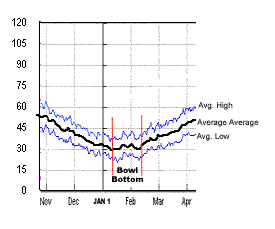
WELCOME TO THE BOWL: Up here in the Northeast, we’re just entered the heart of the winter season. If you look at a chart showing the average temperature per day throughout the winter (which I’ve thoughtfully attached), you will see that it looks a lot like a bumpy soup bowl. Temperatures slide downward pretty steeply through November and December and on into January. Then right around the 15th, they flatten out. On average, it doesn’t get any colder, but it doesn’t really start getting warmer either. It just stays cold for a month (and keeps on snowing most of the time). Then, right around the middle of February, the warming trend kicks in and average temps finally start rising, continuing on into March and April and thus heralding the arrival of spring.

So we’ve just hit the bottom of the bowl here. If you’re thin like me and don’t take too well to the cold, it’s not much to look forward to. A whole darn month to wait out until things start getting better. The only encouragement available for now is in the evening, when you notice that the sun stays up maybe 10 or 15 minutes longer than back around Christmas. The mornings are still awfully dark (I never knew that sunrises and sunsets are out of synch; the earliest sunset occurs around December 15, whereas the latest sunrise waits until January 1; the shortest day, however, occurs right in-between, on December 21st).

Is it any coincidence that our nation’s biggest sporting event, the Super Bowl, occurs right in the middle of the temperature bowl? Football is ultimately a cultural phenomenon, and culture is definitely driven by its environment. So as you watch a team (the Eagles?) drive up past the 50 yard line, perhaps you’re subconsciously thinking about your life slowly making its way across the flat bottom of your own winter of discontent.

Well, then again, maybe not.

SILLY SEASON STARTS: OK, so it’s time once more for the Democrats to pick a Presidential candidate. I previously expressed my positive opinions regarding Howard Dean. And I still like the guy. But to be honest, I’m having a lot of second thoughts, wondering whether he’s the next McGovern or Dukakis (the Democrats have a flair for nominating well-intentioned people that our heartland couldn’t ever take seriously; the Republicans haven’t strayed far from the mainstream since Goldwater in ’64). I read today that his wife has thus far taken almost no interest in his campaign. She mostly wants to stay in Vermont and be an aging hippie doctor. My kind of gal. But not the kind of woman who can help draw the attention of all those swing voters in Ohio and New Hampshire (so much like Vermont and yet so different) and Oregon and West Virginia who will make or break the Democrats (so far, it looks like “break”). She’s not exactly the “stand by your man and your Bible” type.

I hate to say it – maybe I’m just having Clinton flashbacks – but after watching one of the debates the other night, John Edwards by far looks the most like a President (Mr. Edwards’ wife is in fact campaigning for him). Gephardt comes across like a perpetual member of the House, and Kerry looks like an ersatz member of the Kennedy family. Sorry, but rightly or wrongly, the world isn’t ready for a President Al Sharpton yet, nor for a President Lieberman, nor (most unfortunately) for a President Moseley-Braun. General Clark is obviously trying to lock up the VP slot.

Perhaps Dean is close to the brass ring, but if there is to be a darkhorse charging up from behind in the primaries, I’d say that it’ll be Edwards, not Gephardt. We shall see — could be an interesting year (up to convention time, anyway).

◊   posted by Jim G @ 12:35 pm       No Comments Yet / Leave a Comment
 
 
TOP PAGE - LATEST BLOG POSTS
« PREVIOUS PAGE -- NEXT PAGE (OLDER POSTS) »
FOR MORE OF MY THOUGHTS, CHECK OUT THE SIDEBAR / ARCHIVES
To blog is human, to read someone's blog, divine
NEED TO WRITE ME? eternalstudent404 (thing above the 2) gmail (thing under the >) com

www.jimgworld.com - THE SIDEBAR - ABOUT ME - PHOTOS
 
OTHER THOUGHTFUL BLOGS:
 
Church of the Churchless
Clear Mountain Zendo, Montclair
Fr. James S. Behrens, Monastery Photoblog
Of Particular Significance, Dr. Strassler's Physics Blog
Weather Willy, NY Metro Area Weather Analysis
Spunkykitty's new Bunny Hopscotch; an indefatigable Aspie artist and now scholar!

Powered by WordPress