The ramblings of an Eternal Student of Life     
. . . still studying and learning how to be grateful and make the best of it
 
 
Wednesday, March 25, 2009
Food / Drink ... Photo ...

Like most people, I like to eat; I enjoy the act of consuming tasty, well-prepared food. But I also know that too many kinds of tasty food have bad side-effects, e.g. obesity from too much fat and sugar, high blood pressure from too much salt, and possibly cancer from certain preservatives and by-products (e.g. the stuff in bacon, maybe even the crust on bread!). And I also know that what I eat has a bigger effect on the planet and on humankind at large. As such, I choose not to eat meat, and to minimize the amount of animal products that go down my throat (admittedly, I’m not a perfect vegan yet). Furthermore, I’m convinced that what I eat has an effect on my psyche; I’d get pretty depressed after a while trying to survive on microwaved burritos and non-stop Micky D’s (although I know people who do survive on that diet — in fact, too many people).

So, I’m a bit of a “foodie”, a vegetarian foodie. I put a lot of time into cooking and baking, I constantly try to improve my recipies, I own about 7 or 8 different cookbooks, and I’m on the lookout at the supermarkets for interesting new ingredients that might fit with my food philosophy. (Unfortunately, most of the new things I see at those supermarkets are highly-processed “food-like” items, exactly what I don’t want to eat). I’m kind-of a “slow food” guy, although I’m also trying to keep it simple. I don’t do complex, elaborate dishes; I don’t go bonkers to get the freshest, most exclusive items from specialty stores; and I don’t limit myself to organic fruits and veggies (too expensive!). I mainly use ingredients available at the local supermarket (although I do order some things now and then from bulkfoods.com, and I stop in at the local Whole Foods every month or so).

My meals are fairly simple; no fancy salads or appetizers, just a plate full of carbs, proteins and veggie fiber, followed up by a small dessert (maybe some cookies or a cupcake that I made – from scratch – during my weekend cooking sessions). With perhaps a glass of wine or ale (or porter or stout), but sometimes just a glass of seltzer with lemon. I concoct my main dishes on weekends, so that a weeknight consists of cooking some rice or pasta and heating up some veggie side-dishes along with the “main event” (usually a soup, a bean dish, or a pasta sauce). And then sitting down to enjoy the results.

Notice that I cook a lot, and thus use a lot of heat. Yea, admittedly I’m not a raw-foods person. I come from a Polish ethnic family and even though what I eat is very different from what they ate (lots of starch and meat fat and nothing green or yellow), I still tend to favor hot, cooked meals. As such, my carbon footprint is larger than for those good, progressive folk who get by on nuts, salads and raw brocolli. But there’s something very familiar and comforting about having a steamy plate full of calories under my chin, come dinner time — even in July! With me, the old tradition lives on (even though the spices and basic ingredients are all different).

So what’s on the menu? Here’s a list of my main dishes at present. I go back and forth between these items, making enough for 8 or 10 meals and then moving on to another item to sustain me for a few weeks.

– Black beans / rice or cornbread, with broccoli and yam or yellow squash
– Black bean soup w bread, yam or yellow squash
– Veg chili, red beans and lentils, with broccoli and yam or yellow squash
– Green split pea soup (no ham) with bread, broccoli and yam or yellow squash
– Lentil / tomato soup w bread, yam or yellow squash
– Beans baked in molasses and onions w whole grain raisin bread, yam or yellow squash
– Lentil / barley / mushroom soup w baked potato, broccoli and squash or yam
– Black eyed peas / rice or cornbread w yam or yellow squash
– White bean / kale / tomato soup w bread, yam or yellow squash
– White bean / broccoli soup w red vinegar, bread, yam or yellow squash
– Pinto bean stew w wheat noodles or baked potato, broccoli and yam or yellow squash
– Lentil / carrot / ginger soup w bread, yam or yellow squash
– Baked lentil loaf w sauteed mushrooms, baked potatos, yam or yellow squash
– Ratatouille (zucchini, eggplant, tofu, bread crumbs) w rice, yam or yellow squash
– Curried eggplant with peas, rice, yam or yellow squash
– Noodle casserole w tomato, green pepper, onion and tofu, with yam or yellow squash
– Stir fry (broccoli, red cabbage, red pepper, onions, tempah, garlic) w rice (sweet or short brown)
– Whole wheat pasta, orzo or aroboli rice w lentil/onion sauce, sauteed split mushrooms, steamed broccoli
– Garlic/chick pea/red lentil/cracked wheat soup, with yam or yellow squash
– Falafel with tahini sauce, bread, brocolli, yam or yellow squash
– Red Beans, hot peppers, cumin w/ rice, salsa, yam or yellow squash
– Pasta with kale/red cabbage/garlic, sauteed zucchini and portabello mushroom
– Pasta sauces: Tomato; Lentil/onion with basil pesto; Green pepper and onion w red vinegar

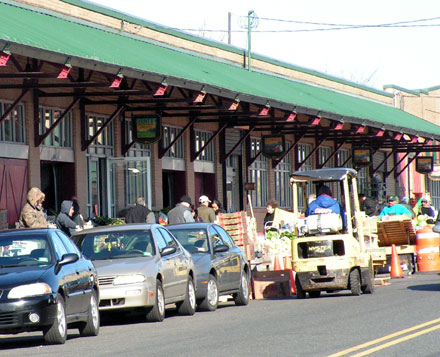
FINAL POINT: Most foodies love farmers markets. Up to now I haven’t given those markets much attention, as they are usually provisional affairs open at a odd times in odd places without good parking. But this past weekend I discovered a more institutional farmer’s market — some snobby foodies might not even consider it a farmer’s market. It’s in South Paterson, NJ, about 5 miles from my house, and I came across it by accident on a photo expedition. It impressed me by its size and scope (it’s not a handful of tables in a town square, but a series of warehouse buildings along a two block stretch where food merchants set up bins on the sidewalk and along the curb). So I got out and walked around, and was quickly astounded by the low prices and high quality of the stuff for sale on those bins. I picked up some apples and tomatos and strawberries at half to 3/4 of the supermarket price.

Most of the sellers aren’t farmers but food wholesalers, although supposedly some farmers set up tables and sell direct during the summer months. So maybe the apples came from Chile and the strawberries from Mexico and the tomatos from Florida or such. This market is not necessarily local, but neither am I. In fact, it’s patronized largely by the local Arab and Hispanic neighborhoods. It’s what “one-worldism” is truly about, once you get past the elitist idealism of the Barack Obama / PBS crowd (to which most “foodies” subscribe). It’s gritty and industrial; it’s not organic and there aren’t any Starbucks nearby (in fact, there are classic old diners to either side of it!). Here’s a pic. My kind of place — I’m definitely going back!
◊   posted by Jim G @ 7:17 pm       Read Comments (3) / Leave a Comment
 
 
Sunday, November 30, 2008
Food / Drink ... Personal Reflections ... Religion ...

It’s Sunday and a lot of people have gone to church today to participate in services meant to worship some form of divinity. I wasn’t one of them. I haven’t attended a regular church worship service in almost ten years. In some ways I miss it. I still believe in a divinity, and there’s no reason why the divinity that I believe in doesn’t deserve my participation in a communal worship service honoring that divinity. But one of the things that turns me off about church worship, such as it is available in my community, is that it seems to be about more than just divine worship. Much more. Too much more, in my book.

Let me be honest here. It’s also a matter of personal economics. Church don’t come cheap around here. Most congregations will hit you up for money once they see you as a regular. And that’s legitimate; it costs money to heat and maintain church buildings, and hire ministers and other staff, and buy songbooks and such. But for now, my parental support responsibilities make me do cost-benefit comparisons for any major purchase I might consider. And the typical costs for belonging to a typical church just don’t outweigh the benefits, in my book.

Why not? Well, the churches (and mosques and synagogues and whatever else might be out there, including Quaker meeting houses) just don’t deliver the kind of intellectual stimulation that I’d like. I am an eternal student, after all, and the subject of God for me is not a settled one (and never will be). So there’s never a lack of thirst for intelligent things to be said about the question of God, and of how we should live our lives in light of that huge question. But most of the churches that I’ve been part of (and I sampled quite a few back when I was younger) seemed to focus on repeating the same things over and over.

Sure, someone usually gives a sermon with a few thoughts on how the ancient scriptures and confessions of faith relate to current events. But they have to walk on eggs, they can’t question whether the ancient writings and creeds might be wrong in some ways or whether someone else’s ancient writings and creeds might fit better given the issue of the day. They can’t be very open minded. And I’m not in the mood to spend scare money on closed mindedness.

And what else bothers me is the focus on “the founders” and the history of the sect. When I was hanging out with the Quakers, it was suggested that I get to know Matthew Fox and Quaker history (which I did, somewhat, as it is worth knowing about). When I was an Episcopalian, I was expected to know something about Bishop Cranmer and Anglo history. The Roman Catholics of course have their many saints and popes to learn about (but only up to a point; they don’t want the average Joe to know too much about the old popes, given some of the less-than-stellar leaders the Roman Church has had over the centuries).

And then of course there are the worship rituals and all the time and effort needed to support them. And then the basic grounds-and-facilities issues and the business stuff, like fixing the leaky boiler and balancing the budget. Then there are the social customs, the picnics and dinners and bake sales and youth activities and such. All well and good. Oh, and then also the social activism that some congregations engage in. Even better. But as to getting back to the basic question: why should we believe in God, and live our lives as though God really does exist – everyone seems almost embarrassed to consider it. As though it’s all settled, bringing it up implies lack of conviction.

Maybe the problem – or my problem anyway – is that churches are about worship, and not about ongoing existential dilemmas. Worship implies that you’ve gotten past the existential of believing in God, and are ready to start acting out your belief. At least during the hour allotted for worship services. I guess that existential dilemmas regarding faith are not easy to share and discuss and deal with. So we don’t. At least no where in my neck of the woods. And that’s too bad. I could see pulling out a twenty and losing an hour or two on a Sunday morning if there were a group format nearby that mixed discussion, learning, meditation and singing, along with comparisons of the many ancient and modern thoughts on God and faith from throughout the world, personal reflections on the crisis of belief and faith, and sharing of ways to enact faith in daily life and social life. And no requirement to memorize the founders and past history of the movement! I.e., no Moses, Mohamed, Buddha or Saint Peter to bow down to.

(The Unitarians claim that they do this, but they fail to make it to first base with me, as they don’t presume belief in God or even interest in belief in God; the latter would relate to those of us – most of us, actually – who entertain doubts amidst our hope. The Unitarians don’t even require hope for a loving divinity, you can be an atheist and be fully accepted in that community. Not my cup of tea, a bit too weak of a brew.)

So for now, I stay home on Sundays. But I maintain my hope that there’s something out there somewhere like this. A church of eternal students on the road, searching for faith within their lives.

BEER REVIEW: Here’s a quick review of two new beers currently being pushed on the masses by the giant American brewers, Budweiser and Miller. They both involve lime. I personally like lime, and I was intrigued by the notion of how limey flavors would go with beer. Well, Bud and Miller, in their infinite wisdom, decided that lime flavor would go best with a watery light beer. So they have given us Bud Light Lime, and Miller Chill. Of the two, I like Miller Chill better. It still tastes just a bit like beer; and the lime flavor is subtle, not all that far from fresh lime juice. On the other hand, Bud Light Lime tastes more like lime-flavored candy, liquid style. Too much cheap quasi-lime flavoring in it. So Miller has the better entry in the lime beer war, for now.

WEB SITE REVIEW: There are plenty of useful little web sites that you don’t notice or look at until you specifically need what these sites do. One of those sites is www.filleritem.com I came across it the other day when ordering something from Amazon and just missing the $25 threshold for free shipping. That’s when you want to know what can you buy from Amazon for a buck or two that would put you over the top and avoid the $5 or more for shipping. It’s not easy to to that directly on Amazon, as they don’t have a price-range search (which further selects out those items sold directly by Amazon; a lot of listed items are sold by affiliated vendors, and thus are irrelevant to the free shipping offer for goods purchased directly from Amazon). But filleritem.com does indeed allow such a search. Only problem: the site needs updating. Some of the cheap items listed aren’t available anymore, and others have gone up in price. I hope that they do keep this site updated; if you do business with Amazon, sooner or later you’re going to need it! (PS, there’s also www.slickfillers.net)

◊   posted by Jim G @ 8:33 pm       Read Comments (2) / Leave a Comment
 
 
Monday, June 9, 2008
Food / Drink ... Personal Reflections ...

We’re having a very early heat wave here in northern Jersey, with temps above 95 and near-liquid humidity too. In times like this, most people’s minds do not turn to cooking. Only the truest of the true fans of food preparation still think about baking cookies and soups on the range and steamy plates of pasta or rice and stir fry on days like this. And that includes me. Salads and cold dishes? BAH! My mother cooked even in late July and mid-August; no “too hot to cook” excuses for her! And by goodness, so will I, as long as I can stand!

I just bought a copy of an old classic vegetarian cookbook, one that helps keep me inspired at the stove even on days like this. It’s called The New Laurel’s Kitchen Cookbook (the original one was from the 1970s, and the “new” version came out in 1986, which is now old enough to make the ‘new’ version old). I have to say that just leafing through that book makes me feel good, even when its blazing hot outside. Laurel Robertson and her associates really have a love for vegetarian cooking, which comes through loud and clear in her cookbook. As with any cookbook, at lot of the recipes are too complex or too exotic for me. But I manage to pick up some ideas from every cookbook that I get, and Laurel’s Kitchen seems to have a lot of good ideas. And I’ve only breezed through it thus far, still have to give it a more detailed examination. My only disappointment is that many of the recipes depend on milk products such as cottage cheese and yogurt and hard cheese. I haven’t completely eliminated milk from my diet, but I’ve managed to cut back quite a bit; I’m not anxious to go back to the rich, cheesy casserole dishes that Laurel and company seem to value.

I somewhat regret not becoming a Laurel’s Kitchen fan back when I first started my vegetarian ways (in the late 80s). I did just fine with Nikki & David Goldbeck (American Wholefoods Cuisine) and Molly Katzen (Moosewood Cookbook), and managed to adapt a lot of basic recipes from the old classic Better Homes & Gardens New Cookbook. But Laurel and her friends make you feel really good about being a vegetarian and a vegetarian who knows how to cook. Well, better late than never on that account. But there is another account in my life where late is too late.

Back around 1989 when I was trying to get through the changes of life stemming from a recent divorce, I tried to meet women through the personal ads (in the newspapers, pre-internet). Unfortunately, that just didn’t work out so well for me. One reason was that personal ad dating pushes people into making evaluations and decisions quickly, based on very limited and hazy information about who they are meeting. Well, one of my replies was from a lady who had an engineering degree, who liked to buy and read books, and was a fan of Laurel’s Kitchen. At the time, I still wanted to get out and ‘change the world’, not just sit around reading books about it. I also had an engineering degree, but I felt that I had to go out and impress other kinds of people, such as literature and social science majors. And I didn’t know what Laurel’s Kitchen was or what it represented. As such, I didn’t follow up with that woman. And now, almost 20 years later, I look back and regret that. I’ve found out that books can be a source of wisdom and a pleasure in themselves; engineering and science are really beautiful things (it’s just that they are exploited so easily in this greedy world); and Laurel’s Kitchen is a truly wonderful approach to the vegetarian way of life.

Oh well, the woman in question is long gone; I threw out her letter (along with various others that weren’t meant to be) some years ago, and I don’t even remember her first name. But at least I finally found a cheap copy of Laurel’s Kitchen. Even on a sweaty, uncomfortable night like this, even in a life that hasn’t exactly been full of warm and assuring personal relationships, that’s still a nice, comforting thought.

◊   posted by Jim G @ 8:47 pm       Read Comments (2) / Leave a Comment
 
 
Sunday, December 30, 2007
Food / Drink ... Photo ...

The photo below seems almost normal, but not quite. (Much like myself). The subject of the photo is a plate of cookies, sugar cookies decorated for Christmas. Most of the cookies look OK, but what’s with those two ugly dark things? Well, those are the undersides of some cookies that I intentionally left in the oven a bit longer than most people would prefer. (The one between them is the bottom of an un-burnt cookie, for comparison sake).

Every year I continue my mother’s holiday tradition of making sugar cookies with decorative sprinkles (and some walnuts, as I like cookies with walnuts). My mother wasn’t exactly a gourmet chef, and her stove didn’t have precise temperature control. So, she often let her cookies bake too long; there would always be a lot of “burnies” in the cookie tray. But did that stop us kids from eating them? Of course not. If they were anything more than pure ashes and cinders, we’d wolf them down.

I’m not exactly a gourmet chef either, but I now have a two-layer cookie sheet that makes it easy to get the timing just right. But nonetheless, every year I still get out an old flat sheet and singe a dozen or so. Why? Because it brings back memories. I mean, not every cookie needs to taste just like it came from a professional bakery. When you eat a burnt cookie, you get a mix of the bitter and the sweet. As such, those burnt cookies are a good representation of my youth — in more ways than one.

◊   posted by Jim G @ 4:14 pm       Read Comments (2) / Leave a Comment
 
 
Saturday, December 1, 2007
Current Affairs ... Economics/Business ... Food / Drink ... Society ...

I’ve noticed those TV commercials that eBay now has running, pitching the idea that it’s more fun to shop competitively, which is what an eBay auction is all about. I do indeed buy stuff there, but I certainly don’t find it fun to use eBay. You can save money on something you want if you play the game right, but you have to work at it. Ebay is hard work, no doubt about it. And it can be frustration too; you can put in a bid at the start of a 7 day auction and go most of the way as the high bidder, and then be outbid in the last 10 minutes. This has happened to me a number of times (and also to every other regular eBay user). In fact, it happened just last week; I noticed that eBay now sends out a consolation e-mail when you lose. How thoughtful.

It appears that eBay is a bit worried that people are getting tired of it. It’s actually not very hard to pay more on eBay; you can sometimes find something cheaper on a regular (non-auction) web site after maybe a half hour of searching. I have seen that a number of times (luckily I wasn’t the person making the sucker bid). And you have to be very careful about adding in the shipping charges. Admittedly, eBay is good for certain high-volume markets such as used home computers and other consumer electronics (although I had rotten luck on eBay with digital cameras; I found it best to just look around at the regular electronics sites).

But you don’t go to eBay for basic stuff like household items or food or clothes or books. Ebay is good for collectors items and hobby items, anything that you don’t really need and can walk away from if the price goes too high. With eBay, you either need patience, or you need to be so well off that you don’t really care about paying too much on something that you don’t really need.

I’m glad that I don’t work for eBay. They are one of the small handful of success stories from the Internet Revolution That Wasn’t back in the 1990s. However, eBay and the American economy have not gone through a serious economic recession since eBay started back around 1996. We may possibly be in for one if the current mortgage and real estate crisis doesn’t get better soon. If unemployment does increase and consumer spending finally starts to tank, eBay would not be in a good position. If families need get serious about spending within their means, spending on eBay is probably the first thing they will cut out. So eBay is perched for a big fall if the consumer spending blitz that has powered the American economy for the past 15 or 20 years finally stalls.

Ebay is a nervous canary in an economic coal mine right now, hoping that some creative advertising will keep people interested in “the eBay experience”. Unfortunately, that experience is much like the root-canal experience; you don’t do it because it’s fun, you do it because it might help in the long run. But unlike a root canal for a rotting tooth, most everyone can live without eBay. If you see eBay go down, you will know that something big is happening to the U.S. economy. It’s something to watch.

And while I’m thinking about trends, I’ve noticed lately that the word “foodie” has become rather popular in publications like the NY Times, Newsweek, Harpers, etc. So I looked it up. It turns out that “foodie” is a rather old term, coined in the mid-1980s. There is even a web site called foodie.com (but it’s only a link site, little original content). “Foodie” is more or less equivalent to “gourmet”, i.e. someone interested in experiencing fine food. But it owes its current popularity to the fact that it seems more informal and flexible than the stuffy, high-browed images that “gourmet” conjured up.

Given our modern consumer economy and the availability of a wide variety of foods through specialty shops, web sites, and mega-supermarkets, you no longer need to be a patron of the most exclusive restaurants to experience fine and once-rare foods. You can be a soccer mom and dad who get down to the local Whole Foods or other high-end supermarket to buy fresh buffalo mozzarella and fresh-grown fennel and stuff like that. Maybe you could even be a veg-head like me who patronizes four different local supermarkets and a couple of food web sites, who spends every Saturday morning and part of the afternoon cooking for the week, who looks out for new things to make and new ways to make old stuff, etc. I myself am certainly not a gourmet, but I might be a do-it-yourself foodie.

I will admit that it has been our “consumer paradise”, i.e. the same American economy that supports stuff like eBay, that has allowed “oddball foodies” (like myself) to find their way in the suburbs and exurbs. I don’t like the hustle and aggressiveness that seems necessary to support our economic miracle. It looks like that hustle is finally tripping itself up with the mortgage crisis, and I can’t help but laugh. Still, I’d miss being able to buy soy flour and steel cut oats and wheat berries and portabella mushrooms and decaf white tea within a mile of my house . . . foodie that I am.

◊   posted by Jim G @ 11:09 pm       Read Comments (3) / Leave a Comment
 
 
Monday, October 22, 2007
Food / Drink ... Photo ...

To follow up on my essay from Saturday, I took some pix at a relatively nice Italian restaurant, one with classy aspirations (they have osco bucco on the menu). I ordered penne arribiata, i.e. penne with a sauce of tomatos, onions and cherry peppers. Here’s what it looked like:

The sauce was quite fresh and tasty and the tomatos still had some body; they were not over-processed into a Campbells Soup consistency. So, the sauce was not the problem. It was the pasta portion — too big. The dish was simply pasta and sauce. That’s the mindset that needs changing. In my opinion, a restaurant entree should be a complete, satisfying meal in itself. Most of the meat dishes in this place are indeed that – they come with potatoes and veggies. But with pasta, the prevailing mindset is that you only want noodles and some sauce; you want carbs and little else. If you want some vegetables to make it a more satisfying meal with a better protein balance, you have to order them and pay extra. So I ordered some brocolli rabe sautéed in garlic, as seen in this shot:

OK, now we have a nice dinner going. But the pasta is still out of proportion. The plate here should only be half-full of pasta and sauce, and the rabe and garlic (or some other nice combo, perhaps something with chick peas) should take up the second half. But you can’t get such a meal anywhere that I know of — other than my own kitchen. If I had a lot of time to kill and $$$ to lose, I’d open up a restaurant that served tasty, wholesome, balanced pasta dishes. But given that I’m an underpaid, over-50 bureaucrat with an invalid mother to help support, well . . . I’m afraid that Jim’s Place won’t be opening anytime soon.

◊   posted by Jim G @ 7:45 pm       Read Comments (2) / Leave a Comment
 
 
Saturday, October 20, 2007
Food / Drink ... Health / Nutrition ...

There was a nice little article in the NY Times the other day (by the so-called “Minimalist”) about how pasta should be served. The bottom line is that a pasta dish, whether at home or in a restaurant, should have a lot more vegetables and a bit less pasta than most of us are used to. The role of pasta in an American meal has gone through some changes over the years. Back in the 1950s, pasta was generally served as a plate of spaghetti with a heavy dose of meat sauce. It was your once-a-week break from meat and potatoes.

Then in the 1980s, pasta became a bit more fashionable, and people re-discovered the various shapes and sizes it came in (rigatoni, capellini, twists, shells, bowties, etc.). Cooking it into a limp paste (just like canned Spaghetti-O’s) became a no-no; al dente became the watchword for the culinary police. Also, the sauce now became a supporting actor; you no longer drowned your noodles, and maybe tried some different twists on the basic marinara or meat ragu. Then came the Atkins diet craze, and carbs became the enemy. So pasta portion sizes shrank, and it was back to overwhelming it with rich, heavy sauces, frequently cream-based (e.g. the popular “vodka” sauce, which doesn’t really have any vodka in it). In recent years, I’ve notices a retro-trend, back to big portions of pasta with lots of heavy sauce.

The “Minimalist” makes a cry for sanity in this long night of pasta madness. The world shouldn’t revolve around heavy sauces. Pasta should indeed be a bit chewy, but it shouldn’t cover the plate; it should almost be looked at as a side dish. And the cheese and oil need to calm down too. The star of your plate should be fresh vegetables, preferably sautéed in a bit of garlic and olive oil. This could be more than one vegetable or mix of veggies; perhaps peppers, tomatoes and onions on one side, and zucchini and mushrooms on the other. For you carnivores out there — fine, add your sausage or chicken strips. As a vegetarian, I’ll stick to the veggies (other than my occasional foray into linguine with clam sauce; clams aren’t really vegetables, but they aren’t sentient animals either).

The bottom line here is that pasta should be a complement to the vegetables, not the other way around. Overcooked noodles are considered “high glycemic”; their calories get digested into the body too quickly. At some point, foods that are high-glycemic might contribute to obesity, diabetes and liver problems (or so I’ve read; I’m not a doctor or an expert on this). Increasing the veggies and reducing the pasta (and keeping it al dente) certainly makes for a healthier meal. Another factor is the protein balance; wheat flour needs vegetables to give a properly balanced protein mix. But, in my opinion, and the Minimalist’s too, the veggie-first, pasta-second philosophy also makes for a nicer, better tasting meal.

That’s my 2 cents; I guess that everyone likes what they like. All I’m saying is that you might want to try it, if you haven’t yet. Bon appetite.

CHEAP-SKATE VEGETARIAN SIDENOTE: As an aging veg-head, I have to take my daily vitamin supplements, to make sure that I’m not missing anything by cutting meat out entirely. About two years ago, my doctor ordered me to take a B-complex every day. And I’m glad that he did, because I’ve been feeling a bit better since then, and haven’t gotten sick as much either. But a good B-complex pill can be relatively expensive. I’ve seen some premium vitamin brands charge as much as $20 per hundred tablets. (Another B-complex problem: their RDA percentages vary a lot; the mix of thiamin, riboflavin, niacin, B-6, B-12, biotin and pantothenic acid vary all over the place.)

I found a pretty good B complex at Whole Foods that goes for about $22 for 180 tablets, or around $12.22 per 100. Given the Whole Foods persona and clientèle, I would assume these pills are of high quality. Then I saw Sundown B-100 going in the local Shop Rite at around $8 for 60 (about $11.67 per 100). They have a bit less biotin, but more of the other stuff in each pill (except for folic acid – just about all B complexes come with 100% of the RDA for folic). Sundown is a Rexall brand, and I would assume that on old-time pharmacy company like Rexall knows to sell a decent if not top-line pill.

Today I picked up a B complex with the same daily values as the Sundown product, but only costing $7 for 100. This was the house brand at the local A&P; it’s called America’s Choice. I’m hoping these are decent vitamins, without any harmful ingredients. I see carnauba wax and polyethylene glycol listed on the bottle, although this article from Better Nutrition hints that such stuff isn’t anything to freak out about. P.E.G. isn’t anti-freeze, which is ethylene glycol, a cousin.

Well, as a cheapskate, I always love a bargain. But as someone concerned about health and nutrition, I think I’ll hedge my bets and buy the Whole Foods brand sometimes; maybe I’ll go 50-50, cheap-o pills and better-made pills (no car wax or quasi anti-freeze) every other day.

◊   posted by Jim G @ 1:52 pm       Read Comments (3) / Leave a Comment
 
 
Thursday, September 13, 2007
Food / Drink ... Foreign Relations/World Affairs ... Politics ...

I’ve been dealing with some heavy topics lately, including global warming and the war in Iraq. Perhaps it’s time for a beer. Today I’d like to talk about a rather unusual beer — Leinenkugel’s Sunset Wheat. But before I do, let me say one more thing about Iraq — my gut feeling right now is that the nation of Iraq only works with a repressive, strong-man government. Democracy is just not forceful enough to hold such a crazy mix of ethnic rivalries and religious disagreements and clashing economic interests. Some nations just don’t hold together without dictatorship, as we saw with Yugoslavia and the greater Soviet Union / Warsaw Pact. It’s one of those lessons of history. And in Iraq, the USA seems to be ignoring that lesson with all its might.

Once you do remember that lesson, however, the choices for Iraq become clear, if not very appetizing: 1.) re-install a dictatorship; or 2.) split it up into a Kurd nation, a Sunni nation, and a Shiite nation, each with some degree of viable democracy. Strategically, the first option would be the best for the USA, assuming we could maintain a western-friendly dictator (someone like the former Shah of Iran). Unfortunately, dictatorships are ultimately unstable arrangements. They make too many enemies and eventually get toppled by the combined forces of internal dissent and old age. Eventually the second option will be realized; that’s just like water finding its lowest level because of gravity.

So, it would make sense for the USA to just bite the bullet and cut to the chase. The three-nation solution is not a good one; a Kurdish nation would get Turkey all flustered, and they might threaten war against it. The Sunni nation would be very poor (no oil), and might thus become a haven for Al Qaeda; and the Sunni nation could become a vassal state of Iran (although Sunni Arabs in Mesopotamia probably don’t want to be vassals of Sunni Persians). But that’s pretty much where things are headed; the USA could keep 200,000 troops in Iraq for 20 years, and things would probably turn out the same in the end. Why don’t we just start dealing with the inevitable result, and stop delaying it with American (and Iraqi) lives? We tried something similar in Vietnam back in the 1960’s and early 1970’s and found out that we couldn’t prevent the inevitable. Once the inevitable finally came in Vietnam, we learned to deal with it. By 2003, it seems that we forgot that lesson.

Oh, sorry. Back to the beer. Yes, Leinenkugel Sunset Wheat — a rather strange beer experience. It’s basically a wheat ale — OK, that’s simple enough. But then they ferment it like a lager — no big deal, that’s been done before (e.g., Genesee Cream Ale). But then they add coriander to give it a “witbeer” character. Still not too confusing, just another variation of Blue Moon (which is made by Coors; Leinenkugel is owned by Miller). But then they add a “top note” of blueberry flavor. And that’s what throws this beer into a spin. I’m presently working on a six-pack of it; 3 down and 3 to go (but not all at once!). And it is quite strange, although the third one started tasting a bit better. Perhaps one needs to acquire a taste for this beer. As you sip it, the blueberry and the coriander notes combine into an unfamiliar taste; the closest thing I could think of would be the bergamot flavor in Earl Grey tea. But come to think of it, an Earl Grey wheat beer might not be so bad. Maybe you just have to find the right frame of mind to approach this brew with. It’s substantial enough so that the flavorings, however strange, don’t overpower the underlying grains, hops and yeast. That’s what gives this beer some hope. If it were a thin lager (like regular Coors or Bud or Miller), this arrangement would not work at all.

The web-site reviews for Sunset Wheat are quite interesting. Predictably, they are all over the lot. Some people love it, some think it’s awful, and many are willing to give it a chance. Some people said that it reminds them of Fruity Pebbles cereal (also Trix and Fruit Loops). One unenthusiastic fellow said that it’s like puking up Fruity Pebbles. Others said that they taste the blueberries and some lemon. There appear to be a wide range of reactions to this brew; people taste different things. It definitely has potential as a mind experiment, a project for a student working on a doctoral degree in cognitive psychology. The outcome of such an experiment would surely be happier than the outcome of our nation’s experiment with democracy in Iraq.

It’s a crazy, complicated world . . . . but as people say, “that’s why we drink beer”. Oh, one final example of beer and politics: a recent Oktoberfest celebration in the West Bank!

◊   posted by Jim G @ 9:00 pm       No Comments Yet / Leave a Comment
 
 
Tuesday, January 30, 2007
Food / Drink ... Health / Nutrition ...

An article in this past Sunday’s NY Times Magazine by Michael Pollen almost made me cry. Mr. Pollen’s article is called “Unhappy Meals”, but it actually made me very happy. It’s about something that concerns me a lot – the connection between eating and health. Over the past 10 or 15 years, there has been a lot of confusion about whether we humans, especially those of us here in the rich western world, can live longer and healthier lives by eating the right things in the right amounts. Being a vegetarian and a healthy-eating advocate, I believe that it can be done. Being a rationalist and a son of the Enlightenment, I believe that we can use our brains to turn away from impulsive, immediate – gratification eating habits and learn to shovel the right stuff down our throats. And that we can do it while still maintaining respect for flavor and satisfaction, thus obtaining the best long-term outcome.

Unfortunately, a lot of people don’t think it can be done. Most disappointingly, a lot of scientists have been adding on to this theme lately. Within the past year or two, a bunch of studies have come out implying that nothing works; you can’t prevent cancer or heart disease or anything else by eating more broccoli and fewer bacon and cheese omelets. All the theories regarding the benefits of low-fat, high fiber, highly diverse diets have been cast in doubt. Might as well pile up on the fried chicken and ice cream.

Mr. Pollen acknowledges all of that, and then fires a heavy salvo of common sense back at it. He turns the tide back toward the obvious: Americans generally eat a lousy diet, and are paying the price in poor health. Oh sure, you can come up with all kinds of statistics about how healthy and long-lived Americans are. But that’s because capitalism is so good at coming up with fixes for all the bad stuff we do to our bodies by chowing down on the junk. We have heart by-passes, insulin pumps, statins, chemotherapy, all kinds of stuff to keep our messed-up bodies alive. But is that really the life we want to be living? And isn’t it catching up with us – the rising costs of health care are a big threat to the economic well being of our nation. If things keep going as they are, at some point it’s going to come down to triage; some people are going to get health care, and others are going to be left in the gutter.

Well, me and my little blog here aren’t going to change all of that. But maybe Mr. Pollen has a shot. His article is that good. It’s really worth a read. It reminds me of a line or two from a 1980’s song by Asia: “and now, the tears are in my eyes, the sound you can’t disguise, the truth comes back from lies”. (I think this was from Voice of America). The light of truth is finally reaching the dark recesses of Republican-era dieting fads like Atkins (although Atkins was right about one thing: protein makes you eat less, and eating less is good; however, you can still be a veg-head like me and get enough protein to control your calories).

I might disagree with Mr. Pollen on a couple of points. He says that eating meat in small quantities is OK. Well, it may not have any terrible health consequences if people truly would learn to use meat only as a seasoning and cut out the fat. But there are still lots of social and even moral benefits to going “cold tofu turkey” with meat (e.g., less production of greenhouse gasses). Also, Mr. Pollen says to avoid all processed food, i.e. all modern ménages of food ingredients like Cool Whip or breakfast bars. Well, I mostly agree; however, there may be a good innovation here or there that should not be thrown out. My favorite candidate: soy yogart (unpaid-for plug here for White Wave Silk; I like it, and I think it’s a health food – I want to see it catch on).

But still, the point remains: we know what a good overall mix of foods looks like, and in what amounts. A diet based on such a mix would most likely make a whole lot of people healthier. And it wouldn’t taste all that bad either, although it wouldn’t deliver the immediate gratification that our overly-sweet and salty and fatty fare does today.

Big business has turned America into a nation of junkies for sugar, salt and fat – and for all sorts of medicines and medical treatments. Some folk are getting rich off of this, but a whole lot of people are doing poorly, just as any other sort of junkie does — be they a heroin junkie, a crack junkie, a booze junkie or a cigarette junkie. Mr. Pollen is the voice of culinary reason crying in the wilderness: America, break the habit, and pass the kale and the asparagus.

◊   posted by Jim G @ 8:43 pm       No Comments Yet / Leave a Comment
 
 
Thursday, June 8, 2006
Current Affairs ... Food / Drink ...

HEADLINE FROM IRAQ: head-chopper al Zarqawi finally got a taste of his own poison, courtesy of the U.S. Air Force. Nice work, dart-drivers (i.e., F-16 pilots) and spooks (intelligence people). Enjoy your post-mission beers.

Z’s death is certainly front-page news, but is it cause for joy and celebration? Not really. Not that the guy didn’t deserve it. But in the end, it’s just another facet of war. They kill our guys, we kill their guys. Nothing really new here. If we someday figure out how to change our genetics in a way that eliminates the drive to go to war, now THAT would be front-page news. The world would then become a truly different place. But until then, it’s just the same old world as it has been for what, oh, maybe 5000 years.

WHEN THE DOG BITES, WHEN THE BEE STINGS, WHEN I’M FEELING SAD, I SIMPLY REMEMBER MY FAVORITE BEERS AND THEN I DON’T FEEEEEL — SOOOOO — BAAAAAD: Despite war and all the other horrible things, beer makes the world almost worth living for. Here’s a list of some of my favorite beers, in no particular order:

Stoney Creek Vanilla Porter
Molson Golden Ale
Dixie Blackened Voodoo
Victory Storm King Imperial Stout
Samuel Adams Cherry Wheat
Wyerbacher Raspberry Imperial Stout
Sierra Nevada Pale Ale
Lancaster Four-Grain Ale
Shipyard Export Ale
Alaskan Oatmeal Stout
Buffalo Bill Pumpkin Ale
Dogfish Head Raison D’Etre
Lancaster Milk Stout
Genesee Cream Ale
Otter Creek Stovepipe Porter

As you can see, I have a thing for flavored beers and heavy ales (porters and stouts). Also I don’t include any German beers or Belgian ales. I appreciate the German purity law, and a fine Belgian (like Chimay) can be a real treat. But those beers just don’t seem like home to me. Oh, I didn’t include any IPA’s; sorry, but all those hops get on my nerves after a while. That’s just me. And the light, high-production American lagers don’t make the cut, although Yuengling Lager on tap sometimes has a nice, nutty flavor to it. So maybe it should make the list (but in bottles, I’d go with Yuengling Premium first).

So, here’s to good beer drinking. At my age, you don’t want to drink much, so you might as well drink quality (even if quality for you is meibocks or extra special bitters or pilsners).

AND FINALLY: In War and Peace, Tolstoy argues that the great men of history were actually powerless to change the course of history. They were simply the puppets of their times. By contrast, Tolstoy praises people who learn to make the best of things by going with the flow, such as Commander Mikhail Kutuzov. Tolstoy is very Taoist in this regard. In contrast to Tolstoy is Hegel, who says that the “great men of history”, driven by a will to change things, pull the right levers at the right time and in fact do change things (if they’re at the right place at the right time). This change is not necessarily for the better; but certainly things do change. E.g., Julius Caesar in the transition from the Roman Republic to the Roman Empire. Was al-Zarqawi a man of history, or just a chump? Something to think about, is all I’m saying . . . . . while drinking a Stout’s Fat Dog.

◊   posted by Jim G @ 7:22 pm       No Comments Yet / Leave a Comment
 
 
TOP PAGE - LATEST BLOG POSTS
« PREVIOUS PAGE -- NEXT PAGE (OLDER POSTS) »
FOR MORE OF MY THOUGHTS, CHECK OUT THE SIDEBAR / ARCHIVES
To blog is human, to read someone's blog, divine
NEED TO WRITE ME? eternalstudent404 (thing above the 2) gmail (thing under the >) com

www.jimgworld.com - THE SIDEBAR - ABOUT ME - PHOTOS
 
OTHER THOUGHTFUL BLOGS:
 
Church of the Churchless
Clear Mountain Zendo, Montclair
Fr. James S. Behrens, Monastery Photoblog
Of Particular Significance, Dr. Strassler's Physics Blog
Weather Willy, NY Metro Area Weather Analysis
Spunkykitty's new Bunny Hopscotch; an indefatigable Aspie artist and now scholar!

Powered by WordPress