The ramblings of an Eternal Student of Life     
. . . still studying and learning how to be grateful and make the best of it
 
 
Friday, May 29, 2009
Psychology ... Science ... Society ...

Here’s my candidate for the most interesting article of the week: “Loves Me, Loves Me Not (Do the Math)” By Steven Strogatz, in the Wild Side blog on the NY Times.

Dr. Strogatz, a mathematician noted for his work in chaos theory and the dynamics of complex, non-linear systems, wrote about how certain math equations and concepts help to describe what he had experienced as a young man in love. Well, there’s a lot of overlap between love and chaos,and if any scientists are ever going to have anything to say about romantic love, it’s going to be the chaos experts. The psychologists have been trying for years, but without much luck; only the math people who search for (and find) hidden patterns within the crazy swirls of reality (e.g. stock prices, political campaigns, virus infections, insect colonies, etc.) can even get close to what courtship and romantic love involve.

Most people are still pretty cynical as to whether math and science can really tell us anything about love and relationships. And ultimately they’re right; love is ultimately an experiential thing. The realm of science, as broad and powerful as it is, stops just short of being able to fully explain an experience. This reality is at the heart of the “consciousness problem” in the field of “philosophy of mind”. You can look up the comments that were sent in response to Dr. Strogatz’s article, and more than half of them are rather dismissive about what the professor seems to be attempting. Many of these commentors try to pass him off with a bit of humor (the good doctor himself seemed to end the article on a tongue-in-cheek note). Emily Bobrow on The Economist’s “More Intelligent Life” blog does about the same.

As with the mind, science can only go so far in talking about love. But that still might be much fartherer than most people think. A few years ago, a book came out called “The Mathematics of Marriage”, based on a long-term study done of married couples led by Dr. John M. Gottman. Dr. Gottman and his team came up with a mathematical system to describe marital dynamics, based on chaos theory (and more specifically, “catastrophe theory”), and applied these equations across a sample of married couples over time. These couples were recorded talking to each other on video, and were then analyzed and classified based on the types of emotional responses being exchanged by man and wife during their conversations. The bottom line: if Dr. Gottman analyzed an hour of a husband and wife talking, he predicted with 95% accuracy whether a couple would be married 15 years later. And if he watched a couple for just 15 minutes, his success rate only dropped to 90%. Hmm, not bad if true (I didn’t read the book or the study, so I can’t really judge it).

SO, perhaps science will never tell us exactly why we exist in this universe as feeling beings. But it already can tell us a lot about how we obtain those feelings and what we do in response to them. And in the future it will be able to do this better and better (although it will never be able to predict any one individual’s course of actions in detail for long periods of time; there’s too much “chaos” and not enough information practically available about complex human relationships, just as the chaos in the atmosphere and limitations on weather data collection prevent us from accurately predicting the weather too far in advance). As with any scientific tool, it will be up to us whether we use this for good or for evil. As with most significant scientific tools from the past two or three centuries, the potential goodness will be VERY good, and the potential evil will be VERY evil.

PS, here’s another blog comment on the Strogatz column by Rick Nelson, a fellow engineering guy.

And here’s an article from 2003 in Slate about Dr. Gottman’s study and his book:
Love by the Numbers; Can a few differential equations describe the course of a marriage? by Jordan Ellenber.

PPS, On a different but familiar topic, i.e. General Motors; my favorite quote for the week is from Judge Richard Posner’s blog on The Atlantic web site: “We should be concerned lest GM become a kind of economic Vietnam”.

PPPS: I see that Obama is going to appoint a “Ciber Czar”, after recently appointing an “Auto Czar” (Ed Montgomery). OK, we know what a “czar” is (a.k.a. “tsar”, a Russian dictator from the 16th thru early 20th Century), but where did that word originate? In ancient Rome, of course; czar is just a Russian corruption of “Caesar”, reflecting the old Russian myth that it had inherited the legacy of the Roman Empire when Russia converted to Eastern Christianity (around 1000 AD), followed by the fall of the Byzantine Empire to the Turks (pretty much done by 1350, but with Constantinople holding out until 1453). Hopefully, President Obama is not going to appoint himself “Casear of the Czars”.

◊   posted by Jim G @ 9:48 pm       Read Comments (2) / Leave a Comment
 
 
Tuesday, May 26, 2009
Photo ...

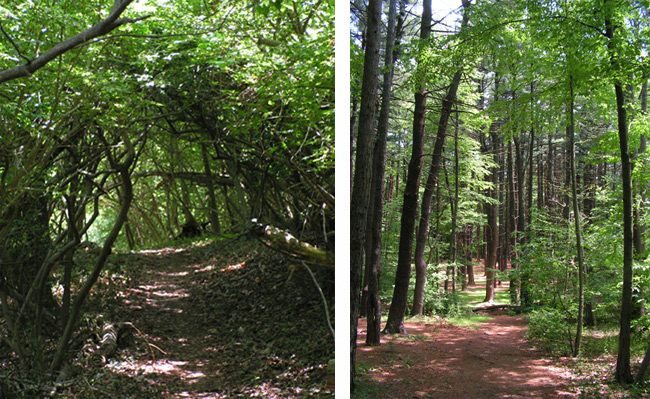
I haven’t done much hiking lately, but I finally got myself back out onto a local trail yesterday for about 2 hours. Here are two scenes; a bit of a tree tunnel, and a pine grove (too bad computers can’t convey that subtle but wonderful smell of a pine grove). Enjoy!

◊   posted by Jim G @ 5:51 pm       Read Comments (4) / Leave a Comment
 
 
Monday, May 25, 2009
Brain / Mind ... Society ...

I just started reading another book on the mysteries of the brain and mind: “How Brains Make Up Their Minds” by Walter J. Freeman (not to be confused with Walter Freeman the lobotomy doctor). I’m only about 20 pages into it, but I already came across two lines that seem too good not to share. In chapter 2, Dr. Freeman discusses the meaning of meaningfulness (that’s about the best way to sum it up!). The first quote doesn’t sound all that interesting, but when you mix it with the second quote, you get something worth pondering — sort of like nitric acid and glycerin combining to make nitroglycerin. So here we go with quote 1:

“Meaning is closed from the outside by virtue of its very uniqueness and complexity. In this sense, it resembles the immunological incompatibility of tissues . . . “

I.e., what “means something” to you won’t necessarily take root in my mind; just as my body would likely reject transplanted tissue from your body.

Given that, here’s a second quote to ponder:

“Much of the effort and energy of our lifetimes is spent in trying to understand the meanings of others and to induce others to understand our own.”

 »  continue reading …

◊   posted by Jim G @ 9:51 am       Read Comments (2) / Leave a Comment
 
 
Friday, May 22, 2009
Economics/Business ... Society ...

It’s starting to look as though our nation’s economy is bottoming out; the big drop in economic activity is abating. Things are bumping along the bottom right now. Perhaps by mid autumn there will be sure signs of renewed economic growth; unfortunately, those first signs will not include higher wages and increased employment. That trend won’t start until sometime in 2010.

We’ve just gone through the biggest economic drop relative since the 1930s. It wasn’t expected, it came on suddenly, and has done a lot of damage that will take much time and many resources to fix.

The big lesson, I think, is that real estate bubbles are nasty things; and maybe that’s because real estate ownership itself can be a nasty thing, despite all the myths about how good it is for average Americans to own real estate. America got into a serious real estate bubble sometime around 2002 (although there had been smaller bubbles in the 1980s due to Baby Boom demand), not long after the internet bubble burst. When the internet bubble burst in 2000, it didn’t do all that much damage; the big stock market run-up from 1995 came to an end, but unemployment hardly rose and Americans continued their vigorous consumer spending.

By contrast, the breaking of the real estate bubble has been vicious. Many major financial institutions collapsed or required massive taxpayer bailouts; banks stopped lending; unemployment rose; consumers stopped consuming; two thirds of the American auto industry collapsed; unemployment shot up, and the government has borrowed billions of dollars (on top of the trillions it already owes), which will weigh down the economy for at least a decade. And the whole situation reverberated internationally, amplifying the whole thing. Our government economic leaders (Bernacke, Paulson, Geitner, etc.) reacted quickly and hopefully stopped the bleeding in time. But the patient is still weak, and recovery is going to take a long time. That’s about where we are right now.

So what is the difference between real estate speculation and other kinds of speculation (such as the internet company craze of the 1990s, or the tulip craze of the 1630s)? That is a key question for economists and policy makers of the future. I believe that the key difference is that most other bubbles, especially technology bubbles, leave something behind that continues to help the economy. E.g., better technology. Even the tulip bubble left the world with something good – more tulips!

By contrast, a real estate bubble, along with all the crazy financial machinations that prop it up (currently known as “toxic assets” and “default swaps”), don’t leave you with much. There’s only so much usable land on the planet, even less in the places that economically count the most (i.e., the American suburbs). There have been some expansions of usable real estate over the past 5 or 6 years as roads and infrastructure were built to open up formerly unused lands, e.g. in the Arizona desert or the Florida swamps or the foothills of eastern Pennsylvania. But opening up new property takes time, and bubbles usually don’t give the economy enough time to significantly expand its usable land inventory. For the most part, bubble money is simply chasing what is already in place. And when it blows, much of the new stuff that was built deteriorates quickly (e.g., foreclosed properties deteriorate quickly and are subject to fires). And since the new lands that were opened were done quickly (by “fast-money” developers), they will probably have negative ecological consequences in coming years.

Personally, I’ve always had mixed feelings about real estate, even though the nation as a whole seems to have a love affair with it. I never owned any real estate, and hope not to. It can bring out the best in people (e.g., homeowners who put a lot of sweat and communal effort into maintaining a livable neighborhood), but it also brings out the worst (e.g., NIMBY activism, ethnic divisions about who is or isn’t welcome in the neighborhood, etc.). Nonetheless, real estate ownership is a key component of “the American Dream”; it has gained mythical status. To be considered a successful, responsible American, you have to own real estate; this line of thinking goes all the way back to the “Founding Fathers”. Thus, a huge industry has built up around real estate, which has been further inflated with all kinds of government subsides (e.g. tax deductions for mortgage interest, special government-sponsored institutions to facilitate mortgage credit such as Freddie and Fannie, etc.).

Now America is seeing that perhaps real estate is NOT so innocent, after all; perhaps it should not be up there with motherhood and apple pie. Lots of “dippy urban-planner types” had been complaining for many years about the environmental evils of “suburban sprawl”. They cried, mostly unheard, about the consequences of replacing natural forests and meadows with low-density exurban developments where everyone has to drive for miles just to buy bread and milk and get the kids to school, and where most of that driving is done with gas-guzzling SUV’s needed to get through the snowy winter weather. These dippy sprawl-opponents were ignored over the past 20 years by Republican politicians and well-intended families seeking their stake in “the dream”.

But now, it almost appears that Mother Nature has struck back, perhaps disguised by declining property values, collateralized debt obligations, subprime mortgages, and spiking gasoline prices. The “dippy urban planners” complaining about sprawl were right that something bad would eventually happen, but wrong in concentrating on declining water tables and vanishing bird species. Too bad that they didn’t foresee the consequences of real estate greed poisoning the human spirit; and the concomitant effects of greed and over-taxed earthly resources on the human economy. The real-estate based American dream has thus become a nightmare.

Our economy is going to recover, albeit slowly. So this was a warning, a serious warning. Let’s hope that our nation will learn to become a bit more circumspect in its love affair with real estate. Warnings like this usually mean that the next offense could be a game-changer, a game-ender for America as we know it.

◊   posted by Jim G @ 4:46 pm       Read Comments (2) / Leave a Comment
 
 
Sunday, May 17, 2009
Current Affairs ... Politics ...

OK, just two minor points for today.

1.) I must admit that I’m generally impressed with Barack Obama thus far. I don’t agree with 100% of his policies and actions to date, but it’s becoming clear that he is quite intelligent AND politically skilled. A smart guy who knows how to use it. I believe that he is inspired by the fearful responsibility that he was given, and will generally try to do what is best for the nation; I think he is becoming what you could call a “patriot”, and not just another scheming, posturing politician e.g. Pelosi and Specter.

I do wonder, though, about Obama’s relative youth. I wonder if he is overestimating the power of his position and of the system that he is there to direct. He is moving to take on all of the big problems at once; global warming, education, economic recovery, the financial system, the auto industry, health insurance, energy supply, terrorism, Iraq, Iran, Pakistan, Afghanistan, North Korea, Russia, etc. And he’s right that everything is inter-related; you really can’t separate out any of these situations. Still, I wonder what Harry Truman might say if he could be in the White House today. I suspect it might be something like this: “there’s a lot for us to do, and we can’t ignore any part of it, like the previous Administration was doing. But by the same token, we can’t solve it all at once; we’re gonna have to set some priorities as to how and when we tackle these situations”. Yea, a bit of Missouri plain talk might be refreshing right about now.

2.) I haven’t seen the new Star Trek movie yet, but it’s heartening for an old guy like me to know that young people today are getting interested in the Trek concept once more, just as the geeks within my generation did about 40 years ago.  »  continue reading …

◊   posted by Jim G @ 12:04 pm       Read Comments (2) / Leave a Comment
 
 
Thursday, May 14, 2009
Brain / Mind ...

Memory experiment: I had a slow day at work recently, so I Googled around for a while and eventually found a video for an interesting old TV show from 1966. The show is called “The Nowhere Affair”, an episode from NBC’s “Man From U.N.C.L.E.” series, which I saw as a kid and vaguely remembered many years later because of the philosophical implications of its closing scene. (Man From UNCLE was part of the spy show craze that followed the first 007 movies in the mid-60s).

What stuck in my memory about “Nowhere Affair” was the repartee during the closing scenes between UNCLE agent Napoleon Solo (Robert Vaughn) and a woman who was somehow involved in a recent battle between UNCLE and the evil forces of THRUSH. I recalled that the plot involved a desolate town in Nevada called “Nowhere”, the site of an underground THRUSH complex . This site became a “former site” by episode’s end; Solo and his partner, agent Ilya Kuriaken (David McCallum), had of course managed to take down the place. I couldn’t remember exactly how this was done or what the woman’s role was in the process, but I did recall that she had lost her memory. (Ah! How appropriate to this test of my own memory!). I only remember seeing this episode once, when it aired during prime time in 1966; perhaps I might have seen a re-run of it in 1967, but after that I am quite sure that I never saw it again. Until now.

According to my 42 year old memory regarding this UNCLE episode, Solo and Kuryakin were sitting together somewhere after accomplishing their mission of taking THRUSH out of “Nowhere”.  »  continue reading …

◊   posted by Jim G @ 8:41 pm       Read Comments (2) / Leave a Comment
 
 
Sunday, May 10, 2009
Photo ...

PHOTO TIME: Time once again to replace my usual thousand words with one picture. Here’s a shot taken last night, a warm Saturday night in May, at the Eagle Rock Park / 9-11 Memorial in Montclair, NJ. That would be mid-town Manhattan in the distance. I’m tempted to ramble on about the meta-themes that intermix in this shot. But for now, I’ll just let the picture do the talking.

◊   posted by Jim G @ 10:35 am       Read Comments (2) / Leave a Comment
 
 
Saturday, May 9, 2009
Politics ... Public Policy ...

The blog world (and now the Twitter world) seems to value brevity. Obviously, I don’t. But today I will offer a brief thought, perhaps out of laziness. My brief thought for today is a follow up from my blog a few days ago regarding George McGovern’s semi-conservative reboot. As an older guy, McGovern has come to question whether big government is always a good thing. His life experiences following the demise of his political career during the Reagan Revolution taught him to question the doctrinaire liberalism that he so ardently fought for in the Senate and as a Presidential candidate in 1972. I.e., that government is always good and more government is better; and that big government control of the economy is the sine qua non of a just and humane society.

Now McGovern is saying that big government, even American constitutional big government, actually does have its downsides. Thus, perhaps we have to trade off some injustice and inhumanity so as to preserve and foster the long-term benefits of a free society. Conservatives say that big government can’t enforce humane-ness and justice; in doing so, government itself can become inhumane and unjust (this has happened a bit too often during the history of civilization). They believe that the only path to a just society is via the underlying VALUES of a society. You can’t force people to have the right values using big government; you can only hope that they somehow adopt the right ones through societal traditions, e.g. via religious institutions and property ownership. Conservatives (well, the more intelligent ones, anyway; not that Bush crowd) say that the founders of our nation assumed this, and they actually have a good point there. As Madison said, “To suppose that any form of government will secure liberty or happiness without any virtue in the people, is a chimerical idea.”

Well, I myself don’t see this as a complete “either / or” situation. In a just society  »  continue reading …

◊   posted by Jim G @ 6:53 pm       No Comments Yet / Leave a Comment
 
 
Thursday, May 7, 2009
Politics ... Public Policy ...

It’s always refreshing to read about a man who reconsiders and challenges some of his own political views as he matures, in search of a greater truth. The world is not a simple place; politics tries to over-simplify the world in order to gain a certain end. Too often, political ends are served by means of twisting the truth. George McGovern, perhaps the most liberal presidential candidate of the past 80 years or so (lost to Nixon in a landslide in 1972), is trying to revive some of the greater truths. He has recently published three articles in the Wall Street Journal (of all places), which challenge doctrinaire liberal views (just when those views have come back into vogue thanks to Barack Obama).

Obviously the WSJ published these articles because they support its pro-business agenda. Has McGovern become a reactionary fascist in his old age?  »  continue reading …

◊   posted by Jim G @ 8:57 pm       Read Comments (2) / Leave a Comment
 
 
Sunday, May 3, 2009
Current Affairs ... Society ...

The Mexican swine flu, which scared the jeebers out of millions of people, doesn’t seem so scary after all. It’s starting to look like your run-of-the-mill flu. It got off to a nasty start in Mexico, but that may be because a lot of people there avoid or have trouble getting to a doctor. There’s still a lot of folk medicine going on in those little villages. So, the American supermarkets and drug stores may soon be able to restock their shelves with anti-microbial hand lotion and face masks. As a sidebar, this reminds me of the run on duct tape a few years ago, after the government released a report about how to survive if a terrorist releases radiation or deadly germs near your home. (I.e., the report said to tape big sheets of plastic around your windows and doors.)

There’s another little side-bar going on in the liberal blogosphere right now about the pig farm in Mexico where the current swine flu might have originated. (I can’t say whether this side-issue is also happening on in the twitter-osphere; the attention spans there are probably too short for it.) Some reporters and Mexican officials are tracing the new flu to a village named La Gloria, which is near an industrial food production farm run by Smithfield Foods – yes, an American corporation that produces and sells pork. Actually, Smithfield Foods is the largest pork producer in the world. Smithfield denies that their pigs were involved, saying that they are clean — none of them showed any signs of having the latest flu strain. Of course, you’ve got to wonder just how thoroughly they looked and tested; and whether the local health officials were willing to risk angering the gringo outfit that probably comprises 90% of the local job market and economy.

Personally, I don’t seek to blame Smithfield Foods alone for the flu; they’re probably running their pig farms like most any other industrial pig farm, no better and no worse. Who I do blame is us, we Americans who can’t think outside the box about our diets. I am a former meat-eater who became a vegetarian about 15 years ago, and over time I’ve seen more and more evidence of the stress that meat consumption places upon the world. Meat consumption today is big business, a product of international corporations which grow, process and serve most of the meat eaten in America and in other developed nations. The stress from it includes poorer health in old age and the resulting burden on medical resources (reflected in soaring health care and Medicare costs); and increased energy use (fuels needed for growing animals, transporting them and refrigerating them) and the global warming greenhouse gases they produce. It’s a bit harder to get fat on a balanced vegetarian diet; and grains, beans and veggies certainly use less fuel and have a smaller “carbon footprint” per calorie consumed. And now, it’s starting to look as though ham and bacon and spare ribs encourage the development of super-bugs that could take down a whole lot of people.

Why is this? Modern pig farms, like any other kind of industrial food-animal facility, try to maximize their efficiency by jamming animals as close together as possible. Also, pigs have genetic DNA structures that in certain ways are closer to human genetic structures than with most other animals (hmm, what does that say about us???). A whole bunch of pigs jammed together, tended by low-paid human workers who may not have such good sanitary habits, become a central hub for infectious diseases that could affect humans. They present a lot of opportunity for viruses to do what they do naturally — i.e., mutate, change their own genetic codes a bit. So you have all these pigs exchanging germs with humans and each other, each pig incubating millions and millions of different types of germs. This gives these germs new chances to develop even more variations, which affect their ease of transmission and what they can do to you once they reach you. Most of these virus variations are failures; they die off quickly. But every so often, by luck of the draw, a new combination occurs that can spread easily and can do some real damage to humans.

If you had a pig in the forest who developed this new super-bug, it probably wouldn’t get far. But a pig jammed together with hundreds or thousands of other pigs will almost assuredly spread it to the other pigs, who in turn will then spread it to the humans who tend them (or who live near-by in villages like La Gloria, possibly by insects). Oh, and another thing — pigs crammed together in farms also interact with birds, and we know that birds are also pretty good at developing flu viruses that can affect humans. The pig farms can’t keep birds from landing near their pigs (or roosting in their living areas) and depositing their droppings so that pigs can breath or ingest the more successful avian germs strains. Well, that’s another head-start that these pigs get in developing germs that can really knock human beings for a loop.

It’s kind of like having a house with a door that opens with a six-digit code number. Every day you punch in six numbers on the door panel, and if use the right code, it lets you in. You set the code number, which can be any number from 000000 to 999999; i.e., there are one million possible number combinations. Let’s say that there’s a bad guy in the neighborhood who wants to get into your home and rob everything and then kill you during the night. The house is pretty secure, and the only way the robber can get in is to punch in the right code number. Let’s also say that the robber only gets one chance each night to punch in one number; he doesn’t know the number, so he guesses. And he’s very persistent; he keeps coming back each night, trying another number.

If we assume that he has no idea about what number you would use, nor whether you would use some kind of pattern (like 212121) or just select a number randomly (like 598830, perhaps), then on average it will take him 500,000 nights to come up with the right code. Let’s see, that’s 1,369 years. I’m not a good math guy, but you could also come up with probability bands, e.g. something like a 90% chance that it will take him at least 100 years, etc. (Not sure of the exact number, but it would be something like that). Obviously, there’s only a one-in-a-million chance that he will finally break in and kill you on any given night. So you decide, OK, I can live with that.

But let’s say that things change, so that the robber can try out a whole lot of numbers every night; then his chances get better and better. And let’s say that he also gets some info about you, on what kind of number you might select. Based on your past decisions, he knows that you are likely to use a subtle pattern in the numbers, e.g. 791827 (the second, fourth and sixth number are in descending order). Say that the bad guy figures out what that pattern is, and is smart enough to use it to narrow down the list of possible numbers. Now this robber is a whole lot more dangerous. That’s the difference between a thousand pigs wandering around in a forest, occasionally being hunted and eaten by a human, and a thousand pigs jammed together in an industrial factory-farm in a third-world country. Viruses have a much better chance with such a pig farm of finding the right code to “break in and rob the human house”. The odds are being stacked in their favor.

So perhaps we got off light this time. The birds, pigs and people in Mexico have cooked up (thru the enhanced trial-and-error process going on at pig factories such as Smithfield Foods) another new virus, which has some “legs”. It has the right “code” to spread around in people; but it doesn’t have the punch to do more-than-average damage. In reality, humans are like a house with more than one door and door code; the robber (virus) might figure out the code to get in thru the outside door, but might not get the code to the master bedroom where you sleep. Thus you won’t be killed. BUT, with pig farms giving these “robbers” more and more chances and more head-starts regarding information structures (from the viruses they exchange with humans and birds), sooner or later a really deadly virus will emerge.

That’s the trade off for those delicious spare ribs at Chili’s or that affordable Easter ham from the local supermarket or that bacon / ham McMuffin at Mickey D’s. Don’t blame us vegetarians when the big avian-pig-human virus finally does come knocking at your door.

◊   posted by Jim G @ 11:19 am       Read Comments (2) / Leave a Comment
 
 
TOP PAGE - LATEST BLOG POSTS
« PREVIOUS PAGE -- NEXT PAGE (OLDER POSTS) »
FOR MORE OF MY THOUGHTS, CHECK OUT THE SIDEBAR / ARCHIVES
To blog is human, to read someone's blog, divine
NEED TO WRITE ME? eternalstudent404 (thing above the 2) gmail (thing under the >) com

www.jimgworld.com - THE SIDEBAR - ABOUT ME - PHOTOS
 
OTHER THOUGHTFUL BLOGS:
 
Church of the Churchless
Clear Mountain Zendo, Montclair
Fr. James S. Behrens, Monastery Photoblog
Of Particular Significance, Dr. Strassler's Physics Blog
Weather Willy, NY Metro Area Weather Analysis
Spunkykitty's new Bunny Hopscotch; an indefatigable Aspie artist and now scholar!

Powered by WordPress