The ramblings of an Eternal Student of Life     
. . . still studying and learning how to be grateful and make the best of it
 
 
Friday, September 4, 2015
Religion ... Spirituality ... Zen ...

It’s time once again to think about the Big Question: what should you ultimately believe about YOURSELF (and about the world around you)? About where you are heading, why are you here . . .

In the Zen tradition, there is no self, no eternity, no personal transcendence of death (although through karma, something of one’s behavior does achieve transcendent manifestation). Time is a mental abstraction, a product of the mind. As such, it is discouraged from any use other than making sure that you get to the dentist on time, and other such quotidian things. The ultimate psychological emphasis should be on the present, on the now, on living in the moment. The future, the eternal . . . that is all just “mind stuff”.

In a lot of ways, the Bible’s Old Testament isn’t all that far removed from Zen; at least the early stages of it (i.e., the core “Torah” books). There is little philosophy in it, little struggling with the nature of God and the Universe and the meaning of one’s existence. There is a creation story along with some stories of tribal deliverance, but after that, the Torah has little worry for the future. With all its codes and social edicts, the Torah is mostly about getting by in the present — and about getting along with God. No promises of eternal paradise, just  »  continue reading …

◊   posted by Jim G @ 6:53 am       Read Comment (1) / Leave a Comment
 
 
Sunday, August 30, 2015
Photo ...

Here’s a simple little home decoration touch that I recently saw in my neighborhood during a night walk. A nice way to take advantage of a slanted window.

◊   posted by Jim G @ 1:42 pm       Read Comment (1) / Leave a Comment
 
 
Thursday, August 27, 2015
Current Affairs ... Politics ...

If you read the latest headlines on the national political front, you might think that Hillary Clinton is in trouble. And you might be right. The voters don’t trust her, and things could get even worse depending on what the FBI finds (or doesn’t find) on her e-mail server. Although the vote is still months away, recent polls hint that Clinton could lose the New Hampshire primary to Bernie Sanders. That would not be a good way to start the primary season.

So, it’s looking a bit less likely that Hillary will be the our next President, although it’s not yet to the point of being a lost cause. Perhaps the most cogent insight regarding this topic is that Barack Obama may well be the king or queen-maker; if Obama decides that he wants someone other than Hillary to “carry on his legacy” (say V.P. Joe Biden), Obama could have the FBI and Department of Justice throw the book at Hillary for any petty regulation that she may have violated regarding government records management (something like what they did with David Petraeus). So, we shall see what Barack decides. For now, he seems to be giving Joe Biden a great big “MAYBE”.

On the GOP side, however — the Republican faithful seems to have lost all faith in the “deep bench” of viable candidates that they have. I.e., Jeb Bush, Scott Walker, Marco Rubio, Ted Cruz . . . since the first GOP debate, the three candidates who have picked up the most interest and the most support in the national polls are Donald Trump, Ben Carson, and Carly Fiorina — three people who have never held public office. It doesn’t seem likely that  »  continue reading …

◊   posted by Jim G @ 9:11 am       Read Comment (1) / Leave a Comment
 
 
Saturday, August 22, 2015
Food / Drink ... Health / Nutrition ...

Here’s a health and nutrition topic that I believe should be watched by all those who, like me, have been looking for the fountain of eternal youth. Or at least something that slows the body’s aging and decaying process down a little bit, anyway. The topic in question regards the toxic chemicals found naturally in a variety of edible plants, and how they induce “hormesis” in the body. Hormesis is based on the notion that a little bit of bad can do you good. In other words, just a little bit of poison in the body, in just the right amount (not too much and not too little), puts temporary stress on the cells that make up our various body parts and systems; however, when the poison goes away and the cells recover, they become stronger and better than before.

It’s sort of like exercise, which improves the state of the body’s muscle fibers by causing slight injury to them, tearing and mangling little bits of them. Once you stop the exercise and rest, the body over-compensates in repairing these minor injuries, and your muscles become firmer and stronger, maybe even bigger (i.e., the body supplies more structural tissue to the temporarily over-used muscle, as to better handle similar stress in the future). Well, it turns out that many fruits, vegetables and condiments, especially the more bitter ones like broccoli, coffee, eggplant and turmeric, have various chemicals in them that help the plant to survive by making it unpleasant to insects. These chemicals (e.g. polyphenols) are somewhat toxic; too much of them can eventually kill living cells. However, in most edible plants, there isn’t enough to really harm a person, unless maybe that person ate only one thing (e.g. arugula) all the time and nothing else (just like too much exercise can result in actual muscle or joint injury).

But it you eat a typical portion of one of these food items, your internal organs (including your brain) will get a bit stressed, but given enough resting time to recover from the “insult”, they will be stronger and more disease-resistant. I found out about all of this in an interesting article in  »  continue reading …

◊   posted by Jim G @ 10:57 pm       Read Comment (1) / Leave a Comment
 
 
Saturday, August 15, 2015
History ...

Over the past year or two, race relationships have become a big political topic in the US once again. This is not an entirely good thing, given that the issue has been brought back from the 1960s because of a series of recent police killings of unarmed black men and women. Hopefully, something good can still come out of it, just as the the Civil Rights movements of the 1960s helped to change and reduce some of the many injustices against blacks (some but not all, unfortunately) that were embedded in American government and society up to them.

One interesting side-effect is that certain writers are taking a new look at the historical components that have contributed to the vexed and unsettled issues of race and equality today. One of the biggest historical institutions that still today affects how we get along is slavery. History has a lot of lessons to teach about slavery, both big and small. Let me share something I just came across, one of the smaller stories about slavery in America.

American slavery is usually thought of in the context of a rich white landowner of European heritage using African slaves for agricultural labor, i.e. planting and harvesting cash crops like peanuts, cotton and tobacco (and doing so in quite a cruel fashion). Interestingly, not all African slaves were owned  »  continue reading …

◊   posted by Jim G @ 7:14 pm       Read Comment (1) / Leave a Comment
 
 
Sunday, August 9, 2015
Current Affairs ... Public Policy ... Society ...

The New Yorker recently published perhaps the first personal profile of former Ferguson, MO Police Officer Darren Wilson since he shot and killed 18 year old Michael Brown. Wilson obviously met with and cooperated extensively with writer Jake Halpern, who gave a detailed overview of Wilson’s life and career experience leading up to the Brown shooting, and since that time. At first, I found the article to be fair and quite informative, a well-needed focus on the perspective of Wilson, given that he unwittingly became involved in an incident where the media overwhelmingly focuses upon the victim and the many reactions from the public. In the end, however, I was disappointed by this article. Halpern had an agenda after all, a very familiar one for media such as the New Yorker; basically, to use Wilson as exhibit 1 in explicating the faults of whites in general, and white police officers in particular, in dealing with African Americans in an organizational context.

Halpern spoke in some detail about Wilson’s choice to work in North County outside St. Louis, as it was a more challenging environment for a police officer than a quieter, more affluent suburb. While working for a different but near-by police agency prior to his employment in Ferguson (in Jennings, MO), Wilson made the acquaintance of Mike McCarthy, another white officer (a field-training officer). McCarthy seemed to have a better understanding than Wilson did of the minority communities they were patrolling, and thus Wilson asked him for guidance in how to best deal with the people living in these areas. Wilson admitted to “culture shock” while addressing McCarthy, who agreed to help Wilson. Halpern seems to indicate that McCarthy’s efforts weren’t in vain, and that Wilson appeared better able to work in relatively high-crime minority communities because of it.

Halpern obviously asks McCarthy how he felt about the Brown killing. McCarthy’s reaction was that Wilson was basically doing his job, doing what any police officer in that situation would have to do, and that the tragic outcome did not have to do with Brown being black and Wilson being white. But of course, Halpern was not satisfied with this, so he pushed McCarthy further. Was it possible, Halpern wanted to know,  »  continue reading …

◊   posted by Jim G @ 3:40 pm       Read Comment (1) / Leave a Comment
 
 
Friday, July 31, 2015
Religion ... Science ... Spirituality ...

The Atlantic published an article not too long ago about near death experiences, and the latest edition (July-August, 2015) published a few reader responses to it. The author of the article, Gideon Lichfield, replied to these letters, and said something very interesting here. To quote:

It’s worth noting that some religious NDErs move away from their religion after the experience, because it can lead them to develop spiritual beliefs that conflict with their credos.

Whoa, now there’s a twist. You believe in God and follow a religion in order to live in accordance with that belief. Then one day, you get a message from God — or at least you imagine that you do, I’m going to stay agnostic here as to whether NDE’s are real or not — and you decide that your old religion just doesn’t cut it anymore; that there’s more to spirituality than what you were used to.

But hey, why not? If there is anything “substantial” about near death experiences, if not empirically “real”, it should convey a deeper and more mature understanding of the holy. I did a quick search to find some stories about nominally religious people who have NDE’s and then learn to put their traditions into context and thus find bigger and more universal concepts of divinity. There ain’t much out there; however, it turns out that Kevin Williams, a born-again Christian and NDE enthusiast / author who runs what is acclaimed to be the most comprehensive web site about NDEs, has accumulated of few similar stories. Interestingly for someone who himself seems to be “very religious”, Mr. Williams  »  continue reading …

◊   posted by Jim G @ 8:26 am       Read Comment (1) / Leave a Comment
 
 
Saturday, July 25, 2015
Current Affairs ... Economics/Business ... Religion ...

If you are a private investor looking to get rich, or just an aging middle-class schlemiel like myself hoping to retire sometime in the next five years or so, you might know about the marketwatch.com web site. It’s a pretty good place to get up-to-date stock and bond market information, and it publishes a fair number of articles that might be of interest to small-fish “investors” like me.

(Really, I never thought of myself as a capitalist financier. But any working person today who wants a half-way decent retirement is not going to be able to fully rely on Social Security and whatever few real pension arrangements are still out there. You’re going to have to save, and your employer, if they really like you, is contributing to your old-age savings. By the time you pass the big six-oh, if you’ve been diligent, you’ve got what might sound to many like a really big chunk of money; it looks like you’re rich!! But no, this chunk is all that stands between you and poverty over the next few decades of your life, as your body slowly weakens and mind slows, and you really just can’t stay up with the 9-to-5 working world anymore.)

So anyway, if you’re presently in the boat that I’m in, you may have heard of marketwatch.com and have read some of their articles. One of the regular featured columnists on that site is Paul Farrell, who seems to be the “house pessimist”. In late 2008, as the US economy was hitting bottom  »  continue reading …

◊   posted by Jim G @ 2:46 pm       Read Comment (1) / Leave a Comment
 
 
Saturday, July 18, 2015
Public Policy ... Science ... Society ...

The New York Times recently published an article about genetic crop modification (“GMO“, as popularly known) by financial experts Mark Spitznagel and Nassim Taleb. Spitznagel and Taleb (yes, the “black swan” Taleb) think that tinkering with agricultural products by intentionally altering their genes through now-common scientific techniques is a formula for trouble. They feel that “complex chains of unpredictable changes in the ecosystem” could lead to catastrophe (shortages, high prices, economic depressions, starvation) if important crops get unexpectedly wiped out or are no longer able to grow in a changing environment.

To give their argument some weight, Taleb and Spitznagel compare the current GMO situation with the growth in the late 90’s and early 2000’s of hybrid financial arrangements for sub-prime investments (e.g. credit default swaps, tranched mortgage backed securities, collateralized debt obligations, etc). These investments were designed based on detailed economic studies, statistical analyses and complex mathematical and computer techniques, and became very popular in the big-money world of high-finance. Unfortunately, they had some unforeseen flaws in them, such that changing conditions in the US housing market triggered a cascade of events that ultimately led to a financial crisis and a “Great Recession”.

Their logic was criticized in an article in Forbes by Henry I. Miller, a biomedical scientist and former FDA drug regulator. Miller first points out that Spitznagel and Taleb are  »  continue reading …

◊   posted by Jim G @ 12:40 pm       Read Comment (1) / Leave a Comment
 
 
Monday, July 13, 2015
Photo ... Society ...

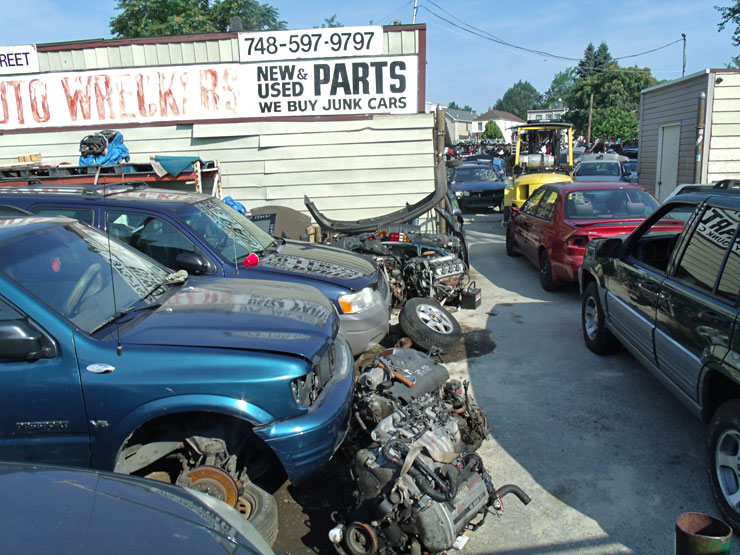
On my daily drive to work, I recently noticed that I pass an “auto wreckers” business every day. This is something that you don’t see much anymore, especially in the middle of a residential area (well, the area in question might be more of a “mixed use” situation, as they say in zoning law — but there are plenty of houses nearby). I remember places like this from when I was a kid; we called them “junkyards”. They pretty much disappeared from my home turf in the 80’s or 90’s or whenever. So I had to stop the other day and get some pics — here are two shots that give you the flavor of the place. Dig that true junk!!


     »  continue reading …

◊   posted by Jim G @ 6:57 pm       Read Comment (1) / Leave a Comment
 
 
TOP PAGE - LATEST BLOG POSTS
« PREVIOUS PAGE -- NEXT PAGE (OLDER POSTS) »
FOR MORE OF MY THOUGHTS, CHECK OUT THE SIDEBAR / ARCHIVES
To blog is human, to read someone's blog, divine
NEED TO WRITE ME? eternalstudent404 (thing above the 2) gmail (thing under the >) com

www.jimgworld.com - THE SIDEBAR - ABOUT ME - PHOTOS
 
OTHER THOUGHTFUL BLOGS:
 
Church of the Churchless
Clear Mountain Zendo, Montclair
Fr. James S. Behrens, Monastery Photoblog
Of Particular Significance, Dr. Strassler's Physics Blog
Weather Willy, NY Metro Area Weather Analysis
Spunkykitty's new Bunny Hopscotch; an indefatigable Aspie artist and now scholar!

Powered by WordPress