The ramblings of an Eternal Student of Life     
. . . still studying and learning how to be grateful and make the best of it
 
 
Saturday, January 12, 2008
Personal Reflections ... Practical Advice ...

Just before Christmas, I got a card from a guy who I worked with at my first professional job after graduating from college. That was way back in the 1970s. The guy in question, Charlie Spencer, was quite a bit older than me. Actually, he was the same age as my mother. And he came from the back woods of Pennsylvania, quite different from the urbanized realms of northern New Jersey from which I hailed. And yet, despite the age and cultural differences, we got along quite well during the time we worked together.

Charlie and I teamed up on a number of productivity improvement projects, and during the breaks we talked a lot about our lives and interests and viewpoints. We were actually friends. Despite being as old as my own parents, and having a son of his own, Charlie never treated me “like a son”. And that was a good thing, in my book. I didn’t need another parent; but as an introvert living in a new town, I did need another friend. And Charlie was able to do that; he was able to put his own age on hold, and also the realization that he knew more than I did about life and how things really work. (Now that I’m just about the age that Charlie was when we met, I realize that I know a lot more about life and how things actually work than any 24 year old does; and I also know that in another 30 years, those 24 year olds will figure this out for themselves). In working with Charlie, I started to see that he had something that I didn’t – i.e., this wisdom of old age. He just knew how to get things done with people, even though he didn’t have a college degree like I did. So I learned to respect him and just watch and pick up some tricks from him.

After two and a half years out in the working world, I was able to get into law school back home in New Jersey. So Charlie and I bid each other adieu. Oh, we promised to get together again; I said that I would come down and visit, maybe stay over with him and his wife. But of course I never did. The years went by, the 1980s and the 1990s zoomed along, and Charlie and I pretty much forgot about each other.

But actually, Charlie didn’t forget about me. Sometime in 2000, out of the blue, he called me up. It was good to hear from him. He had retired and was living down in Florida. So we swapped e-mail addresses and he invited me down to Florida for a visit. Unfortunately, my own mother was beginning to falter and would need more and more financial support for her home care. So the years went by and I kept telling Charlie that I hoped to get down to see him; but again it never happened. My brother and I had pretty much agreed that neither of us would make any road trips given my mother’s increasingly frail and unpredictable state; we agreed to respond to anything within an hour or so. Still, I kept Charlie and his Florida home on my list of places to go after my mother passes.

Unfortunately, that trip isn’t going to happen. In his card, Charlie said “send me some e-mail”. Actually, I was swapping e-mails with him back around 2002 and 2003, but he started swamping me with those unfortunate “pass this on to everyone you know” e-mails, some of which contained questionable attachments (dangerous to your computer). I started deleting his e-mails and stopped sending my own personal ones because of this, and we lost touch again — other than the annual Christmas cards. But hey, I thought, let me start the e-mail thing again. Charlie had lost his wife back in 2005, and said that he was lonely. So sure, I attached some pix of myself and my mother and brother and shot them down to him. About 10 days later, I saw a reply from his address. But instead of what I expected (“thanks for the pictures, glad to see what you look like today, etc.”), the message said “this is from Charlie’s son and his computer teacher Steve; sorry, but the bad news is that Charlie passed away on New Years Eve. He took a nap during the afternoon and never woke up …”

Now I feel an emptiness, and I’m sad about not putting more energy into staying in touch with Charlie. I don’t even have a picture of him. With certain people, they come and go through your life and you take it in stride. But with a special few, it’s like an iceberg; their significance to you is very real but is well hidden. You’re not fully conscious of what they mean to your life until they’re gone. As with my late Uncle Bruno. And as much as I respect her, I don’t stay up nights thinking about my ex-wife; but I’m still a bit hung up on the memory of a girl in high school who tried to get past my Asperger’s-like barriers to make contact with the super-nerdy kid that I was (and still am, in various respects). Well, she never did get past my immature suspicions and fears, and I haven’t seen nor heard any references to her in the 37 years since I graduated from high school (not even Google or classmates.com have helped; but that’s probably just as well). Even now, though, I still think of her. As with Uncle Bruno. And now, Charlie Spencer.

So watch out for those “iceberg” people in your life. Do what the Titanic did, even though it shouldn’t have; get close to them and keep close. Real icebergs will sink ships, but relationship icebergs are good for the soul.

◊   posted by Jim G @ 7:39 pm       Read Comments (2) / Leave a Comment
 
 
Thursday, December 20, 2007
Personal Reflections ...

I just posted an unread book inventory for my apartment, so I’m going to follow up with my un-drank alcoholic beverage inventory. Here’s what’s in my booze cabinet (actually two cardboard boxes on the kitchen floor) right now:

BEER

Otter Creek Raspberry Brown Winter Ale
Ipswich Oatmeal Stout
Anchor Christmas Ale
Genesee Cream Ale
Franziskaner Weiss
J W Dundee Pale Ale

WINE

Gascon 2006 Malbec
McManis 2005 Petit Sirah
Gato Negro 2006 Cabernet Shiraz
Alexander Valley 2004 “Sin Zin” Zinfandel
Joel Gott 2005 Zinfandel
Monte Velho 2006 Table Wine
J. Lohr 2004 Paso Robles Merlot

So, it looks like I’m well stocked for a long winter’s night.

But one should never feel too cozy about these things. Recall the parable of the rich man in Luke 12: I will say to my soul, ‘Soul, you have ample goods laid up for many years; relax, eat, drink, be merry.’ But God said to him, ‘You fool! This very night your life is being demanded of you. And the things you have prepared, whose will they be?’

◊   posted by Jim G @ 6:45 pm       Read Comments (2) / Leave a Comment
 
 
Sunday, December 16, 2007
Art & Entertainment ... Personal Reflections ...
 

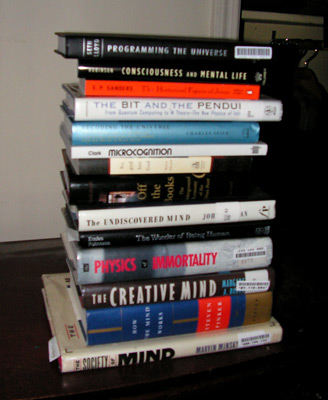
Here’s the stack of books that I bought in 2007. It looks as though I’m going to need 2008, and maybe part of 2009, to read them all. Some of them were real bargains; maybe $5 or $6 with shipping. Many hearken back to the 1980s and 90s, but they still say things that are relevant. I look forward to whatever insights about our wide and wonderful world they may give me. So here they are, from bottom up:

The Society of Mind, by Marvin Minsky; how brains and minds operate – perhaps.

How the Mind Works, by Steven Pinker; ditto.

The Creative Mind, by Margaret A. Boden; ditto again, with a computational twist based on neural networks.

The Physics of Immortality, by Frank J. Tipler; his plan for a ‘resurrection of the dead machine’ has already been vetoed by developments in cosmic physics; but the idea is so audacious that it still deserves attention. There’s still time to find another way to do it!

The Wonder of Being Human, by Sir John Eccles and Daniel N. Robinson; why consciousness – and our selves — may really be exist and be important after all.

The Undiscovered Mind, by John Horgan; why we may never really know if consciousness is real after all.

Off The Books, by Sudhir A. Venkatesh; how the poor get by, in Chicago at least.

No God But God, by Reza Aslan; the case for Islam.

Microcognition, by Andy Clark; a philosopher of mind ponders neural networks and parallel distributed processing models.

Decoding the Universe, by Charles Seife; the new science of information, and the universe as a big computer.

The Bit and the Pendulum, by Tom Siegfried; pretty much ditto.

The Historical Figure of Jesus, by E.P. Sanders; I thought I had my fill of historical Jesus books, but E.P. Sanders is the dean of such studies.

Consciousness and Mental Life, by Daniel N. Robinson; Professor Robinson has the credentials to make some sense out of the current trends in cognitive science and the consciousness debate.

Programming the Universe, by Seth Lloyd; one more book on information and the universe as a big computer.

P.S. — My chances of getting thru all these books within the next year just went down, as I just found out that CBS is going to give Jericho another chance! How about that, the fan protest and all the packages of nuts that they sent to CBS actually worked! At least it was good for another seven episodes. Jericho is a show that shows just how creepy the world could actually get, given the right mixture of greed, terror and technology. And it makes you wonder what can be done to not let it get so creepy. One suggestion — cut back on the greed, terror — and technology. Before we lose it all and have to go back to living like they do in the mythical town of Jericho.

◊   posted by Jim G @ 4:39 pm       Read Comments (3) / Leave a Comment
 
 
Tuesday, November 6, 2007
Personal Reflections ... Society ...

Not long ago, I finally got bitten by the genealogy bug. All of the relatives who could have helped me with this were gone by the time I started with this. But there are also lots of resources available today on the Internet, and that got me hooked. So over the past 5 months or so, I’ve been doing a lot of web surfing, looking for various clues about the lives of my ancestors and the world that they lived in. In some cases, the search engines have led me to buy a book or contact a government agency, but they have also led to some web sites where I’ve found direct reference to family members (e.g., the Ellis Island web site search, and the 1920 and 1930 Census info available for a fee on ancestry.com). Overall, it’s been much like any other form of academic research, all dry and crisp and precise. As a geek-like eternal student, that kind of thing appeals to me. So it’s been enjoyable.

But it has also made me stop and think: what about the human factor here? Back when I was a kid, I was pretty close to a lot of the stuff that I’m now looking down at from “on high”. I was actually around the kind of people that I’m now reading about, i.e. the immigrants and their immediate offspring. I actually saw and heard and otherwise sensed a bit of the “older world” that I now seek to rediscover from a digital perspective. E.g., meat markets and other ratty little stores, tenement buildings and people raising pigeons for food, women cooking cabbage soup. And to be honest, I didn’t always like that world. I wanted to be a regular suburban American kid, and the old “pollock” stuff seemed very un-cool. Those people were locked into the past, inferior to me and my friends.

So I feel a bit schizoid about the whole project. In some ways I am sorry for once being so uncharitable and dismissive about “the old world” that had still been a part of my mother and fathers’ lives. But in another way, I still harbor some negative feelings about that world. I generally don’t look back at it nostalgically, longing to recapture something of the way that they lived.

But actually, I have differences in feeling about my mother’s “old world” versus my father’s “old world”. I was (and still am) more sympathetic to my mother’s relatives and the experiences that I had as a child with them (in the Dundee neighborhood of Passaic). I remember that the people involved on my mother’s side seemed “nicer”. I still looked down at them for the most part (except for my Uncle Bruno, who was always pretty cool). But today, it seems much easier for me to have good feelings about “Mom’s old world”.

My dad came from Wallington, which was a early on the suburb of Dundee, the place where factory workers went to buy a home with a little bit of a backyard once they could save some money. I’d need a shrink and a lot of time and money to ferret out all of my memories regarding my father and then analyze them; but the bottom line is that I didn’t like his world too much. They didn’t seem as nice as the Dundee crowd. They seemed more “Americanized”, but in the worst ways. E.g., mindlessly materialistic, concerned about status without a sense of style, locked in a continuing sense of dissatisfaction. Dundee somehow seemed to retain some “old world charm” to balance off the old-world poverty. By contrast, Wallington seemed to have ditched the poverty, to a greater extent, but also lost the charm, to be replaced by a bastardized Polish-American sense of reality.

I’m probably being unfair to my father and his Wallington world in many ways. And my present exercise in genealogy will hopefully be a good way for me to come to grips with my own prejudices. But there is one thing that I remember that I still believe needed rejection. And that was the attitude about other ethnic groups and races that I picked up around my father’s friends and associates.

Not that my mother’s “Dundee world” was utterly innocent in that regard. They were quite afraid of the black and Puerto Rican families who started moving in during the late 50’s. I also recall my mother telling me and my brother that we shouldn’t get too involved with Italian families — read, don’t bring an Italian girl home to be your bride. But on the other side of the coin, they maintained some humility about other kinds of people; the “n-word” for blacks and the “s-word” for Puerto Ricans was not used (sensibly enough, given that the “p-word” could easily be used against them). And actually, my Uncle Bruno (who was still living in Dundee with my grandparents) told us that as future world travelers, we should be ready to meet different people. He even told us of some good experiences he had with blacks in his travels.

OK, so my Uncle wasn’t exactly a freedom marcher in Mississippi, and the rest of my mother’s relatives had their fears. But compared with what I heard from the Wallington crowd, this was positively enlightened. Let’s just say that my father’s people weren’t terribly circumspect about using insults against other races. I still remember those guys in their T-shirts with cigarettes and beer guts, talking about how “they” just don’t want to work and “they” expect others to take care of them and “they” behave like pigs. There was a certain viciousness in their words, which I just don’t remember from the Dundee crowd. Well, maybe that’s just a phase that people coming out of poverty need to go through. The Dundee folk were content to keep renting their little cold-water tenement apartments; the Wallington folk were now land-owners, and thus had more to lose (and not much more income to keep it with). Their pride mixed with their heightened fears of losing what they had achieved, and spawned some very uncharitable attitudes about all that remained “outside the boundaries”.

That’s the human factor that the research doesn’t immediately reveal. In a lot of ways, I probably was wrong in overlooking what was good about the good old days. I purposely stayed away from the people who could have told me directly what I’m now trying to discover via the Internet. I had my uppity attitudes, and that was wrong. HOWEVER, there were indeed things about the good old days that were not so good. I hope that I’ve at least done a little bit better in terms of being open to all people, to overcoming the tribalism that ultimately dooms humanity to war without end. I’m not free of bigotry and bad attitudes, but at least it concerns me. I think the same goes for my brother and all of my cousins. Hopefully, there was some generational progress in that regard after all.

◊   posted by Jim G @ 2:25 pm       Read Comments (2) / Leave a Comment
 
 
Saturday, October 27, 2007
Personal Reflections ... Society ...

I’ve been doing some ancestral research of late, trying to cobble together whatever factoids that I can gather about my relatives. I was able to put a basic picture together on my mother’s side, going back to my great-grandparents. After that the trail goes cold, given that they were all in Poland and I have no practical access to any trace they may have left behind over there. Even if I were rich and could go to Poland for a few months on a fact-finding mission, there might not be many facts left to find, given the mess that was made of eastern Europe during WW1, WW2 and Soviet Communist rule. But still, I know a good bit more now about my grandparents, and I can better appreciate what they went through. They seem like real people to me, much more so than when they were alive. The language, age and cultural barriers between them and us (i.e., my grandparents versus my brother and my cousins) kept us apart; but now I can almost enter their bubble and see that our lives weren’t all that different, on the most important levels anyway. My little genealogy project has been quite satisfying in that regard.

Unfortunately, I haven’t been able to do much with my father’s side. At least I had a small cache of family papers and pictures that my mother’s brother had saved, which we inherited when he died eight years ago. But I have almost nothing to go on regarding my father’s family. He died almost 35 years ago, and his surviving brother died back in 2001. We hardly saw my uncle at all after my father died, but I had a chance to speak with him briefly in 1999 at his late wife’s wake. He wanted me to stop by his house for a longer visit. But of course I didn’t. Back then I had “bigger fish to fry”. Only now do I realize the golden opportunity that I passed up there.

If my maternal grandparents were “on another planet” back when I was a kid, my paternal grandparents were off in another galaxy. I never even knew my father’s father, as he died shortly before WW2. I somewhat remember my paternal grandmother, as she lived upstairs from us. But she only spoke Polish and didn’t always get along with my mother, so my brother and I mostly stayed away from her. She died when we were around 10 or 11. So there ain’t much that I remember about her, other than the little musical “glockenspiel” she had with the mechanical boy and girl coming out of the doorways during the song, along with the smell of mothballs up in her apartment. And the fights that she used to have with my mother in Polish. I remember my father saying that they ran a “dry goods” store in Wallington, NJ, and that he had good memories of occasionally taking the train to New York City with his dad to order stuff. And that they were all good Roman Catholics of Polish origin. But really, that’s about all I know.

Up to now I haven’t mentioned my last name on this blog; that gives me more leeway to talk candidly about my employer, a county law enforcement agency. But if you knew my last name and did a Google on it, you’d think that my grandparents (or grandfather, anyway) were Russian Jews. It’s one of those “strongly” Jewish names. In fact, many people in the past have assumed that I’m a Jew (and that actually may have helped me to land a job or two). Also, I’ve heard that being a dry goods merchant was a rather Jewish thing to do back in the early 20th Century. So what was the story with my grandfather? My father was a more-or-less devout Catholic, and never expressed any interest in Judaism; he was perfectly at ease eating pork sausage (kelbasa) and other non-Kosher stuff. Also, I don’t remember any signs of Judaism in my grandmother’s apartment; no Stars of David or even a candle set. My grandfather is buried in a Roman Catholic cemetery, so I assume that he had an official Catholic burial. And yet, I also remember that my father had a certain Jewish sensitivity, somewhat rare for a Catholic son of Poland (although he was born in the USA). If he even thought that my brother and I were making fun of Jews (easy to do in the all-white, all-Christian neighborhood where I grew up; all the kids were little bigots), he would yell at us. By contrast, he left us alone when we got down on blacks.

I recently came across a little tidbit of info on my paternal grandfather on ancestry.com. I paid the $20 for a month’s access and then managed to drag up my grandfather’s WW1 draft registration card (from 1917), along with an entry in the 1930 Census for my father’s family. The registration card did confirm one thing: my grandfather was a “Rusky”, born in Minsk (actually that’s in Belarus, so I guess that he was a Belarusky). But he was also living in a very Polish Catholic section of Passaic at the time, and worked in the Botany woolen mill as an elevator man. He was already married by then, and would have his first son (the uncle who died a few years back) in another year. So he was living the same life as my authentic Polish-Catholic maternal grandparents, who at the time were only two blocks away and working at the same mills.

And yet, in 1930, something of a Jewish trend could be seen. In the Census, he is listed as the proprietor of a dry goods store and has three kids. Also, they own a house in suburban Wallington. My maternal grandparents were still renting, and never did leave their tenement in Passaic. But my paternal grandparents had obviously stepped up an economic notch or two during the 1920s. My father’s family might have been relatively well-off had my grandfather lived into the 1960’s.

Well, no need for me to ponder what might have been, in that regard. But it is interesting to consider what a unique individual my granddad must have been. He was a bit of a “black swan”, in the sense of that interesting book by Nassim Taleb. He went against the averages, deviated from the trends, and was an unpredictable phenomenon. Most Russians families with his last name (and mine) came over from Russia in the 1880s, and clustered in one of two urban regions: one in southern New Jersey, and one on the other side of the Hudson River. (The New York clan actually had a rubbish carting business; I remember once being in a car with some friends next to a garbage truck with my name on it – obviously I took a ribbing for that!). Yet there was my grandfather in Passaic, where there was no one else with his last name. There certainly was a Jewish section of Passaic, but my grandfather was firmly entrenched in the Polish Catholic zone, living and working (and arguably praying) just as any other Pole would. And yet he pulled off some kind of Jewish connections to become a successful local merchant, something that very few of the typical Polish immigrants would do (other than a candy store here and a meat market there).

Back when I was in law school, one of the profs asked me if I were related to the southern NJ clan, as they had produced a number of attorneys who had gained local fame. All I could tell Professor Cohen was “no”. But now I’d tell him, quite proudly, that I’m with the black-swan branch of the family!

◊   posted by Jim G @ 6:31 pm       Read Comments (2) / Leave a Comment
 
 
Saturday, October 13, 2007
Personal Reflections ... Photo ...

Last night I dredged up a childhood memory from the dark recesses of my mind. Perhaps it was the sudden arrival of cool, dry autumn air that got me going. The memory regarded a little airport about 5 miles from where we lived, right near the factory where my father once worked. One of the most frequent entertainments of my early youth were little road trips with my parents. My father would get my brother and me (and sometimes my mother) in the car and drive us around. Being an organized kind of man, my father usually had an idea of where to go. A common destination was Teterboro Airport. We would cruise up along the industrial road on the west side of the airport and find a place to park, near the big old bare-metal aircraft hangars. I wasn’t very impressed by Teteboro, as the planes there were just little Piper Cubs and such; nothing like the fighter jets and bombers that I built plastic models of back at home. Just a little plane buzzing up or down the field now and then, pulling up to the gas pumps once in a while to refuel for a weekend recreational trip.

One thing made the time there a little less boring for my brother and me: a Good Humor ice cream truck was usually parked near-by. My parents weren’t the only ones who made use of this rather tepid but certainly affordable form of family entertainment (Disneyworld was not seen as a suburban birthright back in my day). After the snack, though, there wasn’t much to do between planes but watch the cars and trucks going by on Route 46, off in the distance. Eventually it would be time to go home and turn on the tube, or if it was a nice evening maybe get out the bike for a short ride around the block.

Teterboro later became somewhat more entertaining for kids given all the corporate jets that started using it in the late 1970s. I lived not far from the airport back in the 1980s, and I remember the powerful sound of Leer jets torquing up their engines for a fast take-off. I wasn’t the only one impressed by it; I remember seeing families in cars pulled over along Route 46 at the north end of the runways, watching the action on summer evenings. Unfortunately, that doesn’t happen anymore. It became another subtle casualty of nine-eleven; today the airport is considered a vulnerable target whose perimeter needs to be defended by the authorities.

Obviously, I now sort-of miss old Teterboro, despite the dearth of action and the acrid smell in the air from garbage burning in the near-by meadowlands. Maybe it’s just childhood nostalgia, maybe it’s just that life and the world in general seemed simpler back then.

In truth, the world wasn’t all that much simpler. Every weekday, my father used high-quality tools and machines across the street to craft parts for guidance devices that would guide military aircraft and missiles, some armed with nuclear weapons, precisely to their targets if and when needed. The Cold War was going strong back then, as we were reminded every Saturday at noon when the local air raid sirens were tested. The world was not a safe and cozy place back then either.

But the world sure has changed a lot over the five decades of my life, and it threatens to keep on changing faster and faster. Given all the dizziness in the air these days, I wouldn’t mind going back to Teterboro with my parents for an hour or so late on a sunny Saturday afternoon in September, munching on an almond crunch ice-cream bar. With 20/20 hindsight, boredom wasn’t so bad after all!

Here are some recent pix of the area. The black plane is pretty cool, but there ain’t no friendly place to park and watch. Teterboro ain’t Mayberry or Hootersville no more (if you remember your 60’s TV).

◊   posted by Jim G @ 2:29 pm       Read Comments (4) / Leave a Comment
 
 
Tuesday, July 10, 2007
Personal Reflections ... Practical Advice ...

Many years ago, my ex-wife and I went our own ways after an earnest but star-crossed attempt to “build a life together”. During the process, she gave me a farewell present of sorts. It was a little acrylic birdfeeder meant to be attached to the outside of a glass window. My ex was a pro-nature, “Mother Earth” kind of person, so it wasn’t much of a surprise. I graciously accepted her gift, but being the mechanical kind of guy that I am (you can see why we really weren’t meant for each other), I was rather dubious about its utility. Sure, it would be nice to see wild birds at a window every day. But I doubted if its small suction cups would hold the thing up for more than a few hours. One blue jay, or even a starling, would bring it down. It was another idea that was just like our marriage: idealistic but unable to survive in this rough-and-tumble world of ours.

Being a pack-rat, however, I never threw the thing out. It sat in a box gathering dust in some corner of my apartment since the late 1980’s. This past spring, I came across it again, and I had an idea. I have an exterior air conditioner mounted in a window in my living room. Maybe with a piece of wood and some duct tape, I could attach the thing to the window and yet provide vertical support from the air conditioner. One Saturday afternoon I started experimenting, and voila, I came up with a reasonably sturdy support arrangement for the birdfeeder. I bought a small bag of cheap feed mix from the supermarket, loaded up the thing, and waited.

Finally, after a week or so, a couple of sparrows acknowledged my generosity. Then came a mourning dove or two. Then a blue jay stopped by, and of course some starlings followed. But then I saw a tufted titmouse making occasional forays from a tree across the driveway. And then came the cardinal couple, recently arrived from the south. Seeing the shocking-red male cardinal with his black mask just outside my window, along with his brown-feathered mate, got me hooked. Before long I started fiddling with different kinds of feed, including old bread, black sunflower seed, and dried corn. It was all good fun.

But you bird feeding enthusiasts out there know what came next. One day I heard an unusual amount of noise coming from the top of the air conditioner; of course, it was from a squirrel gobbling up the day’s bounty. I made some noises and managed to chase the thing away. But the next day he was back, and the next, and the next. He would still jump back down to the driveway whenever I arrived at the window making threatening sounds. But a half-hour later he was back, finishing off what I had hoped would be enjoyed by the cardinals and their more dowdy-winged companions. The birds still managed to get a few nibbles in, but given how fast the food was disappearing each day, I was obviously doing more to support the local squirrel population than anything else.

If you do an internet search on squirrels and bird feeders, you can read a wide variety of opinions and approaches to the problem. Some people just give in and try to enjoy the natural charms (?) of the grey squirrel. Others totally give up; birds don’t really need people to feed them, as they know how to get by on grass seed and wild berries. Others try to appease the squirrels, setting up a feeding area just for them at the other end of the property. And then there are those red-blooded bird-lovers who see this strategy as a replay of Chamberlain at Munich in 1938.

I am that kind of bird lover. With Churchillian resolve, I vowed to fight squirrels on the driveway, fight them on the garbage cans, fight them on the house shingles, fight them on the air conditioner — and never surrender! But being an apartment renter in a twit-town (Montclair, NJ), I would have to stay within certain boundaries. I.e., no permanent attachments to the house, no traps, nothing that smacked of animal cruelty. OK, I was ready for the challenge.

First off, I cut some pieces of wood and taped them to the sides of the feeder (which was otherwise open on three sides). This cut off the preferred attack route of the enemy, but still allowed birds to fly and perch on the front edge of the feeder (slightly over the front of the air conditioner). I also re-arranged the garbage cans below my window, as to make the jump up to the air conditioner more difficult. This seemed to work for a few days. But one fine Saturday morning, there was that furry tail in the window again. The local squirrels adapted to the side panels by learning to perch atop the feeder, craning their necks like a vacuum cleaner hose down into the feed bin. This was a classic case of attack, response, and counter-response. My ex-wife would smugly proclaim the victory of Nature at this point, and advise me to just learn to live with the furry little critters.

But, as the web site discussions on this point clearly indicate, there are thousands of humans out there who see the struggle to feed birds without rodent interference as their privilege and destiny. So I got my tool kit out again and fashioned some further additions to the feeder. These included a small “porch” meant to push the birds back an inch or so from the feeding tray (so as to minimize the volume of seed falling down on to the driveway, otherwise attracting the attention of all critters in the area); and a 4-inch high “stage front” over the top edge of the feeder, meant to keep squirrels from perching atop the feeder. I also put some wood pieces into an alcove along the side of the air conditioner, after observing the squirrel invasion tactics (i.e., jump from the garbage can or adjacent window screen into the alcove, then jump from there onto the top of the AC).

Well, the first line of this new defense worked for a few days. But the enemy soon learned how to grab on to the wood in the alcove, and lurch themselves up from there. As to my second line of defense — the “front” over the top edge of the feeder — they soon figured out a way to anchor their feet on to it and lower their shoulders down into the feed bin. Most interesting. What was also interesting was their reticence to just cram themselves into the bin, tail and all, and suck up the food all around them. I saw them do this a couple of times; but each time, they would only stay for a moment or two, then get out. Most interesting once again — squirrels obviously don’t like to go into a walled-off area; they must have an instinct against becoming trapped.

OK, the squirrels had made another tactical adaptation; but this inspired a further response on my own part. I fashioned a higher “front”, and glued a small dowel stick, which protruded down into the entrance area. It would hardly affect the birds, but would require squirrels to enter the feeder perpendicularly, with their tails exposed to the public. If they had an anti-trapping instinct, they would certainly not favor this arrangement. So, after an hour or two of cutting hardboard and gluing and taping some wooden support pieces, I upped the ante for my opponents.

A day or two later, I watched with both alarm and fascination as a squirrel hopped onto the feeder, jumped to the top of the new edge front, and hung himself downward into the feed tray. I could see what he did in order to access the feed; basically, he had to twist his head a full 180 degrees. Amazing. But even more amazing was when he gave up after a minute or two! What? Did I finally find the limit of what even a squirrel can endure in its relentless search for food? Was this the end of the beginning, if not yet the beginning of the end?

Hah! The next day I came home, only to find that my super edge-front had been torn off and sent down to the driveway macadam. I realized what was being said: “we ain’t playing no more”. I was a bit shaken given the level of force involved, but I took the hardboard edge-front back into the house and pondered the situation. I was almost ready to give in, but the web site discussions on the squirrel-bird feeder war renewed my faith in the power of the human race. First off, there were things I could do to structurally reinforce the edge front; I had previously relied on a rather lame version of duct tape, which was colored green to appease the environmental notions of my neighbors. Second, there were more things that could help to block the access route — e.g., covering the alcove area with slippery plastic. Third, and most important, I could make the reward less rewarding. There are several approaches here. First off, squirrels like big, chunky food like corn bits and sunflower seeds. They don’t like the smaller milo and millet seeds (although they will certainly eat them in a pinch). They dislike safflower seeds even more. So I went to Home Depot and got some safflower seeds, which are a bit expensive relative to basic bird food (but on the other side of the coin, cardinals are said to love this kind of seed).

However, the big gun is hot pepper. Birds just don’t taste it, but squirrels do. Even the most legitimate biology science web sites agree about this. There are some anti-animal cruelty sites that urge bird feeders not to add pepper flakes to the mix, because of the unpleasantry it causes to squirrels. But that said to me that it probably works! And excuse me, animal activists, but squirrels are extremely tough creatures; a little bit of ragin’ Cajun cuisine isn’t going to harm them, although it might send them looking for milder fare.

So I got out the pepper flakes and mixed them into the safflower and milo. The feeder was still “naked” of its front-edge defense, quite open to the hungry squirrel. The next day, I watched as the big tail popped up outside the window; I couldn’t believe my eyes. The dang thing stuck its nose into the feed, and immediately withdrew it. It walked away. And yet the birds kept on gobbling the stuff down, oblivious to the seasoning.

But that didn’t deter me from pursing the other upgrades to the defense system, i.e. the sheet of plexi-glass over the alcove and the beefed-up structure supporting the re-installed edge-front, along with a parallel “middle front” to keep the critters from finding a comfortable position with which to attack the edge panel. My brother also gave me some anti-critter pepper granules made by “Havaheart”, meant to deter ground approach. It seems like a pretty good system overall, one with various layers (kind-of like the American anti-ballistic missile system). But only time will tell how it will all work, especially once winter comes and squirrels get really hungry.

Actually, I don’t intend to take the battle any further; otherwise I’d have to buy a portable generator and a mask, and learn to arc-weld plate steel inside my apartment. (Not to mention that favorite squirrel solution out in the heartlands, i.e. the rifle and the skillet; the web has plenty of squirrel recipes!) At some point, even I will give in; I’d throw whatever feed I had left into the backyard and let nature take its course without my further interference. I’d go back to enjoying the antics of the local avian population from a distance. Including their fights and other nasty behavior.

But still, it will be good to know that with the help of human resources such as the Internet and Home Depot, I gave the critters a good run for the money — but I also know when to stop. My ex-wife couldn’t appreciate this, but it is important for humans to do their thinking and tinkering and researching and engineering. But admittedly, it’s also important for us to play within the rules. Squirrels can’t do research, can’t share ideas, can’t engineer solutions, and can’t make up and honor rules of fair play. I might make them climb and twist a bit, and give them a hot mouthful or two, but I’m not crippling or killing them. Whatever happens, I can still say that this is my finest hour.

(Or pretty good, anyway).
◊   posted by Jim G @ 8:01 pm       No Comments Yet / Leave a Comment
 
 
Saturday, July 7, 2007
Personal Reflections ... Practical Advice ...

I’ve read about the relatively new mini-fluorescent light bulbs on the market, and how they hold great potential to cut our nation’s overall power consumption, improve the environment, and help forestall the upcoming calamity of global warming. Well, not wanting to be left out in such a noble cause, I decided on my last visit to Home Depot to invest in such a bulb. I bought a 30 watt bulb advertised as holding the equivalent illumination of an incandescent 120 W bulb. It sounded perfect for the lamp next to my reading chair, which presently uses a 100 W bulb. So I shelled out the $9 or so for the high-tech bulb and felt all warm and fuzzy about cutting power consumption, improving the earth and maybe even helping my own eyes.

Alas, the bulb turned out to not be the panacea that was promised. First off, the bulb was not good for reading. It just isn’t as bright as a regular 100 W bulb, despite the advertising claims. In fact, it’s noticeably less bright than a regular bulb. Second off, it’s rather large. It doesn’t fit in a lot of places where a 100 W or 60 W bulb can now be used. (However, the 60 W equivalents do fit fairly well into existing bulb spaces). In fact, aside from my reading lamp, I could only find one other place in my house where this bulb could be used (and it’s an out-of-the-way place where I only occasionally turn on the light). Third, the mini-fluorescent has mercury in it. Thus, it says on the package that you can’t just throw it out when it finally burns out. You need some sort of special environmentally approved program to get rid of it (hopefully your town has a hazardous waste pickup day). People say that this is not really a problem, since the average mini-fluorescent will last 7 to 9 years, and makes up for its environmental downside by saving a lot of electricity (and thus carbon emissions).

Personally, I found the thing disappointing. There are places in the home where the larger mini-fluorescents would work well – maybe ceiling lights or porch lights. But they are not good for reading purposes, and they have an environmental downside (aside from being a pain in the neck to properly dispose of – and how many people are going to go looking for a mercury disposal program versus just tossing them in with last night’s dinner scraps?). So I’m going to hold off until a truly and greener better light bulb is invented. (In the interim, I will spend a few bits more for the longer lasting incandescents.)

◊   posted by Jim G @ 9:08 pm       No Comments Yet / Leave a Comment
 
 
Thursday, March 29, 2007
Personal Reflections ... Religion ...

I actually attended an Episcopalian “Eucharist Service” this past Sunday, for the first time since 2000. I grew up as a Roman Catholic, but I converted to Anglicanism in 1988. At the time, it seemed like a really groovy thing to do. And for a while, I tried to make a go of it. But in the end . . . . . well, Christianity in general just didn’t seem to be my bag. And Episcopalianism in general didn’t seem as dynamic as it was cracked up to be. It really didn’t seem all that . . . . healthy (not intended as a criticism of their pro-gay philosophies, which I still give them credit for). There’s an underlying neurosis of some kind in that church; they just can’t seem to decide what they stand for – English cultural tradition? the Enlightenment? the establishment? the anti-establishment? core Christian doctrines? red doors on old stone buildings?

Nonetheless, I wanted to catch up with a guy who worked at one of the non-profit agencies formerly affiliated with New Community Corp., my former employer. I helped this guy get the job way back in ‘92, back when I was a newly-minted Episcopalian. My friend was still a devoted if liberal Roman Catholic at the time. So it surprised me to learn a few months ago that he was now involved with an Episcopal parish.

Thus, I made the trip across the Hudson River to St. Bart’s in Manhattan, for the 11 AM Eucharist, where my friend was helping out as an usher. Bottom line: it was good to catch up with a former associate, but as to the church stuff – well, it was the same stuff as before. They say you can’t go home again, ‘cause the old home just ain’t home no more. That’s pretty much how I felt.

Afterwards, I was pondering the fact that Christian tradition is so ingrained within our Euro-American “daily culture”, while the tradition of ancient Greek philosophy was reduced to an appendage within our academic institutions. I’ve heard some philosophers talk about “Jerusalem and Athens” being the two legs of our modern ethos. But it seems to me that Jerusalem certainly won a much bigger share of social recognition, although it did so by conquering Rome (and Constantinople). There are Christian churches all over the American landscape. On any Sunday morning in most any town with a population of over 100, you have your choice of congregations praising the risen lord in a variety of styles. And yet, if you want an intelligent conversation about how to live in an increasingly crazy world, perhaps guided by the wise men and women of the past, well . . . that’s rather hard to find.

I myself regret that Athens lost out to Jerusalem and Rome. Why, one might ask, did people come together on those Greek isles long ago to ponder what life means; what our obligations are as humans; how are we to govern and be governed; what is our relationship to the divine; etc. When did that lose popularity? When was it relegated to a course or two that you take in school when you’re 18 or 20? When did philosophy become so shrunken, so dried-out, so esoteric, so hidden away, so irrelevant? Where are the successors to Socrates, Aristotle, Kant and Kierkegaard in a world of techno-terrorism, zenophobic globalism, interconnected loneliness, and transitory family values? When leadership is bought and sold, when children are pre-designed, when morals and human rights are used to sell cars and soap (along with immorals and human wrongs)? Why aren’t people demanding philosophic wisdom in the face of all this confusion?

I know that there have been recent attempts to popularize philosophy. In fact, I attended a local chapter of the Socrates Cafe movement for a number of months. The concept sounded great, but the execution left me somewhat disappointed. There was almost no reference to what Socrates, nor any other philosophers ever said or taught. It was generally a 15 or 20 person bull session / group therapy exercise, which broke by 9pm so that the younger crowd could get to the local pub for a nightcap or two. No one seemed very inspired afterwards; no one wanted to keep the discussion going. By 8:45, everyone seemed antsy to get back to socializing and chit-chat; the group leader became anxious to keep the conversation from veering off in new directions. I never came away with any great insights.

And I didn’t come away from St. Barts this past Sunday with any great insights either, except that it’s always good to catch up with a friend. And that the Episcopal Church hasn’t changed so much since I left. Oh well, maybe that’s for the best. Long may they pay, pray, and pretend not to obey. And yes, I’ll probably stop by again to see my newly Anglicized friend. But what would really impress me is if St. Bart’s started their own Socrates Cafe — and did some real philosophy with it.

◊   posted by Jim G @ 8:07 pm       No Comments Yet / Leave a Comment
 
 
Saturday, January 20, 2007
Personal Reflections ... Society ...

VERY SUPERSTITIOUS: When I was a kid, I was a bit superstitious. Maybe I still am, despite my life-long efforts to be a man of reason, a Renaissance man, a man of the Enlightenment. One of the most spooky (and thus effective) superstitions that I know of came from my cousin Mike at around the age of 11 or 12. Mike told me that it was bad luck to count the number of cars in a funeral procession. He said that he once did it, and a day later he got hit in the head with a pipe. So ever since then, I always did my best not to start counting when a funeral procession was driving past me. I would look away, or start humming the national anthem, or do something to distract myself. And it seemed to work, as I haven’t been hit in the head with a pipe yet (although I’ve had many other forms of “bad luck” in my life, as has everyone else).

On another day long ago, the same cousin and I pondered the fact that superstitions aren’t entirely irrational. The one about walking under ladders is obvious. Because mirrors were once hugely expensive, the superstition about cracks in the looking glass encouraged good care of them. As to black cats, well, that one is more Freudian in nature. However, the superstition against counting cars in a funeral procession does in fact make a point, maybe an important point. When you see a funeral procession going by, something important is happening. Instead of counting cars (or trying to avoid counting cars, as I have done for so many years), it might do everyone on the sidelines some good to ponder the question of human mortality. We might extend a bit of sympathy in our hearts to those in that procession who will miss the decedent, whether emotionally or financially (or both, as is often the case). We might hold solemn the end of another human life, the finishing of another story in the book of humankind. We probably don’t know the person who died, but hey – for whom do the bells toll, anyway?

A person might also be tempted to count the cars in a funeral so as to gauge the decedent’s importance. If there were just a few cars, the deceased man or woman was probably just another schmuck. If there are 30 cars or so and they’re mostly big and expensive – well then, maybe we have a bigshot funeral going by, a corporate president or a politician.

Again, though, such thinking deserves a pipe to the head. Saints often die lonely deaths, and people who did a lot of harm in this world are often well celebrated upon their passing (celebrated with acclaim, that is, not with raw truth). If “the other side” truly exists and there are hosts of angels waiting at the gates, hopefully they do a better job of gaging the worth of a person when she or he enters their realm, than we do when they pass from us.

Superstition ain’t the way, as Stevie Wonder sang. But with regard to superstitions about funerals, perhaps there is a point to be made – i.e., if you can get beyond counting or trying not to count.

◊   posted by Jim G @ 3:09 pm       No Comments Yet / Leave a Comment
 
 
TOP PAGE - LATEST BLOG POSTS
« PREVIOUS PAGE -- NEXT PAGE (OLDER POSTS) »
FOR MORE OF MY THOUGHTS, CHECK OUT THE SIDEBAR / ARCHIVES
To blog is human, to read someone's blog, divine
NEED TO WRITE ME? eternalstudent404 (thing above the 2) gmail (thing under the >) com

www.jimgworld.com - THE SIDEBAR - ABOUT ME - PHOTOS
 
OTHER THOUGHTFUL BLOGS:
 
Church of the Churchless
Clear Mountain Zendo, Montclair
Fr. James S. Behrens, Monastery Photoblog
Of Particular Significance, Dr. Strassler's Physics Blog
Weather Willy, NY Metro Area Weather Analysis
Spunkykitty's new Bunny Hopscotch; an indefatigable Aspie artist and now scholar!

Powered by WordPress