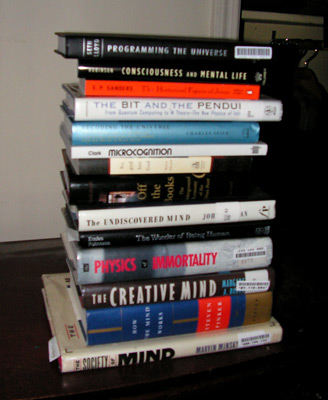
Here’s the stack of books that I bought in 2007. It looks as though I’m going to need 2008, and maybe part of 2009, to read them all. Some of them were real bargains; maybe $5 or $6 with shipping. Many hearken back to the 1980s and 90s, but they still say things that are relevant. I look forward to whatever insights about our wide and wonderful world they may give me. So here they are, from bottom up:
The Society of Mind, by Marvin Minsky; how brains and minds operate – perhaps.
How the Mind Works, by Steven Pinker; ditto.
The Creative Mind, by Margaret A. Boden; ditto again, with a computational twist based on neural networks.
The Physics of Immortality, by Frank J. Tipler; his plan for a ‘resurrection of the dead machine’ has already been vetoed by developments in cosmic physics; but the idea is so audacious that it still deserves attention. There’s still time to find another way to do it!
The Wonder of Being Human, by Sir John Eccles and Daniel N. Robinson; why consciousness – and our selves — may really be exist and be important after all.
The Undiscovered Mind, by John Horgan; why we may never really know if consciousness is real after all.
Off The Books, by Sudhir A. Venkatesh; how the poor get by, in Chicago at least.
No God But God, by Reza Aslan; the case for Islam.
Microcognition, by Andy Clark; a philosopher of mind ponders neural networks and parallel distributed processing models.
Decoding the Universe, by Charles Seife; the new science of information, and the universe as a big computer.
The Bit and the Pendulum, by Tom Siegfried; pretty much ditto.
The Historical Figure of Jesus, by E.P. Sanders; I thought I had my fill of historical Jesus books, but E.P. Sanders is the dean of such studies.
Consciousness and Mental Life, by Daniel N. Robinson; Professor Robinson has the credentials to make some sense out of the current trends in cognitive science and the consciousness debate.
Programming the Universe, by Seth Lloyd; one more book on information and the universe as a big computer.
P.S. — My chances of getting thru all these books within the next year just went down, as I just found out that CBS is going to give Jericho another chance! How about that, the fan protest and all the packages of nuts that they sent to CBS actually worked! At least it was good for another seven episodes. Jericho is a show that shows just how creepy the world could actually get, given the right mixture of greed, terror and technology. And it makes you wonder what can be done to not let it get so creepy. One suggestion — cut back on the greed, terror — and technology. Before we lose it all and have to go back to living like they do in the mythical town of Jericho.
Jim,
First, in regard to your comments about JERICHO: I have to say I have a somewhat–make that a very different–take on TV shows. Just once I’d like to see something on TV about how the world might be better if we lived a little more altruistically. Recently, I saw for a second time the movie PAY IT FORWARD. (I watched it again as movies tend to flee my mind as soon as they are over.) When I initially heard the theme of it, I took an attitude of “so what.” But then, as I say, on a lazy Saturday afternoon, in need of some veg-out time, it was the only thing I cared to watch. One approach to the “pay it forward” concept intrigued me. Specifically, the “pay it forward” idea did not presume the person was a “really GOOD person.” For instance, a guy in prison was “paying it forward” in there for something good that had been done for him. In another case a homeless person (who most likely would remain homeless by choice) also “paid a good deed forward”–to someone else who not necessarily would be considered “good.” I thought: Interesting concept: Doing good things does not preclude people who may not be the most stellar denizens of society. So the concept of “pay it forward” does not demand up front that the person be a “good” person.
I also wonder: If the apocalypse actually did come would it absolutely, positively mean that the only people left would be those who are out to get others before others get them? Something like the second to last “Oprah book” by Cormac. (I think that’s his name.) While I really gave the book short shrift, in the end I did consider that it was a book that said in the midst of all the “I’ll-get-you-before-you-get-me” aspect of society, there was one person who tried to pass on to his son a concept of altruistic behavior. But I have to confess I didn’t give too much attention to the entirety of the book as it was so depressing.
Surely, if altruism evolved in humans, there would remain some vestige of it if the apocalypse came; so that the “gene” for altruism might survive. And if it did not survive, might not the human race mutate in some way to allow for an altruistic trace?
Second, regarding your books: They are all really wonderful books, and I have to give you credit for them. But I find myself saying I wish I could say that I spent that much money on books for a year. I have a really bad “addiction”, one may say. I remember that years ago I heard a fellow colleague say she spent $50 on cosmetics that week. (In those days it was a fortune.) I was shocked–that is, until I realized I had just spent $50 that same week on books; think of the rest of the weeks of the year! Good grief! So there you have it. My addiction is such that in any given month I may spend $200 on books, some of which I may pick up, start to read, put down, pick up again, maybe finish, maybe not finish. But I never know if I may want to go back to them. I can read a novel (or sometimes what I call “lighter” books in a day or two–and that means simply that I carry them around with me and read in between other things I do.) Then I get rid of those books–give them away. The only books I keep are those I may want to refer to again. So I have stacks of books.
I think I need to get some control on my “book” spending and buy only books I know I actually will read–but then comes the problem: How can I know that until I get half-way thru the book?
I admire your careful choice of books, your disciplined reading of them, and your careful, thoughtful discussion of them in your blogs. I need more of what you have.
Right now in addition to the books I’m using for some articles I’m writing (which I consider professional books), I’ve got a start on a book on Richard and John the 2 kings of England back in the 1100s, a book on how the transformation from Christianity to Protestantism took place in the 1500s, a layman’s book on physics, 2 novels, a book on the evolution of the human race–and at this point I have to say “etc.” I can d
Comment by Anonymous — December 18, 2007 @ 5:16 pm
Jim,
First, in regard to your comments about JERICHO: I have to say I have a somewhat–make that a very different–take on TV shows. Just once I’d like to see something on TV about how the world might be better if we lived a little more altruistically. Recently, I saw for a second time the movie PAY IT FORWARD. (I watched it again as movies tend to flee my mind as soon as they are over.) When I initially heard the theme of it, I took an attitude of “so what.” But then, as I say, on a lazy Saturday afternoon, in need of some veg-out time, it was the only thing I cared to watch. One approach to the “pay it forward” concept intrigued me. Specifically, the “pay it forward” idea did not presume the person was a “really GOOD person.” For instance, a guy in prison was “paying it forward” in there for something good that had been done for him. In another case a homeless person (who most likely would remain homeless by choice) also “paid a good deed forward”–to someone else who not necessarily would be considered “good.” I thought: Interesting concept: Doing good things does not preclude people who may not be the most stellar denizens of society. So the concept of “pay it forward” does not demand up front that the person be a “good” person.
I also wonder: If the apocalypse actually did come would it absolutely, positively mean that the only people left would be those who are out to get others before others get them? Something like the second to last “Oprah book” by Cormac. (I think that’s his name.) While I really gave the book short shrift, in the end I did consider that it was a book that said in the midst of all the “I’ll-get-you-before-you-get-me” aspect of society, there was one person who tried to pass on to his son a concept of altruistic behavior. But I have to confess I didn’t give too much attention to the entirety of the book as it was so depressing.
Surely, if altruism evolved in humans, there would remain some vestige of it if the apocalypse came; so that the “gene” for altruism might survive. And if it did not survive, might not the human race mutate in some way to allow for an altruistic trace?
Second, regarding your books: They are all really wonderful books, and I have to give you credit for them. But I find myself saying I wish I could say that I spent that much money on books for a year. I have a really bad “addiction”, one may say. I remember that years ago I heard a fellow colleague say she spent $50 on cosmetics that week. (In those days it was a fortune.) I was shocked–that is, until I realized I had just spent $50 that same week on books; think of the rest of the weeks of the year! Good grief! So there you have it. My addiction is such that in any given month I may spend $200 on books, some of which I may pick up, start to read, put down, pick up again, maybe finish, maybe not finish. But I never know if I may want to go back to them. I can read a novel (or sometimes what I call “lighter” books in a day or two–and that means simply that I carry them around with me and read in between other things I do.) Then I get rid of those books–give them away. The only books I keep are those I may want to refer to again. So I have stacks of books.
I think I need to get some control on my “book” spending and buy only books I know I actually will read–but then comes the problem: How can I know that until I get half-way thru the book?
I admire your careful choice of books, your disciplined reading of them, and your careful, thoughtful discussion of them in your blogs. I need more of what you have.
Right now in addition to the books I’m using for some articles I’m writing (which I consider professional books), I’ve got a start on a book on Richard and John the 2 kings of England back in the 1100s, a book on how the transformation from Christianity to Protestantism took place in the 1500s, a layman’s book on physics, 2 novels, a book on the evolution of the human race–and at this point I have to say “etc.” I can definitely see I need more of your discipline. But then I think, sadly, I’m probably too much of an old lady at this point to change my dissolute habits when it comes to books. But I do have to say I have decided to read the double stack of books I have before I buy any more. Enough is enough!
I look forward to any discussion you may choose to share in your blog that arises from the books in your picture.
MCS
Comment by Anonymous — December 18, 2007 @ 5:16 pm
Jim,
First, in regard to your comments about JERICHO: I have to say I have a somewhat–make that a very different–take on TV shows. Just once I’d like to see something on TV about how the world might be better if we lived a little more altruistically. Recently, I saw for a second time the movie PAY IT FORWARD. (I watched it again as movies tend to flee my mind as soon as they are over.) When I initially heard the theme of it, I took an attitude of “so what.” But then, as I say, on a lazy Saturday afternoon, in need of some veg-out time, it was the only thing I cared to watch. One approach to the “pay it forward” concept intrigued me. Specifically, the “pay it forward” idea did not presume the person was a “really GOOD person.” For instance, a guy in prison was “paying it forward” in there for something good that had been done for him. In another case a homeless person (who most likely would remain homeless by choice) also “paid a good deed forward”–to someone else who not necessarily would be considered “good.” I thought: Interesting concept: Doing good things does not preclude people who may not be the most stellar denizens of society. So the concept of “pay it forward” does not demand up front that the person be a “good” person.
I also wonder: If the apocalypse actually did come would it absolutely, positively mean that the only people left would be those who are out to get others before others get them? Something like the second to last “Oprah book” by Cormac. (I think that’s his name.) While I really gave the book short shrift, in the end I did consider that it was a book that said in the midst of all the “I’ll-get-you-before-you-get-me” aspect of society, there was one person who tried to pass on to his son a concept of altruistic behavior. But I have to confess I didn’t give too much attention to the entirety of the book as it was so depressing.
Surely, if altruism evolved in humans, there would remain some vestige of it if the apocalypse came; so that the “gene” for altruism might survive. And if it did not survive, might not the human race mutate in some way to allow for an altruistic trace?
Second, regarding your books: They are all really wonderful books, and I have to give you credit for them. But I find myself saying I wish I could say that I spent that much money on books for a year. I have a really bad “addiction”, one may say. I remember that years ago I heard a fellow colleague say she spent $50 on cosmetics that week. (In those days it was a fortune.) I was shocked–that is, until I realized I had just spent $50 that same week on books; think of the rest of the weeks of the year! Good grief! So there you have it. My addiction is such that in any given month I may spend $200 on books, some of which I may pick up, start to read, put down, pick up again, maybe finish, maybe not finish. But I never know if I may want to go back to them. I can read a novel (or sometimes what I call “lighter” books in a day or two–and that means simply that I carry them around with me and read in between other things I do.) Then I get rid of those books–give them away. The only books I keep are those I may want to refer to again. So I have stacks of books.
I think I need to get some control on my “book” spending and buy only books I know I actually will read–but then comes the problem: How can I know that until I get half-way thru the book?
I admire your careful choice of books, your disciplined reading of them, and your careful, thoughtful discussion of them in your blogs. I need more of what you have.
Right now in addition to the books I’m using for some articles I’m writing (which I consider professional books), I’ve got a start on a book on Richard and John the 2 kings of England back in the 1100s, a book on how the transformation from Christianity to Protestantism took place in the 1500s, a layman’s book on physics, 2 novels, a book on the evolution of the human race–and at this point I have to say “etc.” I can d
Comment by Anonymous — December 18, 2007 @ 5:16 pm