The ramblings of an Eternal Student of Life     
. . . still studying and learning how to be grateful and make the best of it
 
 
Sunday, August 22, 2010
Current Affairs ... Religion ... Society ...

I put my 2 cents in on the Catholic parish ‘revolt’ going on out in St. Louis in my last blog entry. So, for what little it’s worth, I shall now move over to Islam and throw a few coins out about the Park51 / Cordoba House mosque that a Sufi imam wishes to build near the former World Trade Center site, a.k.a. nine-eleven ground zero. I think that we all agree on the outlines of the controversy: here in America, the First Amendment guarantees groups like Imam Feisal’s Cordoba Initiative the right to purchase property and put up a center for religious worship. There is no evidence that Feisal would use this facility to forward the cause of radical Islam or to promote terrorism or even anti-American attitudes. No one has suggested that Feisal and his associates would do anything illegal in their planned new mosque. However, the site involved does have a strong 9-11 connection; a part of the landing gear from the hijacked United Airlines flight 175 Boeing 767 crashed into the Park Place building after the plane decimated WTC tower 2. Despite all the mayhem nearby, no one in the building was hurt (this sort-of brings new meaning to the Foo Fighters’ recent hit song, “When The Wheels Come Down”). Obviously, having a mosque at such a site offends many people who lost family or friends on 9-11, given the radical Islamist inspirations of Al Qadea.

So, the argument is not about whether the law can stop the Imam from building. It is more focused on whether he should build, given American sensibilities. The last poll number I saw said that about 64% of Americans are against it. I guess that the next question is, if the Imam does go ahead and build, are the many Americans who have bad impressions of Islam as a whole justified in their attitudes (and thus, in their “sub-legal” prejudice against Muslims, e.g. social shunning, suspicious stares at anyone with an Arab appearance, etc.). In a January, 2010 poll, Gallup reported that about 43% of Americans feel some prejudice against Muslims, and 55% view Islam negatively. I think it is safe to say that these numbers will increase if the Park51 mosque is built. The next question is, should they?

Some writers have pointed out a bit of western hypocrisy, given how America and Western Europe responded to Islamic outrage when the Danish newspaper Jyllands-Posten published cartoons critical of Mohammad and Islam in 2005.  »  continue reading …

◊   posted by Jim G @ 2:11 pm       Read Comment (1) / Leave a Comment
 
 
Wednesday, August 18, 2010
Current Affairs ... Religion ...

Given that my grandparents all came from Poland and that as a boy I went to church at a Polish Catholic parish, I couldn’t help but raise an eyebrow when I came across a recent NY Times article about the St. Stanislaus parish controversy in St. Louis. St. Stans was a nice Polish church not unlike Sacred Heart in Wallington, where I grew up (although as an urban-based parish, it might be a bit more like Holy Rosary in Passaic, where my mother was raised). About five years ago, the parish got into a disagreement with the St. Louis archbishop (Raymond Burke, at the time) regarding ownership of the land and buildings at St. Stans. It had something to do with protecting diocese property from being seized in law suits stemming from clerical abuse. (Ah, what a tangled web that has been weaved . . .). The board at St. Stans decided to stand its ground about parish control of the property; the secular law was pretty clearly on its side.

However, the priests who performed all the Catholic rituals (masses, confessions, baptisms, marriages, last rites) at St. Stans also agreed that the archbishop was their boss. So, when the bish got ticked off at those stubborn lay people on the parish board, he decided to pull his guys out; no more priests. The idea was to get the parish board to reconsider, given that they now had a Catholic church without any Catholic sacraments happening inside of it. In a nutshell, the parish board decided to see the archbishop’s bet and raise him one, by finding a priest from another parish to come in and get the sacramental mill rolling once again. They found their man in a priest named Marek Bozek, a guy in his thirties who grew up in Poland but who became a priest and served the church in the USA.

For the past 4 years, Bozek has been keeping the holy fires burning at St. Stans. But Archbishop Burke struck back  »  continue reading …

◊   posted by Jim G @ 7:25 pm       Read Comment (1) / Leave a Comment
 
 
Saturday, August 14, 2010
Personal Reflections ... Photo ...

People who came of age in the past twenty years or so don’t remember much about “The Bell System“. But for old fogies like me, Bell Telephone (aka “Ma Bell”, the nick-name given to AT&T and the local affiliates that ran most of the telephone phone system in the United States up thru 1984) was once a way of life. It was how you made a call. The bell logo (which was a tribute to the telephone’s founder, Alexander Graham Bell) was almost everywhere you looked; on phone books (remember those?), on phone booths (ditto), on your phone bill, on maintenance trucks, advertisements, utility buildings . . .

But the world has changed, and the Bell System is an idea whose time has long passed. There are all kinds of different companies out there today offering a menu of different phone services. But the old Bell organization should not be forgotten, as it was well run; in the first half of the Twentieth Century it allowed the telephone to become a critical component of American life, for both business and social purposes. Bell / AT&T did its job and did it well.

And interestingly enough, you don’t have to walk very far today in most any town before you can see evidence of the old Bell organization. You simply need to know where to look. And that is to look down. There are still thousands and thousands of manhole covers in the streets bearing the Bell logo (ah, “manhole cover” — another antiquated, politically incorrect phrase!). Given how long cast-iron covers last, it could be many decades before the last symbol of the old Bell infrastructure is put to scrap. I took a little walk around my own neighborhood, and hardly had to venture more than two blocks to find several old Bell covers. So I snapped a few pix, in tribute to the enduring legacy of the old AT&T / Bell organization. Enjoy!


◊   posted by Jim G @ 4:46 pm       Read Comment (1) / Leave a Comment
 
 
Thursday, August 12, 2010
◊  8-9-10
Personal Reflections ... Society ...

On Monday afternoon I was working on another piece of bureaucratic paperwork, and I had to write a date next to a signature. For just a second, I noticed that it was 8-9-10. How ’bout that.

Hmmm, for the next four years we’re going to get sequential dates like that. That seems to me like something to be celebrated. I mean, why is January 1 any more sacred?

But no one else (that I know of) seemed to notice. I didn’t see or hear any comment about it in the paper, radio, internet nor TV. And that’s too bad. Nice little things like ascending date numbers are always overlooked. We all want the big thrills in life, and we live in on-going disappointment about how rare and unpredictable they are. So why not focus on the little things that you can count on?

Hey, 9-10-11 is coming! We all should start thinking now about how to celebrate it, as a part of the on-going celebration of our lives.

◊   posted by Jim G @ 6:20 pm       Read Comment (1) / Leave a Comment
 
 
Wednesday, August 11, 2010
Personal Reflections ... Religion ...

I got interested in the “historical Jesus” movement about 10 years ago, which was a number of years after the whole thing started getting public attention (given the Jesus Seminar and the best-seller books put out by Dominic Crossan and Robert Funk, arguing that Jesus was really a whole lot like a modern liberal social reformer). I’m always a little behind the curve. Well, about five years ago, after reading several books covering a wide range of positions about who Jesus really was and what he intended, I burned-out on the whole subject. But not before the apocalyptic crowd convinced me that Jesus is better explained by historical factors than by divine salvation. I could no longer go into a Christian church, not even an Episcopal church (the last kind of church that I affiliated with), and proclaim Jesus as the Son of God, true God and true man. From then on, I would still regard Jesus as a key figure in my life, a man from history deserving of much veneration and attention; but I could never again pray to him as a divine being.

So that’s pretty much where things have stood between me and Jesus for the past 4 or 5 years. But I had one more book about Jesus sitting on my shelves that I wanted to get to, by the highly regarded scholar E.P. Sanders (“The Historical Figure of Jesus”). I finally got around to starting that book in late winter, and I finished it not too long ago (it was my lunch-hour read). And I need to say, I found it extremely gratifying. After going thru about 6 or 7 big tomes sifting through the writings about Jesus and the historical / social context of his life, I was forming my own picture of him. It turned out that Sanders’ picture of Jesus was quite a bit like my own. We agreed on one very important point: that Jesus indeed foresaw an immediate “God revolution” in Palestine, the coming of the Kingdom of God in a very literal sense.

Even more important, Jesus did not see himself as a mere observer and prophet of a revolutionary event whose arrival could not be accurately predicted.  »  continue reading …

◊   posted by Jim G @ 8:40 pm       Read Comments (3) / Leave a Comment
 
 
Saturday, August 7, 2010
History ...

I was watching the PBS summer re-runs the other night and saw parts of a two-hour series called “Looking for Lincoln”. It got me so interested that I went onto the PBS web site today to view the show in its entirety. I’m a bit behind the curve here, as this series was first aired on Feb. 11, 2009, on the eve of Abraham Lincoln’s 200th birthday. So it took me a year and a half to find out about LFL and watch it. Better late than never!

The show didn’t initially influence my own opinion of Lincoln. For the past 3 years or so, I’ve made an effort to study the American Civil War, so I wasn’t surprised to hear that Lincoln was not an abolitionist and did not see African-Americans as human beings fully equal with Euro-Americans. I knew that Lincoln’s first concern in the crisis that lead up to the Civil War was to preserve the Union, and his long-running (but hardly unqualified) opposition to the institution of slavery was driven more by political pragmatism than humanistic enlightenment or religious idealism. I also knew that Lincoln wished to make the black man go away in America; Lincoln’s formula, until late in the Civil War, was to free the slaves but send them back to Africa. While President, Lincoln initiated various projects to start that process, supported by federal aid. But none of them were successful.

Looking for Lincoln is hosted by none other than Professor Henry Louis Gates.  »  continue reading …

◊   posted by Jim G @ 8:00 pm       Read Comment (1) / Leave a Comment
 
 
Saturday, July 31, 2010
Personal Reflections ... Science ...

I’m not a big fan of Ken Wilber-inspired “Integral Theory”, as it seems to require large doses of wishful thinking in order to be “truly universal”, i.e. “integral”. But I recently decided to have a look at a book by Ervin Laszlo that proposes a science-based “integral theory of everything”; the book is called “Science and the Akashic Field”. As expected, it has a lot of wishful thinking once the “Akashic Field” side kicks in. But when Laszlo discusses pure science, he gets down to some interesting ideas and theories (i.e., those not his own).

I’m still cutting thru this book, and I just read an interesting overview that Laszlo provides of current “Metaverse” theories. These are serious ideas put forth by cosmologists about where the Big Bang might have come from, what might have existed before our Universe arose, what else there is out there beside our Universe, and what might eventually become of our Universe. There are many very interesting (and very speculative) theories out there, including the “chaotic inflation” model of physicist Andrei Linde. Laszlo describes Linde’s theory of how our Universe and others form as somewhat akin to a bubble bath. Universes form like bubbles from a churning pool of water and soap, each one expanding and separating off from a cluster of others.

Very interesting. This brought back a childhood TV memory  »  continue reading …

◊   posted by Jim G @ 7:58 pm       Read Comment (1) / Leave a Comment
 
 
Monday, July 26, 2010
Economics/Business ... History ... Society ...

In the July 23 review of my life and economic times, found below, I speculated that the American economy was heading for “a new equilibrium” whereby the big corporations and maybe 80% of the population would do just fine, and the other 20% of America would be shut out. That other 20% would be permanently stuck in poverty, unemployment, or under-employment at best. It would scrape to stay alive thru “off the books” activity and whatever government support might still be available (which will obviously decline over the coming decade due to huge federal deficits).

Here’s an article I read today by economist Robert Samuelson that seemed to affirm what I am saying. Samuelson notes that most major American corporations are doing just fine with regard to profits; but they just aren’t hiring. They are learning how to maintain a sufficient return on their invested capital without needing to expand their business base beyond what the big recession of 2008 currently allows. They have adjusted just swell to the recession.

The recent gyrations of the stock market also seem to affirm this;  »  continue reading …

◊   posted by Jim G @ 7:58 pm       Read Comment (1) / Leave a Comment
 
 
Sunday, July 25, 2010
Photo ...

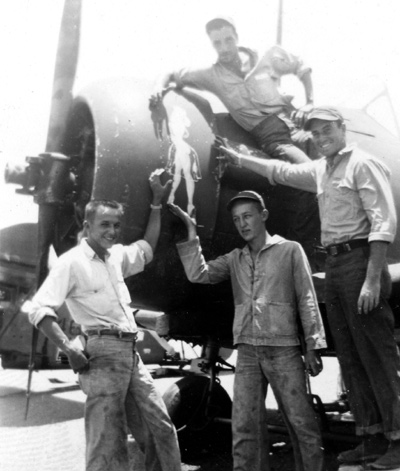
I was scanning some pix today from my father’s old Navy scrapbook. My dad served as a mechanic at Pearl Harbor from late 1944 to 1946. So he is a WW2 vet, and thus he qualifies as part of the “Greatest Generation“. Dad’s the guy at the center, putting a bit of wit into the act (by seemingly holding up the nose girl on the old F2A Buffalo fighter plane with his hand). My brother inherited his spirit and naughty humor; I am much more of a “stick in the mud”. But then again, Dad could be as stodgy and studious as the next guy when he had to be. We both got a part of him in our blood.

Whatever. The bottom line is that he and his generation did do a lot, and we Baby Boomers never gave them enough credit for it. Tom Brokaw struck a nerve with his book; maybe they are finally getting their due.

◊   posted by Jim G @ 2:52 pm       Read Comment (1) / Leave a Comment
 
 
Friday, July 23, 2010
Economics/Business ... Society ...

I am what you might call an “economic determinist”, at least in part. I believe that economic factors such as the material wealth of a society and how that society distributes that wealth determines a lot about that society. Of course, the real world is a two-way street. Social factors effect economics just as much as economics effect social factors. But both social dynamics and economic realities ultimately respond to the environment that the society and its economy live in. And of the two, I believe that economics responds quickly when things change, e.g. war, climate change, new discoveries, depletion of resources; and that social change then follows the lead of economics.

So, I am going to tell the story here of my own life and times in terms of economics, as a way to help understand all the social change that I’ve seen in my 57+ years. When I was born, the USA was recovering from the effects of a major world war. Technology developed in the course of WW2 was being applied to make new products and services, and to make existing products and services more cheaply. Also, the GI bill gave the work force an injection of higher education, providing another boost for the economy. Energy supplies were cheap, especially since the USA now had unhindered access to oil, minerals and other resources throughout the globe. Things were good and getting better.

The rise of the Soviet Union in the 1950s put a burden on the USA, creating the need for large military forces ready to fight the Cold War.  »  continue reading …

◊   posted by Jim G @ 9:45 pm       Read Comment (1) / Leave a Comment
 
 
TOP PAGE - LATEST BLOG POSTS
« PREVIOUS PAGE -- NEXT PAGE (OLDER POSTS) »
FOR MORE OF MY THOUGHTS, CHECK OUT THE SIDEBAR / ARCHIVES
To blog is human, to read someone's blog, divine
NEED TO WRITE ME? eternalstudent404 (thing above the 2) gmail (thing under the >) com

www.jimgworld.com - THE SIDEBAR - ABOUT ME - PHOTOS
 
OTHER THOUGHTFUL BLOGS:
 
Church of the Churchless
Clear Mountain Zendo, Montclair
Fr. James S. Behrens, Monastery Photoblog
Of Particular Significance, Dr. Strassler's Physics Blog
Weather Willy, NY Metro Area Weather Analysis
Spunkykitty's new Bunny Hopscotch; an indefatigable Aspie artist and now scholar!

Powered by WordPress