I’ve been interested in chaos theory for almost 20 years, ever since reading James Gleick’s “Chaos, Making of a New Science” in 1990. I’m not a mathematician, but I was able to appreciate most of the general concepts that scientists were finally beginning to consider when chaos started to become popular. E.g., the “butterfly effect”, how a butterfly flapping its wings in a certain way over Beijing can influence the track of a hurricane over Jamaica six months later.
Today the “butterfly effect” has pretty much become folk wisdom, although the folk view often goes too far. (E.g., if only that darn butterfly went left instead of right, New Orleans might have been spared!). Chaos study shows that many physical systems are non-linear in nature and are recursive in nature. They are thus best described by math equations that are themselves non-linear and recursive (i.e., they utilize the recent outputs from the system as one of their input streams; the past never completely goes away for them). Under certain conditions (and NOT generally), these equations can be very sensitive to initial input assumptions. Again, in certain limited situations (such as the weather), a tiny change in an input factor, say about a tenth of a percent worth, can send the output up or down by maybe ten percent.
People who have reason to be cynical about science, e.g. New Age types and spiritualists, often cite the “butterfly effect” to discount all of science and give their own “mystic intuition” more credence. Well, they have their agendas. Such people often favor holistic remedies, but if they get a really tough infection that threatens their life, they usually take the antibiotic pill that scientists found to be 99.9% effective. They trust that the butterfly was not flapping in this instance.
What I’ve always found more interesting about chaos theory, and harder to understand, is the notion of “strange attractors”. (Here’s a typical example of a strange attractor explanation; if you get it, you’re smarter than I am – but don’t crow, because I’m not all THAT smart). But over this past weekend, while reading a book about chaos and brain dynamics (“How Brains Make Up Their Minds” by Walter J. Freeman), I finally managed to wrap my mind around it! Eureka! I’m only twenty years too late.
The best way, I found, to understand strange attractors is to compare them to with the two other main types of attractors. The first kind, the simplest, is called the “point attractor”. When a system has a point attractor, the system is always trying to get back to one particular fixed state. The classic example is a pendulum at rest. We’re talking about pendulums as they really exist here on earth, with friction in the joints – that’s an important point here. The earthly pendulum is at rest when it is straight up and down. You can flick it and it will start swinging back and forth. But because of friction in the joint (and from the air), it will soon come back to rest, straight up and down. That’s the “attractor state” of it, a state described by a single point (i.e., the point where the pendulum bob is closest to the ground, with its arm straight up).
The second kind of “attractor” is a limit-cycle. That’s when the system “oscillates”, i.e. moves in a circular pattern of some sort. This circular pattern is perfectly predictable. If we could somehow eliminate all friction in the pendulum joint and remove the air around it, you could flick the pendulum and it would swing back and forth forever. If you plotted the pendulum’s position along its arc versus its speed, you would get a perfect circle. For whatever reason, the science and math people decided to call this a “limit cycle”.
In the real world, an old-fashioned cuckoo clock or grandfathers clock is a system having a limit cycle. You pull the cord to lift up the weights, and the pull of gravity on those weights is transmitted by some gears and springs as to give the pendulum a little kick, just enough to overcome friction in the air and in the hinge. So the clock’s pendulum goes back and forth predictably, and thus powers the internal gears that drive the clock hands. If all the gears and stuff are designed well (by German engineers and craftsmen, no doubt), and you keep pulling up the weights now and then, the clock will keep good time. The limit cycle will be maintained.
(Yes, I’m old enough to remember cuckoo clocks. My grandparents had a big one in their apartment, and my parents had a smaller one in our kitchen. When you woke up in the middle of the night, you were never more than 59 minutes or so from finding out what time it was. But the constant tick-tick-ticking of the pendulum often helped you get back to sleep before the mechanical cuckoo sang its hourly song.)
So what is a “chaotic attractor”, more colorfully known as a “strange attractor”? Well, that’s the next step up in the sequence from point attractor to limit-cycle attractor. A strange attractor mixes chaotic unpredictability with just enough regularity to still be considered an “attractor”. To make a cuckoo clock “strange”, you would have to get a mad clockbuilder to put in some additional gears powered independently by a separate weight, and have the output of these gears join in somehow with the regular “kick” that goes to the pendulum. These “strange gears” would work out of synch with the original set of gears; the pendulum might get a kick one way according to one frequency, then get a lesser or greater kick in the other direction at a different frequency.
As a result, the pendulum (and thus the clock) would be all mixed up. Sometimes it might be a half second between ticks, at other times it might take two and a third seconds. So now there is chaos. But it’s not absolute chaos; the pendulum is still ticking, after all. It doesn’t stall and stop ticking, nor does it keep speeding up until it breaks (although that could be arranged; but we are assuming that our mad clock scientist didn’t put that much ooomp in the “strange” kicker system).
Perhaps this clock still keeps some kind of time, but not accurate time; it’s almost always ahead or behind the real time, and you’re never sure which. But on average, over many minutes and hours, the clock hands still advance at a steady rate; this average could even be 24 clock hours per day. So the demented “strange cuckoo” could still be “attracted” to a 24 hour day, but would be too chaotic within that day to give you accurate time. Its “limit cycle” has gone over to become “strange”. But it still has a beating pendulum that hasn’t flown off the hook (that would be a further “state transition” for this crazy cuckoo clock).
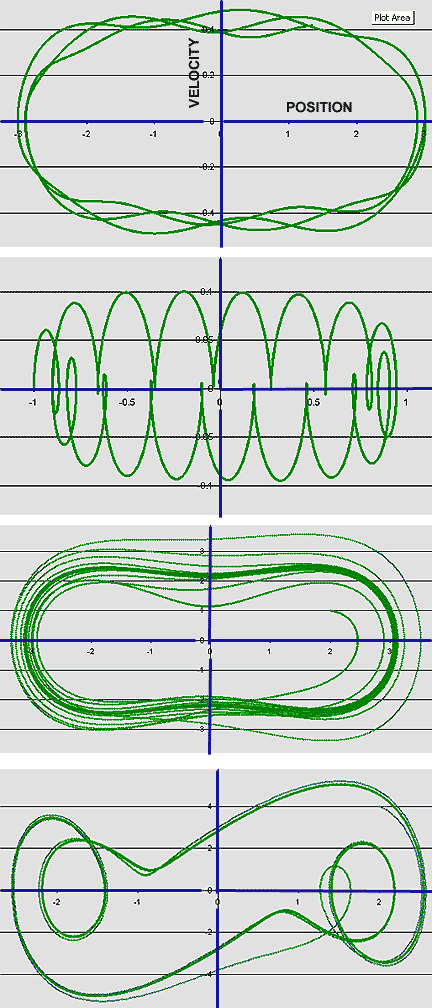
So that’s the strange magic of strange attractors. I’ve been fooling with an Excel program that develops strange attractor patterns for an interacting math system that describes something like a clock pendulum; I’ve attached some of the “state space plots” below. Each reflects the output results over time from a particular set of input conditions. This is just a small sample of the many possible “state space” patterns that can occur between position and velocity, as the input parameters are “tweeked”. Sometimes a small tweek has hardly any effect on the pattern. Once in a blue moon, a small tweek changes everything – and I see that chaotic butterfly at work! It’s all quite interesting – and quite strange!