One of the biggest yet most unanswered questions about health care reform is, why do we need it? This past Wednesday, the President gave a speech before Congress making the case for his own health care plan (and finally offering some more details on just what that plan is). During his speech, he acknowledged his critics who cite polls showing that between 80 to 85 percent of Americans are generally satisfied with the health care they receive, including those without formal health care coverage (who pay out-of-pocket or receive charitable care at emergency rooms). However, he then countered with the unfairness argument, i.e. that many insurers impose arbitrary rules which impact badly on people in certain cases. One of his poster children was a Texas woman with breast cancer whose insurance was canceled right before a double mastectomy because she hadn’t declared a previous case of acne (ah, and also her rapid heartbeat, which she didn’t think was relevant to her health condition). In other words, that 15 to 20 percent of Americans who are NOT satisfied with their care are really getting some very raw deals. And who knows if you or I will be the next one to get such a deal in time of need, even if we are happy with whatever health care we’ve received so far.
OK, President Obama does have a point. However, he and our political leadership in general (Democrat and Republican) have failed to make the public aware of the more widespread social and economic dangers that lurk if the present trends in health care continue. You would need to take the time to read long articles (such as David Goldhill’s brilliant exposition of the crisis within the health system the September Atlantic Monthly magazine) or government reports (such as those put out by the Government Accounting Office) to appreciate what is going to happen if health care costs continue to grow as quickly as they have over the past 25 years. It’s all the more scary because we’ve know about this problem all along and have imposed various reforms, such as health maintenance organizations on the part of insurers and Medicare cost caps on the part of government; and they have not stopped it. It’s like a monster movie where you try this and that to stop the ugly thing now coming at you, but it just keeps coming. It’s pretty creepy – and worse, it’s not just a movie.
What harm will increasing health care costs have? Well, they will prevent a lot of other good things from being done, such as better highways, better schools, more parks and wilderness preservation, more low-income housing, etc. Health care, although it does stimulate the economy by producing jobs and demand for drugs and a wide variety of other goods and services, in the end does not cause net economic growth. Economic benefits from increased health care outlays do not outweigh economic costs.
In this it is similar to military spending. Military spending also stimulates the economy, but not enough to outweigh the costs; too much money goes for things that at best aren’t used (guns, aircraft, missiles), and when they ARE used destroy economic infrastructure and increase world poverty. Health care causes happier outcomes than armies and navies do; but allowing people to live to 85, versus 75, does not add much to our economy’s productivity, since those extra ten years will not be spent at work. (Yes, there is some economic benefit in that better health care allows people on average to be economically productive longer; but most of us want to use the extra time to extend our retirements and not to work longer, so there is generally more economic burden than benefit from extending lifespans).
Is there any evidence that growing health care costs have already put some limitations on what our society can accomplish? I think that there IS. My first example will refer to something that interested me quite a lot as a boy, i.e. space exploration. When I was around 5, the first satellites were being launched. By the time I was 10, the first men were being rocketed into space, if only for a few minutes. By the time I graduated from high school, men had walked on the moon. While I was in college, we landed a robot explorer on Mars. I certainly expected to live to see networks of manned space stations in orbit, colonies on the Moon, and manned missions to Venus and Mars, maybe even a shot at Jupiter. Just like in Kubrick’s 2001, A Space Odyssey. Now it looks like the next manned rocket to the Moon won’t get going for another 20 years, and a Mars mission is stalled indefinitely. I might not live to see either. What happened?
I’ll tell you what happened. Our national leaders realized that we couldn’t afford the tab. Back in the 1960s, NASA’s budget was huge; in 1963 it took up 2.8% of the national budget, and peaked at 5.5% in 1966. By 1970 it was down to 1.7%, then down to 0.8% by 1980, and 0.75% in 2000. Today it’s at 0.55%. The Space Shuttle has been widely criticized, but in the end, ya get what ya pay for. By comparison, the budget for Medicare and Medicaid was about 1% of the federal budget in 1966. Today it’s at 19%, and is expected to continue climbing past 20% over the next year or so. That’s not counting health care cost increases for federal employees and military personnel. Sure, the national economy and the federal budget grew in real terms over this time period; but when a component of the budget grows as fast as health care has, something else has to be cut. It’s quite clear that space exploration has felt the knife.
Want dollar figures? OK, in 1966, NASA spent the equivalent of $32.1 billion (in today’s dollars); in 2008 it had $17.2 billion to work with. This is still a lot, but not nearly enough to dream about manned missions to Jupiter, Mars or even the Moon. Despite all of the wonderful technologies developed over the past fifty years, there’s still no cheap way to overcome the Earth’s gravity, nor to protect humans from the airless, radiation-filled voids of space.
OK, that’s on the government side. What about in the private sector? There is evidence that growing health care coverage costs has helped keep wages from rising. Certainly more employers now forgo offering their employees health benefits. But many still do, and employees are more and more appreciative of having coverage. To the point that we are accepting lower wage increases than in the past. Here’s a chart of average weekly wages in the USA since 1964, in terms of constant 1982 dollars, from the US Bureau of Labor Statistics.
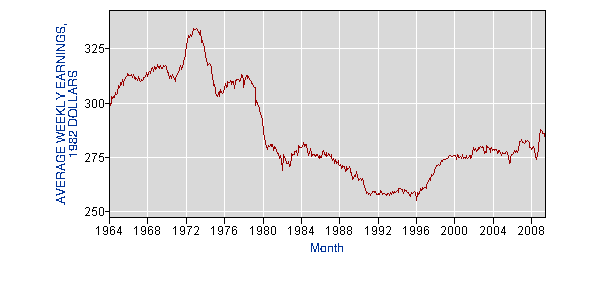
The first thing you notice is that relative to the early 1970’s, wages (in real dollars, reflecting true buying power) have gone down quite a bit. They generally rose from 1964 thru 1973, but then plummeted. The drop was mostly because of the inflation and economic recession caused by the big oil price increases of the mid 70s, along with the economic drag of the Vietnam War. Wages kept on falling thru 1992, as the manufacturing industry shrunk and the service economy grew, and as unions became increasingly less powerful.
Things got a bit better during the good times of the second Clinton Administration (late 90s), but since 2000 the improvement has been just shy of 4% overall (about $30 in 2009 dollars). Despite the recession and financial crisis that started in mid 2008, the domestic economy grew by about 19% in real terms during this time. Obviously, the fruits of this growth are not being seen on the average paycheck. OK, I must admit that wages are influenced by other things including the a
ge of the workforce, the level of immigration, and by the growing economic power that many employers hold over their non-unionized workforces. But mainstream labor economists affirm that spiking health care costs are keeping wages down in the labor markets, and the effect has become significant over the past ten years.
So, for a guy like me, that means that the promise from that childhood book that today lies on a shelf in my mother’s basement (entitled “You Will Go To The Moon”) will go unfulfilled, and that I will have to be satisfied with pay raises that cover the increased cost of living and hardly anything more. OK, I can live with that. Improved health care will hopefully let me live longer or at least a bit better than my grandparents could. If the hungry monster of skyrocketing health care costs would stop there, I’d say fine.
But the monster is not stopping. It will soon cut into the muscle and not just the fat of our federal budget and our economic system. It will soon compete for funds that are otherwise needed for scientific research, transportation infrastructure, education, law enforcement, etc. The pressure will be felt on the military budget too, along with welfare and Social Security. To maintain those basics, taxes will need to go up, cutting even further into spending power and living standards for average citizens. We may live longer and healthier; but we’re also going to live poorer, less educated and less protected if health care inflation can’t be put under control, if we can’t find a more efficient way to realize the benefits of medical advances.
David Goldhill, who confesses to being a Democrat, is on-record as saying that the health care monster cannot be controlled by increased government control of the existing system; in fact, failed government control efforts and the existing structure of health insurance give this monster its destructive strength. President Obama and most other Democrats say that we should keep the system and bring on more government control. This would make for a very scary movie; but unfortunately, it’s absolutely real.
I really wish there were more articles like this on the web.
Comment by Karah — July 15, 2011 @ 2:14 pm