The ramblings of an Eternal Student of Life     
. . . still studying and learning how to be grateful and make the best of it
 
 
Friday, April 24, 2009
Current Affairs ... Economics/Business ... Public Policy ...

I’ve been getting up to speed lately on the carbon cap and trade issue. Up to now, I generally thought it was a good idea, given that something has to be done about greenhouse gasses and global warming. I wasn’t sure that now was the right time, given the big economic mess that we’re in; it seemed better to wait another two years to take on an expensive government program. But overall, cap and trade sounded like a good way to go, once our nation is fully back on its feet.

Since then I’ve learned more about cap and trade. And I’ve become convinced that the whole damn thing needs to be chucked. It sounds like a good idea from a distance, but once you get a close-up look at how it would work and what it could do to our economy over time, it becomes clear that there are some HUGE downside risks. President Obama needs to go back to the drawing board regarding global warming.

I won’t fully explain C+T right here; a good starter explanation is available on this web site, as a PowerPoint slide show. And there are some variations to it. Basically, under the Obama version, the US government would set a number of tons of carbon emissions that could be released from US territory each year into the atmosphere (mostly from combustion of fuels, but farm animal flatulence is actually a significant source). Every year over the next 40 years or so, the target amount would go down. And (in theory), everyone who causes carbon gasses to be released into the atmosphere would need to buy a permit from the federal government to do that. Those permits would be sold by the government at auction, but you could also buy them on a secondary market, sort of a big EBay. If you put out more carbon gas than your permit allowed, the government would fine you, maybe send you to jail. That’s the theory.

So the government only issues permits good for so many tons per year. That’s the “cap” part (and also the TAX part, since you have to pay the government for them; this is how Obama intends to pay for the big expansion of government that he is now carrying out, without raising income taxes). The “trade” part comes with the secondary market; some people or corporations who buy them then decide that it’s cheaper for them to reduce their emissions, so they sell their excess permits at a profit (to others who aren’t so lucky as to be able to cheaply reduce their carbon gas footprint). Supposedly that makes the scheme most efficient, from the overall social welfare perspective.

Unfortunately, there are plenty of things that make the scheme quite inefficient. First off, to truly reduce carbon emissions in the least-cost manner, a cap-and-trade system would need to apply to everyone. And I mean EVERYONE, because virtually everyone burns or does something that throws carbon up into the air. But Obama’s system will not apply to EVERYONE. So not everyone will have the same incentive to reduce carbon. And that will cause economic distortions, inefficient uses of resources.

First off, here in the USA, the politicians will draw a line as to who does and who doesn’t have to buy permits to create carbon gasses. The average person who drives a car or cooks a meal or owns a home and heats it with anything but electricity creates on-site carbon gasses. I do it everyday, you probably do too. But Obama would not be very popular amidst the voters if he told us that we now need to figure out our yearly carbon impact and buy permits for it, or face fines and punishments for driving to work or cooking a meal on the stove or keeping warm in the winter. So the average citizen will be exempted. (A straight-up tax on carbon fuels based on their greenhouse gas content would get around this problem; but it would get shot down because it is clearly a TAX; Obama’s Auction/Cap/Trade system might get by, but only because it doesn’t SOUND like a tax, even though IT IS).

Obviously, the big carbon sources such as utility electricity generators and chemical manufacturing plants will be subject to the permit system,. They would have the technical know-how as to calculate their carbon impact. But what about the in-between cases? Where will President Obama draw the line? What about the bakery up the street? They burn a lot of natural gas (which produces greenhouse gasses, although not as much per BTU as coal does), and maybe some oil too, right on site. And thus they generate a fair amount of greenhouse gas. What about the average restaurant, with all the gas and oil and maybe wood that they burn? What about small charter bus companies? Small construction companies, with all their oil-burning equipment? What about the small dairy farmer or chicken farmer, whose animals spew methane and CO2 just like the corporation ranchers’ animals do? Are owners of mom-and-pop businesses like these going to need to enter the cap and trade market? Will they need to estimate and track their carbon impact each year? Will an EPA / IRS auditor hassle them for allegedly spewing three tons when they only bought a 2.5 ton permit? Ah yes, how will the EPA and IRS monitor gas emissions from each source? In addition to price and resource distortions from exempting the average citizen, the government can either exempt small businesses, and thus allow even more resource allocation distortions; or go after them, with less distortion but at a huge enforcement cost.

Another “EVERYONE” problem in the cap and trade scheme regards how the economic impact will be spread between the rich and the poor. The biggest impact of Obama’s C+T, with its taxation component, will be the price increases it causes for electricity, gasoline, fuel oil and food. Those are products that are made or processed in America by big producers (electric utility companies, oil refining plants, and food processors who use a lot of fuel to make fertilizer, cook / cut and grind farm products, package them in plastic, transport them and keep them cool), and will be most vulnerable to the C+T system. The poor spend much more of their available funds on those basic items than the middle class and the rich. SO, the C+T system will affect the poor in an unfair fashion; as a tax, it is quite “regressive”.

But the biggest gap in the EVERYONE equation is the international gap. Most of the developing economies in the world (the “BRIC” countries, i.e. Brazil, Russia, India and China; plus most of the Middle East, Africa, Latin America and eastern Asia) basically have no interest in making sacrifices to control carbon gas emissions. And they are the ones whose emissions are climbing much faster than America’s and Europe’s, and will soon eclipse the developed world in overall carbon impact. They now manufacture much of the stuff that America used to, e.g. TV’s, refrigerators, washers, machinery, steel, cement, etc. Manufacturing requires burning a lot of fuel, mostly carbon-based fuel. The developing world has access to a lot of cheap coal, which creates a lot of carbon gas when burned; and they want their shot at the good life, as America and Europe have enjoyed over the past 50 years. From what I’ve read, we need to assume that the developing nations aren’t going to get serious about carbon reduction until they have achieved average standards of living equivalent to what we have in the USA and western Europe. And that may be another 10 or 20 years down the road (although it is finally foreseeable, something that could not be said even as late as 1990).

So over the next generation or so, the USA will continue to depend on goods manufactured in China and business services rendered in India, and these goods and services will NOT include a price component to account for their carbon damage. The remaining things and services that we still produce here in the USA will take a beating, as they WILL include carbon damage in their prices. More and more things and services will be bought from overseas, b
eing cheaper, and more and more US jobs will be lost. (Two industries that still make their products in the USA, but might not if the price differential with foreign manufacturers goes up due to cap-and-trade, are the chemical and paper industries; and the already-battered US auto industry might only contract further from this).

That will NOT go unnoticed by the politicians. At some point, it’s clear that they will respond to cries of unfairness from the public, and will set up tariffs on imports as to account for what India and China (and most every other developing nation) SHOULD be charging, if they followed our lead with carbon cap and trade. In the short run, that will save US jobs; but in the long run, it will cause an overall loss of jobs, as everyone becomes poorer when international trade is slowed down. I.e., the developing countries will in turn reduce their buying from the USA, e.g. entertainment, fashionable clothes, education, specialized computer applications and equipment, etc.

But the biggest worry is this: we are extremely dependent right now on loans from those developing nations. China, along with the Middle East, is financing a lot of the US government operating deficit. With the economic crisis requiring stimulus packages and deficit spending, we need their loans more than ever. If we put up tariffs that slow down their exports to us, they may well slow down their loans to us. That would cause interest rates to jump up and stay high, which would keep the stock market from growing for maybe a decade or two (as in the 1970s and early 1980s in response to all the inflation and corresponding interest rate jumps caused by oil price spikes). If the stock market stalls over the next two decades, a lot of Baby Boomers — myself included — are not going to be able to retire when we reach 65 or 70 (or 75 or 80, etc.). We’re will try to work until we drop, which will keep new jobs from opening for young people. EVERYONE would be hurt by this.

What I’ve just outlined is the worst-case scenario. Under that scenario, the USA would take a big economic hit over the next 25 years just as China and India are rising in power, economically and militarily. The USA would lose its status as a world superpower. We would not be able to support the world-wide military establishment that we now do. We’d need to get used to being pushed around by other nations, as we would no longer be the big kid on the block.

Some people, perhaps many Obama supporters, think that might not be a bad thing. But it certainly would be different than today. It certainly would affect the lives of we average Americans, often in the wallet and pocketbook, and mostly for worse and not for better. And it would certainly limit what the USA could do in terms of spreading its ideals and values (such as liberal democracy) throughout the world. Again, some people think that our overall civic values and virtues have been permanently corrupted, and that we really don’t have anything to teach the world regarding politics, economics and philosophy at this point. I believe that these people have a point; but from what I’ve seen in my lifetime, the alternatives out there can be so much worse. Our ideals of personal freedom and open markets as guided by laws and regulations promulgated by a limited representative government, might take a real hit if the USA grows weaker and poorer — they might even decline right here at home (some will argue that they already have).

There is also a best case scenario, of course. Should things fall into place, the US and its expanded government would lead the way to cost-efficient, low-carbon energy and industrial technologies. BRIC and all the other developing nations will soon adopt and adapt these technologies, on competitive economic grounds. Our advanced solar panels and wind turbines and other high-tech green-goodies will turn out to be the lowest cost way to make power and products. The need for protective tariffs in the USA will thus fade away. At that point, maximum world trade will resume, and at the same time carbon-based greenhouse gasses will subside as global warming is contained. Global prosperity will jump and standards of living will resume their growth track in the USA, after a pause for a decade or so. American youth and the the science-technology establishment will rapidly respond to President Obama’s challenge to come up with green technology that beats the old carbon-based way of life. The USA would thus still be a great world power, if no longer THE world power. The world would be grateful for our foresight and our bravery in leading the way to a much better and fairer economic system; they would then take us much more seriously in terms of adopting our democratic political institutions and our visions of freedom.

My point is, Obama is taking a HUGE crap shoot with his cap and trade proposal. The future of our nation really is on the line here. The gains could be tremendous, if the dice roll the right way; but the losses could have equal magnitude. The world, including our comfortable life here in suburban USA, could become much poorer and darker if the green technologies that we develop aren’t as wonderful and transforming as we hope. Some intelligent people are arguing that wind and solar and bio fuels have inherent energy limits, and will never get so cheap as to convince people in Asia and Latin America and the Middle East to voluntarily put aside all the cheap and dirty coal, oil and wood that they have access to. In a well-thought out article, Peter Huber of the Manhattan Institute argues that we should assume that the developing world will continue to burn carbon, and that we in turn will have to follow (or risk severe economic decline and political diminution on the world scene); about the only thing we can do to fight global warming is to direct our collective techno-genius towards airborne reduction schemes on a massive scale.

As I’ve written in my blog many times, the global warming problem is real, and the consequences for our world are great. But we also need to consider what conservatives like Huber speak of, i.e. the need to “keep the fire burning” behind our nation’s best and most enlightened social values. The conservatives are not wrong in contending that the world around us is still a dark, cold and hostile place, in so many ways; and that a weakened American could do less and less to counter that. Before our nation rolls the President’s cap and trade dice, we might want to stop and think about this some more — let’s make sure we’ve considered all the alternatives and scenarios and side-effects, BEFORE we take such a HUGE gamble on our future and the world’s future.
◊   posted by Jim G @ 10:40 pm       Read Comments (2) / Leave a Comment
 
 
Sunday, April 19, 2009
Current Affairs ... Economics/Business ...

On my daily commute to and from the office, I try to find some intelligent discussion of contemporary issues on the radio. There’s talk radio, that certainly qualifies as “discussion of contemporary issues”. But it fails the “intelligent” test. I’ve found there to be only two good sources: NPR and Bloomberg Radio. So, throughout my 30 to 40 minute drive each way, I find myself constantly pushing the channel button on the radio, trying to dodge the commercials on Bloomberg and the fundraising and “progressive music” breaks on NPR.

Thus, by the time I get to work or get home, I’ve heard a blend of two different views on what is important in this country. On Bloomberg, the important things are economics, investing, finance and business management. On NPR, by contrast, you hear a lot about injustice. You hear stories about exploited workers, both in the USA and around the world. You hear about people struggling without health care. You hear about migrant workers and community activists angry with utility companies. NPR certainly does not ignore the current economic crisis; but their stories and interviews generally have a different slant than on Bloomberg. NPR likes to focus on the injustice of an economic downturn that is punishing working class families who live within their humble means, comparing them to the extravagantly compensated corporate leaders whose unreasonable financial risks helped to cause the crisis, yet whose firms are being “bailed out” by the public (while those leaders continue to demand compensation over a hundred times greater than what the working class family gets by on). The commentators on Bloomberg generally acknowledge such sentiments, but in the context of dangerous populist over-reaction to necessary government stabilization measures.

My heart is with all the NPR reporters and commentators who believe that they are helping to bring about a more just world by streaming a constant parade of woe stories (with the regular Obama accolade slotted in). But the Bloomberg people know the nuts and bolts of the world better. NPR and its clients make a meritorious effort to appreciate the nitty-gritty; but I don’t think they could run a container ship port or a distribution warehouse or replace a sewer system or design a mini-steel mill or finance a computer software start-up firm.

For better and for worse, our economy is directed by a mix of greed and politics; and it’s generally good that NPR questions this, and it’s not always good that Bloomberg doesn’t. But our (partially) market-driven economy must ultimately shape itself around millions of people like you and me who try to spend and save our money wisely and try to earn enough to get by on. The Bloomberg people focus on the stuff that will affect these millions of people in their everyday lives. The Bloomberg people better know the forces and mechanisms of world commerce that have brought millions of Chinese and Indians out of poverty (and which now might cast a lot of them back into poverty, along with too many Americans). The Bloomberg people tell you how the world works (in case you’d like to make some money off of it); the NPR people tell you about the injustices of those workings (in case you’d like to stage a protest or change the government — or go down trying, anyway). But unless the rabid NPR fans arrange a return of the Bolsheviks, or Obama manages to nationalize the major corporations, Bloomberg’s topics will affect more of the masses in more ways than NPR ever can.

It’s a complex and confusing world, and if you want to fully experience that complexity and confusion, flip back and forth between Bloomberg and NPR some morning. You will arrive at your destination more enlightened about both the wonders and pitfalls of the crazy-quilt economic and political systems that somehow keep our world turning.

◊   posted by Jim G @ 5:45 pm       Read Comments (2) / Leave a Comment
 
 
Wednesday, April 15, 2009
Outer Space ... Spirituality ...

Two interesting quotes: I just came across two interesting quotes regarding personal spirituality. The first one was in a NY Times article about physicist / astronaut John Grunsfeld, who is going up on the Space Shuttle next month on the last repair mission for the Hubble Space Telescope. Grunsfeld has been on four previous Shuttle flights to the Hubble Telescope, and he played a key role in reversing NASA’s previous decision not to go back to the Hubble. (That thing is what they call “high maintenance”, even though it has returned a lot of good scientific data.) This last mission will give it a few more good years, although it involves some danger given that two satellites crashed into each other a few months ago and the resulting space junk is whirling around in the vicinity of the Hubble.

Obviously, Mr. Grunsfeld’s spirituality is centered heavily around science (and so is mine, to a certain degree). As with many other science people, the God-centered religions such as Christianity, Judiasm and Islam didn’t interest Grunsfeld; but Buddhism held some attraction. Earlier in his life, before pursuing his PhD, Grunsfeld got a job in Japan working with an X-ray researcher at the University of Tokyo. At the same time he lived in a Zen monastery, participating in the meditation life of the community. Wow, sounds great! But according to the article, Grunsfeld came home early one day and found the monks playing baseball. For him, the “spell was broken”; he left the Zen life and went back to the USA to earn his doctorate in physics and to fully immerse himself in science.

Zen monks playing baseball — what was so wrong with that? For Grunsfeld, it was obviously like coming home early to find your husband or wife in bed with someone else. This guy obviously has high standards. Hopefully, the baseball monks prepared him for what he would later experience with NASA, which people used to see as a paradigm of science and technology. In reality, NASA is now just another swamp of federal politics and big business contracts. He obviously stuck with the Shuttle program, despite the two fatal failures it experienced when its managers were swayed from pure scientific thinking by political and financial concerns. He’s still willing to put his life on the line for NASA, despite the imperfections. He’s obviously older and wiser now.

Zen masters are known to teach their young followers with brutal slaps in the face. The baseball game was the reality slap that they gave to Grunsfeld. He seems to have learned the lesson well, as he’s still doing good things with NASA in spite of all the corruption involved. I hope that Dr. Grunsfeld has a good mission and manages to keep the Hubble up there observing the heavens for a few more years.

The second quote was in the April 2009 edition of “Friends of Silence”, a very nice letter that comes out every month or so, filled with thoughts and quotes centered around a spiritual theme. The April theme focused on Spring and Nature, not surprisingly. In the introduction paragraphs, publisher Nan Merrill sings the praises of Nature’s beauty, but also ponders the fact that Nature isn’t always very kind with us. Quote: “She [Nature] weeps with those who bear the brunt of Her inevitable storms and droughts that are but terrible wake-up calls to every one of us”.

I found that apologetic interpretation of nature’s brutality to be just a bit over-the-top. The next time I’m stuck out in the freezing cold and dark of winter, I don’t think it would help much to know that Mother Nature regrets my discomforts and inconvenience. And as to the real suffering, e.g. hurricanes that reek havoc as in New Orleans, tidal waves that kill thousands, cruel diseases that waste millions of lives — does it help the victims to imagine that Nature weeps because of this? And that it is somehow a “wake up call”, implying that disasters are all somehow the fault of humankind?

Let’s keep it real here. I think Lord Tennyson had Nature’s number when he said, in his famous poem “In Memorium”:

Man, her last work, who seemed so fair
Who trusted God was love indeed
Tho’ Nature, red in tooth and claw
With raving, shriek’d against his creed

The natural world is a lovely thing, and humankind needs to deeply consider its ways and its wisdoms. We all depend upon it for survival, and so a cooperative attitude is much better than the exploitive approaches that are used so often here in the industrialized western world (and increasingly in the eastern world too). But at some point, we humans need to depart from the “natural world”. At some point we need to question it, to challenge it, to seperate ourselves from it, to do better than it. As people such as John Grunsfeld have done. That’s the human legacy.

Nonetheless, I still highly recommend “Friends of Silence”. A reasonable donation, say $10 or $15, will get you on their mailing list: FRIENDS OF SILENCE, 11 Cardiff Lane, Hannibal MO 63401.

◊   posted by Jim G @ 7:53 pm       Read Comments (2) / Leave a Comment
 
 
Sunday, April 12, 2009
Brain / Mind ...

Right now I’m reading a turbid book, a tough read. It’s called “The Creative Mind, Myths and Mechanisms” by British philosopher/psychologist Margaret Boden. You’d think that learning about creativity might be fun, but I’m afraid that Dr. Boden has found a rather un-creative way of discussing the topic. But I’m still plowing my way through her book (another 60 pages to go), as it does eventually get around to some interesting points about the human brain, the human mind, and the overall human condition.

I’ve also come across two articles about the mind that, together with Dr. Boden’s book, help to enlighten me about what our consciousness is about; and also why machines as we now know them cannot attain consciousness. Dr. Boden spends many words in her book describing the progress that had been made through 1990 (when her book was published) in coming up with “thinking machines”. That progress is quite astonishing. And that was before they came up with computer programs that could defeat human beings at chess (IBM’s “Deep Blue” and its progeny).

By now, the state of the art in self-learning and concept-forming computer systems must be staggering. I just saw a short article in the NY Times about a system that is used for scientific discovery, one which develops new scientific paradigms and formulas at levels of abstraction and comprehension beyond what most human brains are capable of. In effect, these machines are crunching raw data, digesting previous formulas and concepts, and coming up with new scientific theories that they then teach us! Humankind is rapidly becoming the students of these systems. (But then again, we’ve always had things to help our brain reach higher concepts, e.g. pencil and paper helps us to understand math; the “teacher” is still a creation of the student).

And yet. There’s still something about the human brain that is different from the most sophisticated thinking system. I believe that our consciousness is very much a function of what that difference is. The two articles that I mention help to elucidate that difference.

The first article is an interview with philosopher Alva Noe, who has a new book out entitled “Why You Are Not Your Brain.” So why, as Noe contends, are you NOT strictly a function of what goes on inside your head (basically, lots of neurons firing off electronically in complicated patterns)? It’s not, according to Noe, because of anything mysterious or dualistic; no ghosts in the machine or extra-dimensional / non-local interactions for him. Noe basically contends that “we are the world”. Our minds are deeply rooted in our brains, which in turn are deeply rooted in our bodies, which in turn are deeply rooted in the web of all living things, which in turn are deeply rooted in the system of planets, stars and galaxies; and all these are commonly rooted in the chemical and physical processes and substances that drive our universe.

Noe is commending us to a way of thinking about all that our brains do, including the reflective consciousness that gives us a sense of having a “self”. Science today leads us to the view that our minds are mainly neurons, neurotransmitters, ion reactions and other internal structures, along with their complex organization within the brain. Noe does not deny the importance of all of this. But he points to the extreme interconnectedness and interdependence of human life with the greater world around it. The mind and the self occupy the seat of that human life, and thus can only be explained properly in the context of the greater environment, going all the way out to the boundaries of the known universe. Again, nothing mystical here; just a better way of looking at where science is really taking is, as per Alva Noe.

So then, our brains, our minds and our consciousness are true children of the universe. The second article tells us something about the physical process behind consciousness that helps to affirm Noe’s view. In a recent set of experiments by neuroscientists in France, a group of epilepsy patients whose brains had been “hard wired” with an extensive network of electrodes (meant to control the epilepsy attacks) volunteered to allow their electrodes to be monitored while they viewed images meant to raise their level of conscious awareness. E.g., they would sit in a dark, quiet room before a blank screen, and suddenly a word would be flashed on the screen. The important finding from these observations was that almost the entire brain is involved in processing that sensory inputs that make their way to consciousness. There didn’t seem to be a particular area of the brain that ran the show, a small region that was the center of things; there was no “seat of consciousness”. Consciousness appears to be a dynamic effect based upon widely distributed events in the brain.

How does this relate to Alva Noe’s philosophy, and to Margaret Boden and her thinking machines? Well, the human brain was “designed” over millions of years via the evolutionary response of animals to a wide variety of environmental conditions. In effect, the world around us has “molded” our brains to respond to it, in its entirety (and be able to survive and reproduce in it). Human beings, being at the top of the evolutionary pyramid, have the biggest sweep of the universe. Our five senses take in a lot of information, from the action of a few molecules in the air (via smell), to the perception of starlight from across the Milky Way. OK, so we don’t perceive sound as richly as a bat does, and we don’t see what ultraviolent light reveals about the environment to a honeybee. But our rational mind, our ability to conceptualize and understand things, multiplies what we get from our senses by factors of maybe hundreds or thousands compared to bats and honeybees. Our human minds are thus connected with the quarks at the smallest level of reality, and the big bang at the heart of the overall universe. And everything in between! We can just about hear the song of the universe and smell or touch the most obscure quantum interaction.

And we do that via our consciousness. So it doesn’t surprise me that to have consciousness, our brain has to fire up just about all of its components. Those would include the components for processing sense data, the components for classifying sense data (bright light vs. dim light, round vs. square, cold vs. hot touch, nice vs. putrid smell, etc.), the components for comparing sense data with memories, and all the components for UNDERSTANDING the data. Those latter components probably take up a lot of brain space, space that always goes off regardless of whether the sense data comes from touch, smell, taste, hearing or sight (or whatever combination thereof). And they all stemmed from millions of years of “evolutionary molding” by the world around us. This is fully consistent with Alva Noe’s philosophical view that our conscious mind is better thought of as an extension of the universe as a whole, not as some unique system ensconced in a tiny little section of that universe.

Thinking next about machines that think, we can now see just how different they are from what our brains are. These thinking machines, even those that can out-think their human creators, are still mostly blind to the world, as compared to humans. They only take in what their human creators feed them, and process it for one particular problem (e.g. playing chess). They don’t face the overall problem of survival and reproduction in the world such as it is. And thus they never develop any greater, unified concepts about the world, such as it is. And thus, they are not conscious (like we are).

So, think
ing machines as we now know them are NOT conscious, despite their fantastic combinations of neural network learning circuitry and highly complex problem-solving heuristics (basically what humankind teaches them, so that they don’t have to take hundreds or thousands of years to learn like we did). Could we come up with machines that could eventually gain consciousness? Perhaps; but it would require setting them loose in our own world without our control. They would be given the impetus to survive and re-create themselves in the same world with us. There would be no off switch if they decided that we humans were in their way. It would be bad science fiction made real. I hope I don’t live to see that!

What about trying to create virtual conscious beings in a virtual world, a twist on The Matrix? You would then need a perfect computer simulation of our world and our universe; something that I believe to be inherently impossible. Perhaps some kind of consciousness COULD develop in a virtual world, but it wouldn’t be the same as our consciousness; something would be missing. About the only safe option would be a Star Trek-like experiment, far in the future, when we are shuttling about the stars and galaxies at warp speed. Perhaps we could find some little planet like ours, one with enough unused energy (high “thermodynamic potential”/low entropy) to support our consciousness-experiment machines. Ethically, we would need a planet where advanced life forms have not yet evolved. We could then drop off our thinking, reproducing machines, saying “it’s all yours, have fun; we’ll be back someday to see what happened; hopefully we can then carry on a good, soulful conversation once you have evolved into a self-conscious and socially conscious species”.

Of course, you know how THAT Star Trek episode would go. A few hundred years would go by and the experiment would be mostly forgotten. Then one day a fleet of advanced and threatening space ships shows up in our corner of the Milky Way, ready to give us grief. Yes, they are our “children” from the far off planet, and now they have warp drive technology as well as consciousness and feelings. And they’re mad at us for having abandoned them. But let me stop here, let me cool my heated brain down; I’m not a science fiction writer. Still, it’s a rather surprising and interesting pipedream, emerging as it did from such a dull, turbid book as Professor Boden’s. Perhaps she managed somehow to stimulate some creativity in my own turbid brain!

◊   posted by Jim G @ 12:06 pm       Read Comments (2) / Leave a Comment
 
 
Thursday, April 9, 2009
Politics ... Society ...

What can be said about presidential campaign slogans? The ones that are remembered are usually from the candidates who win. Barack Obama certainly caught the mood of the times with “Yes We Can”. I forget if John McCain even had a slogan. I believe he had some theme words, like “integrity” and “honor”. Oh that’s right, he did finally put two words together: “Country First”. Nice, but very forgettable. What other campaign slogans are memorable? Well, how about “All the Way With LBJ” (Lyndon Johnson, 1964); “I Like Ike” (Dwight Eisenhower, 1952); “Keep Cool With Coolidge” (Calvin Coolidge, 1924); and “Tippecanoe and Tyler Too” (William Henry Harrison, 1840).

The most subtle and intelligent one, in my opinion, was used in John Kennedy’s campaign in 1960: “We Can Do Better”. One of the poorer ones came from Jimmy Carter in 1976, “Not Just Peanuts”. (I still admire and respect Carter as an intelligent, caring fellow, but he just never got the hang of being President). One of the creepier ones, relative to where we are right now with our current economic situation, was from Herbert Hoover’s unsuccessful 1932 re-election campaign: “We Are Turning The Corner”. In 2009, we hope that our economy is starting to turn a corner, just as they did in 1932. They had another 8 years of bad times to go. Let’s hope that we have less.

Interestingly enough, there have been previous slogans expounding the “Yes We Can” spirit. In 2004, lest we forget, one of George W. Bush’s slogans was “Yes, America Can!” And in 2005, a Middle-Eastern presidential candidate ran on the somewhat clumsy tagline “It’s Doable — And We Can Do It!” Yes, that was the one and only Mahmoud Ahmadinejad of Iran. Note that the Iranian and Obama slogans both choose the global “We”, in contrast to Bush’s more nationalist sentiment. No wonder then that Obama wants to talk with Ahmadinejad; they’re both “we” kinds of guys. (And good luck with that!)

Anyway, here’s a good list of past campaign slogans. And for more, see the Wikipedia list.

◊   posted by Jim G @ 9:46 pm       Read Comments (2) / Leave a Comment
 
 
Saturday, April 4, 2009
Politics ... Society ...

THE REPUBLICANS AND SAINT PAUL (no, not their convention site last year): The biggest question for the pundits and political analysts right now is whether the Obama Revolution is for real. Is the USA swinging away from laissez-faire capitalism, international unilateralism and government enforcement of “traditional values”, towards Euro-cosmopolitianism, higher taxes and socialism-lite? I am not ready yet to make a call on that one. It’s still possible that Barack Obama’s election was more a combination of his own talents, the faults of his opponent, and the unique circumstances of the 2008 election (i.e. the financial and economic collapse of autumn), than a change in American political philosophy at large. But then again, maybe things are going in a new direction. There are big demographic changes underway in the voting age population, changes which favor the Democrats. Also, the recession / mini-depression that we will be dealing with over the next few years could have lasting effects on politics, a leftward impact, just as the Great Depression had in the 1930s.

The Republican conservatives, led by Rush Limbaugh, are carping day and night about Obama as the next Vladimir Lenin. But thus far the public doesn’t seem to be buying it. Joe the Plumber’s cries against creeping wealth re-distribution and central economic planning don’t seem to be getting much traction.

If so, the GOP as we know it is in for several decades of eclipse. It will become a minority party in the House and Senate, with only an occasional shot at the Presidency (e.g., if an especially skilled candidate comes along and a third party splits the Democrats; the inverse of Bill Clinton and Ross Perot in 1992).

That is, unless a St. Paul comes along within their ranks.

I recently read and re-read an article about Paul of Tarsus in The Atlantic magazine. It was by Robert Wright, entitled “One World, Under God”. Wright’s theory is that globalization of trade can bring about a kinder and gentler world, a world of inter-ethnic tolerance consistent with the idealistic notions found in some of Paul’s epistles. Wright postulates that such notions were driven by Paul’s involvement with long-distance trade in the Roman Empire, where ethnic and national differences were put aside in the name of doing business. Wright points out, more as a side-point to his theory, that Paul still considered himself a Jew and a Jewish reformer. Paul’s reforms (i.e., extending the franchise to gentiles in the name of Christ, the slain but risen messiah, without imposing Levitical laws upon them) were ultimately unrecognizable to the mainstream of Judaism. When reading St. Paul, it is hard to imagine that he presumed to speak to Judaism, although he repeatedly implied that he was (e.g., he often preached in temples during his three missionary journeys). However, Paul was successful in establishing a new world movement, even if that wasn’t what he had in mind.

So, will we see a GOP version of a St. Paul? And will something new evolve from it, as did Christianity from Judaism? If the Dems veer too far to the left, perhaps we will. Sarah Palin will not be embraced by the public as the alternative (thank goodness). Some of the younger Republicans like Michael Steele and John McCain’s daughter Meghan are discussing their openness toward more centrist ideas regarding government (e.g., support for universal health care) and the “values” questions (e.g., stem cell research, gay marriage). John McCain himself was almost a Saint Paul; had he stuck with his earlier, more centrist positions, the GOP might have started the great debate, an internal debate that will be necessary for it to stay relevant in a changing America. But unfortunately, McCain cravenly veered back to the neo-conservative platform; and as such, the Republicans went down to defeat in unity.

But perhaps within five or ten years an attractive, viable candidate will emerge who will challenge the now-stale Reagan / Bush doctrines that the GOP clings to, in favor of balancing government involvement and personal / economic freedom. And it’s not impossible that the core of the Grand Old party will ultimately reject and disown this movement, much as Judaism in the first and second centuries eventually chose to deny the growing Christian movement. We might then see a viable but forever-minority Republican Party (led by Sarah Palin), and the growth of a popular centrist party in America, as has been anticipated by some writers for years.

Actually, that’s still a long-shot scenario; the Democrats would have to really push their “power to the people” (THEIR people, anyway) big-government initiatives before the public would take a new centrist movement seriously. But there are certain money interests, such as quasi-Republican Michael Bloomberg, who might be attracted by such a scenario. You never know when the next “black swan” will come home from ancient times to roost again.

◊   posted by Jim G @ 10:50 pm       Read Comments (2) / Leave a Comment
 
 
Thursday, April 2, 2009
Personal Reflections ... Photo ...

I gripe every so often about things changing too fast. Let’s say that you buy something that works well and does what you need it to do. Eventually it wears out, so you try to buy a new one. But surprise, surprise, they no longer make it. Once in a very blue moon the newer stuff is better, but too often it just doesn’t work as well. That’s just another side-effect of our dynamic post-industrial capitalist economy (along with worsening distribution of wealth, sub-prime mortgages, the shuttering of Detroit and complex derivative investment instruments that defy mark-to-market accounting, or any other sort of accounting).

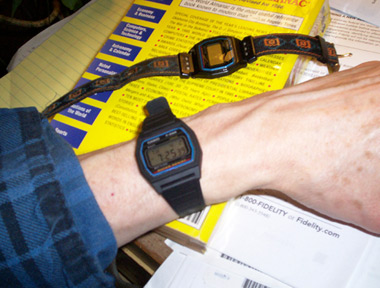
So it’s nice when you can still buy a classic. My Uncle Bruno passed away about 10 years and several months ago, and my brother and I had to clean out his apartment and settle his estate. We didn’t charge fees for our services to the other family members who inherited his net assets. But in return, we did pick out a few small-ticket, low-value items from his stash for our own use. My own booty included a Casio digital watch, the F28W. It was a rather low-budget watch, as my uncle was living a low-budget life (which was too bad, as he deserved better). It didn’t do much, but it did tell you the time and date. Also it was light and comfortable to wear, so I starting using it more and more. After a while it became my main wristwatch. I expected it to crap-out after a few years, but it kept on running as the new millennium progressed. About a month ago, the watch reached the ten-year mark with me.

But all good things must end, and my late uncle’s cheap-o Casio finally blanked out last week. I was told that it wasn’t worth having the battery replaced, as it would cost more than an equivalent new watch. So it was time to look for an equivalent new watch. As a starting point, I went on Google to see if anyone had a good recommendation for an F28W equivalent. It turned out that the most equivalent watch is the F28W! They still make it, and it looks the same. So I found a decent deal on Ebay ($14 with shipping) and punched in my order. And the package arrived today. So here’s the new watch on my wrist next to the old one, that had served me so well. The biggest difference is that the old one was made in Malaysia, whereas the new one comes from — where else? — China. We shall see if the Chinese do as well.

Sometimes simple is better, or so says the Casio web site. Most of the reviews on the Amazon site pretty much agree (but they’re correct about the plastic band breaking within two years; I’ll use the cloth band that I was using with the old one once it does). It’s nice, just for once, to find something old that the modern world still can’t beat. P.S., this isn’t the so-called “Casio terrorist watch”; that would be the fancier F91W. Mine came from some Jewish merchant in Brooklyn; the box was packed with Hebrew-language newspaper pages!

◊   posted by Jim G @ 8:52 pm       Read Comments (5) / Leave a Comment
 
 
Sunday, March 29, 2009
Politics ... Society ...

Let us now praise famous men (Sirach 44:1). I’ve lived my life mostly “under the radar” of important political happenings. So, I never got to rub elbows with any presidents or ambassadors or anyone else who might be interviewed by Barbara Walters or George Stephanopolos. I’m like most everyone else — I’ve seen a famous person from a distance (Jimmy Carter, Sen. Everett Dirkson, Jane Fonda), or I’ve talked to someone who knew famous people (the daughter of former Sec. of State Cyrus Vance, a former savings and loan bank president who knew Paul Volker), or I’ve gotten to shake hands with someone who was once in the news (former HUD Secretary Cisternos, former HEW Secretary Joseph Califano). But I don’t have Rahm Emanuel on speed-dial on my cell phone (I don’t even have a cell phone!).

However, I have had occasion to spend a few hours with certain people who occasionally show up in the news. So I’m going to give them a mini-tribute here, because all three of them seemed like good people who are doing mostly good things.

First honoree: Nicholas P. Retsinas

Mr. Restinas is currently the Director of Harvard University’s Joint Center for Housing Studies. He’s been interviewed by the press a lot lately about the mortgage crisis and the agonies of the housing market. I just heard him talking on Bloomberg radio the other day. Back in the 1990s, Retsinas served as HUD Assistant Secretary for Housing and Federal Housing Commissioner. One day he came up to Newark for a tour of New Community, and I was selected as his chauffeur for the day. He was gracious enough, even to me, and he asked the big wigs some very good questions. I think that I answered a question or two from Mr. Restinas at an odd moment when the Board Chairman was otherwise distracted. I never saw the guy again, but I got some pretty good vibes from him that day. He seemed like a seriously smart guy doing his best to make the federal government run better. Now he’s at Harvard and I’m sure that he’s still doing good things. So hats off to you, Nicholas Restinas.

Second honoree: Carol Lamberg

Ms. Lamberg was and still is the Executive Director of the Settlement Housing Fund, a non-profit affordable housing developer based in New York City. Settlement Housing has been responsible for developing over 55 developments with approximately 8,600 apartments, housing over 25,000 New York City residents in the Bronx, Brooklyn, Queens and Manhattan. The organization currently owns 42 buildings with 2,260 rental units. Besides rentals, Settlement Housing has developed cooperatives, condominiums, and two-family homes. I got to meet Ms. Lamberg in circumstances similar to my day with Nick Restinas; she was visiting New Community for a tour (but this time I was one of the guides, and not the van driver). Again, she seemed like a highly dedicated person, truly interested in bettering the lives of struggling people and families. I hope that she’s still managing to get more affordable housing built despite all the economic turmoil we’re now in. (Especially in a politically tangled situation like New York City!). So hats off to you
too, Ms. Lamberg.

P.S., according to a campaign contribution disclosure site, Ms. Lamberg was for Hilary Clinton in 2007, then got on board with a donation to the Obama campaign in 2008.

And last but not least: Harold Pachios

I got to know Hal (as we called him) in the mid / late 1980s, when I was working for an insurance industry rate-setting group and Hal was representing the industry in its rate increase litigation in Maine. He was and still is a partner in one of the most influential law firms in the State of Maine (the insurance industry wouldn’t hire any old hack!). I went along on many of the trips to the state capitol (Augusta) as I was working in the economics department and I helped to crank out the rate-of-return calculations that were presented to the State. Hal was a great story teller, as he worked in Washington back in the Lyndon Johnson years (Assistant Secretary of Transportation and Associate White House Press Secretary under Bill Moyers). He also served on the presidential campaign of Edmund Muskie. And he still has his hands in politics, serving recently as Maine State Counsel for the Obama Campaign.

Unlike the intellectual Nick Restinas and the Mother Theresa-like role of Carol Lamberg, Hal Pachos was and is more of a political wheeler-dealer. As the main partner in a big law firm, he takes a lot of money from big business. But I knew and still know that at bottom, Hal is a very good man, a fellow who got into politics to do some good. So Hal, this blog’s for you. I’ll never forget those dinners that my boss and I had with you on Commerce Street in Portland, eating really good seafood (back before I became a vegetarian), drinking Geary’s Ale, and laughing at your great stories about LBJ, Hubert Humphrey, Ed Muskie, Bill Moyers, et al.

P.S., I also once met former NJ Governor Jim McGreevey, in an Episcopal church. But I’m not going to brag about that!

◊   posted by Jim G @ 11:53 am       Read Comments (2) / Leave a Comment
 
 
Wednesday, March 25, 2009
Food / Drink ... Photo ...

Like most people, I like to eat; I enjoy the act of consuming tasty, well-prepared food. But I also know that too many kinds of tasty food have bad side-effects, e.g. obesity from too much fat and sugar, high blood pressure from too much salt, and possibly cancer from certain preservatives and by-products (e.g. the stuff in bacon, maybe even the crust on bread!). And I also know that what I eat has a bigger effect on the planet and on humankind at large. As such, I choose not to eat meat, and to minimize the amount of animal products that go down my throat (admittedly, I’m not a perfect vegan yet). Furthermore, I’m convinced that what I eat has an effect on my psyche; I’d get pretty depressed after a while trying to survive on microwaved burritos and non-stop Micky D’s (although I know people who do survive on that diet — in fact, too many people).

So, I’m a bit of a “foodie”, a vegetarian foodie. I put a lot of time into cooking and baking, I constantly try to improve my recipies, I own about 7 or 8 different cookbooks, and I’m on the lookout at the supermarkets for interesting new ingredients that might fit with my food philosophy. (Unfortunately, most of the new things I see at those supermarkets are highly-processed “food-like” items, exactly what I don’t want to eat). I’m kind-of a “slow food” guy, although I’m also trying to keep it simple. I don’t do complex, elaborate dishes; I don’t go bonkers to get the freshest, most exclusive items from specialty stores; and I don’t limit myself to organic fruits and veggies (too expensive!). I mainly use ingredients available at the local supermarket (although I do order some things now and then from bulkfoods.com, and I stop in at the local Whole Foods every month or so).

My meals are fairly simple; no fancy salads or appetizers, just a plate full of carbs, proteins and veggie fiber, followed up by a small dessert (maybe some cookies or a cupcake that I made – from scratch – during my weekend cooking sessions). With perhaps a glass of wine or ale (or porter or stout), but sometimes just a glass of seltzer with lemon. I concoct my main dishes on weekends, so that a weeknight consists of cooking some rice or pasta and heating up some veggie side-dishes along with the “main event” (usually a soup, a bean dish, or a pasta sauce). And then sitting down to enjoy the results.

Notice that I cook a lot, and thus use a lot of heat. Yea, admittedly I’m not a raw-foods person. I come from a Polish ethnic family and even though what I eat is very different from what they ate (lots of starch and meat fat and nothing green or yellow), I still tend to favor hot, cooked meals. As such, my carbon footprint is larger than for those good, progressive folk who get by on nuts, salads and raw brocolli. But there’s something very familiar and comforting about having a steamy plate full of calories under my chin, come dinner time — even in July! With me, the old tradition lives on (even though the spices and basic ingredients are all different).

So what’s on the menu? Here’s a list of my main dishes at present. I go back and forth between these items, making enough for 8 or 10 meals and then moving on to another item to sustain me for a few weeks.

– Black beans / rice or cornbread, with broccoli and yam or yellow squash
– Black bean soup w bread, yam or yellow squash
– Veg chili, red beans and lentils, with broccoli and yam or yellow squash
– Green split pea soup (no ham) with bread, broccoli and yam or yellow squash
– Lentil / tomato soup w bread, yam or yellow squash
– Beans baked in molasses and onions w whole grain raisin bread, yam or yellow squash
– Lentil / barley / mushroom soup w baked potato, broccoli and squash or yam
– Black eyed peas / rice or cornbread w yam or yellow squash
– White bean / kale / tomato soup w bread, yam or yellow squash
– White bean / broccoli soup w red vinegar, bread, yam or yellow squash
– Pinto bean stew w wheat noodles or baked potato, broccoli and yam or yellow squash
– Lentil / carrot / ginger soup w bread, yam or yellow squash
– Baked lentil loaf w sauteed mushrooms, baked potatos, yam or yellow squash
– Ratatouille (zucchini, eggplant, tofu, bread crumbs) w rice, yam or yellow squash
– Curried eggplant with peas, rice, yam or yellow squash
– Noodle casserole w tomato, green pepper, onion and tofu, with yam or yellow squash
– Stir fry (broccoli, red cabbage, red pepper, onions, tempah, garlic) w rice (sweet or short brown)
– Whole wheat pasta, orzo or aroboli rice w lentil/onion sauce, sauteed split mushrooms, steamed broccoli
– Garlic/chick pea/red lentil/cracked wheat soup, with yam or yellow squash
– Falafel with tahini sauce, bread, brocolli, yam or yellow squash
– Red Beans, hot peppers, cumin w/ rice, salsa, yam or yellow squash
– Pasta with kale/red cabbage/garlic, sauteed zucchini and portabello mushroom
– Pasta sauces: Tomato; Lentil/onion with basil pesto; Green pepper and onion w red vinegar

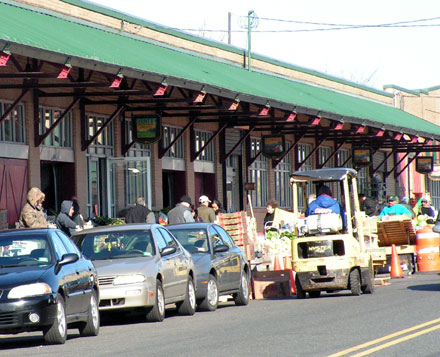
FINAL POINT: Most foodies love farmers markets. Up to now I haven’t given those markets much attention, as they are usually provisional affairs open at a odd times in odd places without good parking. But this past weekend I discovered a more institutional farmer’s market — some snobby foodies might not even consider it a farmer’s market. It’s in South Paterson, NJ, about 5 miles from my house, and I came across it by accident on a photo expedition. It impressed me by its size and scope (it’s not a handful of tables in a town square, but a series of warehouse buildings along a two block stretch where food merchants set up bins on the sidewalk and along the curb). So I got out and walked around, and was quickly astounded by the low prices and high quality of the stuff for sale on those bins. I picked up some apples and tomatos and strawberries at half to 3/4 of the supermarket price.

Most of the sellers aren’t farmers but food wholesalers, although supposedly some farmers set up tables and sell direct during the summer months. So maybe the apples came from Chile and the strawberries from Mexico and the tomatos from Florida or such. This market is not necessarily local, but neither am I. In fact, it’s patronized largely by the local Arab and Hispanic neighborhoods. It’s what “one-worldism” is truly about, once you get past the elitist idealism of the Barack Obama / PBS crowd (to which most “foodies” subscribe). It’s gritty and industrial; it’s not organic and there aren’t any Starbucks nearby (in fact, there are classic old diners to either side of it!). Here’s a pic. My kind of place — I’m definitely going back!

◊   posted by Jim G @ 7:17 pm       Read Comments (3) / Leave a Comment
 
 
Sunday, March 22, 2009
Brain / Mind ... Personal Reflections ...

Smell is a stronger form of sense than most of us realize. That’s probably because it goes way back in the chain of evolution. Before there was eyesight and hearing and taste, there were living things that could pick up chemical signals in the air. Our brains are like Microsoft Office software; they are not designed from scratch, but are “layered” from basic software designs drawn up many years ago. I.e., they still have the original programming design, but with a lot of additions and complexifications as to do more things. As such, we still have a brain that gives a lot of attention to smell.

Thus, it’s not surprising that smells can trigger dormant memories stored way in the back of the mind. I was thinking the other day about how certain kinds of smells can “take you back” to your childhood in just a second or two. You can be watching a baseball game or knuckling down on a math problem or reading an article about secularized sub-prime mortgage securities or pondering a vacation spot, and suddenly a whiff breaks your concentration; your mind wanders to far-away places from years and years ago.

So I drew up a list of some of the smells of my youth:

  • Seagrams rye whiskey (my parents and aunts and uncles always drank it during the holidays, mixed with ginger ale)
  • Balsam (from a Christmas tree in the living room)
  • Clove oil (from the dentist’s office)
  • Tar (the city was re-paving the local streets; and also from the Flintkote roofing-paper factory up the road)
  • Creosote (Railroad track ties — every male child ‘walked the tracks’ back then)
  • Perfumy flowers (funeral parlors and the local Catholic church at Easter time; for that, add the weird, resiny smell of beeswax candles burning)
  • Baseball glove leather and neatsfoot oil (ah, boyhood summer days)
  • Salt water (at the beach)
  • Yeast (pizza shops — back when they made their own dough)
  • Sweet baking smells (the local bakeries — we had two in my neighborhood)
  • Polished wood floors (the school gym)
  • An odd, somewhat rancid damp smell (wet raincoats and galoshes stored in the school classroom closet on a rainy day)
  • Burning tree leaves (in October and November, back when everyone burned autumn leaves)
  • “Beerwood” (the smell in an old bar or restaurant where everything was wood, and was marinated in spilled beer)

Many of these smells are mostly gone, because times have changed (e.g., pizza places now buy pre-made dough; dentists don’t use clove oil anymore for pain relief; you can’t burn leaves in autumn; and most Christmas trees sold are not balsam firs, or were cut months ago and have lost their smell by late December). It just shows that I’m getting old. But it’s still nice when an occasional smell takes me back for a quick mental visit with my youth, the days of long ago.

◊   posted by Jim G @ 11:44 am       Read Comments (2) / Leave a Comment
 
 
TOP PAGE - LATEST BLOG POSTS
« PREVIOUS PAGE -- NEXT PAGE (OLDER POSTS) »
FOR MORE OF MY THOUGHTS, CHECK OUT THE SIDEBAR / ARCHIVES
To blog is human, to read someone's blog, divine
NEED TO WRITE ME? eternalstudent404 (thing above the 2) gmail (thing under the >) com

www.jimgworld.com - THE SIDEBAR - ABOUT ME - PHOTOS
 
OTHER THOUGHTFUL BLOGS:
 
Church of the Churchless
Clear Mountain Zendo, Montclair
Fr. James S. Behrens, Monastery Photoblog
Of Particular Significance, Dr. Strassler's Physics Blog
Weather Willy, NY Metro Area Weather Analysis
Spunkykitty's new Bunny Hopscotch; an indefatigable Aspie artist and now scholar!

Powered by WordPress