The ramblings of an Eternal Student of Life     
. . . still studying and learning how to be grateful and make the best of it
 
 
Friday, February 13, 2009
Photo ...

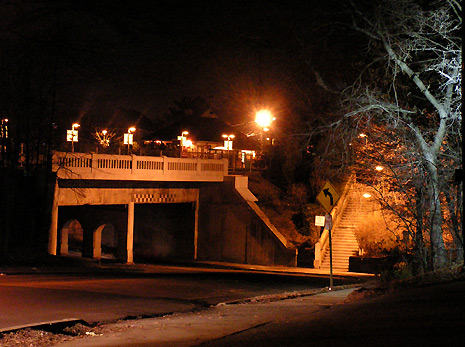
My mother is back in the hospital again, so I’m sitting around in the ICU for 6 hours a day while nothing much happens. Healing is slow, and at my mother’s age, it’s not even certain to happen. We’re not sure how this is going to work out, but whatever happens, this will be a memorable time in my life. One part of the memory will be the drive home through the dark winter night. I decided to stop near a train underpass along the route and get a shot. It’s not much to see, although the lighting is fairly interesting. I don’t usually drive along this road, so this underpass will probably become a “memory marker” for me. Here’s how I’ll remember it; dark, cold, and deserted. A lonely milepost on a long vigil.

◊   posted by Jim G @ 10:34 pm       Read Comments (2) / Leave a Comment
 
 
Tuesday, February 10, 2009
Politics ... Society ...

President Obama made a gloomy speech last night, saying basically that we need much more government in order to avoid an economic collapse that could cause a severe reduction in our country’s standard of living. He wants to give the government a lot of money to spend; his plan will require more and bigger government institutions in the short run, and more government tax burden on the citizens in the long run.

I’m not entirely against all of this. As a young man, I had socialist leanings. I said back then that the government IS the people; there’s nothing else that represents the “social body”. As such, government control of the economy would represent a more democratic and egalitarian way of running the economy than capitalism would. Capitalism requires that rich people control the economy; government (ideally) gives everyone a vote and a voice in it. It seems more fair.

As an old man, I’ve learned that theories like this don’t always work out. Government often takes on a life and a voice of its own, not necessarily the voice of the people. And it usually doesn’t do as good a job in running things as capitalism does.

I had a “government day” yesterday, one that gave me some food for thought regarding Mr. Obama’s philosophy (i.e., exploiting public fears regarding the economy so as to expand government). My mother is in the hospital and things are busy where I work, but my car was due for state inspection. So I got up early and drove over to the local inspection station; it is scheduled to open at 6:30 AM (sez so right on the NJ MVC web site). Well, I got there at 6:50 and there was a chain blocking the driveway, with two or three cars waiting behind it. So I got in line and waited. At about 7:10 a guy finally walked out and took down the chain. OK, fine. Despite the delay, my car passed and I went home.

Next, I needed to visit the Post Office as to buy a money order. Why, in this day and age of credit cards and checks, would I need an old-fashioned money order? Because a local government agency made a mistake and claims that I have an outstanding parking ticket, in a town that my car and I had never even seen. I received a cheery note in the mail from this government agency, stating that if I didn’t send them $95 by the end of the month, they would start collection actions that could include detainers and a revocation of my driver’s license. And by the way, this agency didn’t accept checks or credit cards; only money orders were acceptable. Well, I intend to protest all of this; but having once had my drivers license nearly revoked because of a government agency’s mistake, I decided to pay first and argue later. So I needed a money order, and a bit of research told me that the Post Office was probably the best place to get one.

USPS.COM told me that the local P.O. would open at 8:30 AM. So I got there at 8:45, and guess what? It wasn’t open yet. There were some people waiting at the door; they had heard that it would open around nine. So, another government-sponsored wait for me. Around 10 minutes after nine, the Post Office window finally opened. After a few more minutes I was able to get my money order, as to forestall the government from taking my rights to drive away (and thus be able to help my mother while in the hospital).

While at the window counter, I thought that I might combine some pleasure with business and buy a small sheet of commemorative stamps; hey, why not support a government effort to make its product (postage stamps) nicer to the consumer, and even worth collecting? Well, the friendly postal clerk looked in his cabinet and told me, sorry, no commemorative stamps. What? I get a quarterly catalog from the Postal Service telling me about their commemoratives, and I knew that a variety of special stamps had just been printed celebrating Abraham Lincoln’s 200th birthday, the Chinese New Year, Edgar Allan Poe, and some other stuff. Sorry; my local Post Office was not participating in consumer marketing that day. Just the basics — take it or leave it (after requiring a half hour wait).

Ah, government. Under Obama, government is going to play a bigger role in all of our lives. So we, the common folk, are going to experience more paperwork, more waiting in lines (or on hold on telephones), more “take it or leave it” transactions, more “obey or we go after you” orders. And yeah, more taxes eventually.

Government (as we know it here in the USA) gives its best efforts to 1.) those who get the most attention from the press; 2.) those who can sway the most voters; or 3.) those who work the system best (e.g., utilizing constitutional guarantees to sue the government). Sometimes poor and middle class people can do this; most often, it’s the rich and powerful who do it best. With capitalism, the rich and powerful make the big decisions; but at some point they have to think about whether the poor and middle class will buy what they offer. So, when the dust settles, both systems favor the rich and powerful, but give something to the poor and middle class. Neither is clearly a better system, from the social justice perspective. (If you remember the lessons of history, you will forget about communism as an alternative; communist centralism makes the biggest promises to the poor, and then cheats them the most.)

But yes, there are good things about government, and they were also part of my day. I was able to drive reasonably quickly to my mother’s hospital on a highway built with government funding. My mother’s health is largely subsidized by the government (Medicare). And I myself work for local government, and I was able to get some things done that day that made our agency’s operations a tiny bit better (but admittedly, I can sometimes be a brain-dead, rubber-stamp bureaucrat too; it’s contagious).

So I’m not saying that President Obama is entirely wrong. But for such a bright guy, for a politician who campaigned as an “intelligent pragmatist”, I am surprised at how quickly he has leapt into the “big government” pot. The American people may let him get away with it this time, given the mess that we’re in; but at some point, they may revolt and start listening to the Republicans once again. And then, things will go too far the other way; too much will be handed back over to the private sector. It’s all a question of balance, and I wish that Mr. Obama would try a little harder to strike a good, steady balance (and avoid the inevitable counter-revolution). Even if that means giving less power and glory to Nancy Pelosi and Obama’s many other Democrat friends.

P.S. — Joe Connolly from the WSJ made a good point today on his Business News broadcast (on CBS newsradio), regarding middle aged people getting laid off. He noted that employers are getting flooded by resumes these days, and are tempted to immediately throw out the ones from older folk. Then he suggested that they think twice about that, given that the entire crew of US Airways flight 1549 (the one that successfully ditched in the Hudson River last month) was over 50.
◊   posted by Jim G @ 9:12 pm       Read Comments (3) / Leave a Comment
 
 
Saturday, February 7, 2009
Science ... Society ...

The “rate of incidence” of autism (i.e., number of new cases each year per 1000 people) has increased quite a bit over the past 25 years in the USA. Back in the late 70’s, only around 1 or 2 children per 1,000 developed autism. But today, this rate is estimated at around 6 per 1,000; roughly triple what it had been. What the heck could have caused this? The usual suspect is pollution and toxic chemicals within the environment. Well OK, but the environment here in the USA was already quite polluted back in 1980, and had been for some time. There could possibly be something more happening.

A recent study suggests that the autism rate has increased because kids (and maybe also their mothers) don’t get enough sunshine these days. An economics professor from Cornell named Michael Waldman did a study which found a mathematical correlation between the amount of rainy or cloudy days in a county and the county’s autism rate; and also with how long the county has had cable TV available. The study indicated that the highest rates generally occurred in counties with a lot of clouds and rain, and where cable TV became available early on. The lowest rates were usually in sunny counties where cable didn’t come until later, or is not as prevalent in households.

Of course, a statistical correlation does not always mean that there is a meaningful cause behind it. But this one sounds interesting. It makes rough sense that a vitamin D deficiency could mess up the body metabolism, including the nerve system. But isn’t vitamin D put into milk so that kids always get enough? That’s true; but nutritionists admit that man-made vitamin D isn’t quite the same as the natural stuff produced by the skin from sun exposure; the natural stuff may well be better for you. Perhaps getting less real vitamin D while kids sit inside playing video games or watching cable TV movies is having a negative effect. Ditto for their parents, who probably keep their children out of the sun more than my parents did, for fear of skin cancer. Another factor: the more you stay indoors, the more exposed you are to indoor pollutants like formaldehyde and fire retardants.

Here is a link for a bar chart comparing the autism rates for children from all 50 states. Generally, the southern states have lower rates and the northern states have higher rates. You might expect people and kids in the northern states to get less sun, due to cold and sun angle. But there are exceptions; Alaska, N. Dakota, Montana, and Iowa have low rates. North Carolina, Missouri, Georgia, and Virginia have high rates. But then again, the first four are very rural, whereas the last four have big urban and suburban areas. Those areas have more pollution and more families with cable and computers with video games (or have had them longer). Hmmm.

Well, this theory may or may not hold up; but it seems clear that further research is needed, honing in on causative mechanisms. And also on preventative mechanisms — like good old-fashioned sunshine. The whole thing seems more credible than the thimerosal theory of autism, i.e. regarding the use of thimerosal (a mercury-based chemical preservative) in childhood vaccines.

Here’s one more interesting tid-bit. Another recent study indicates a direct interaction between vitamin D and genetic variations that increase the risk of multiple sclerosis. The study suggests that vitamin D deficiency during pregnancy and early youth may increase the risk of developing MS later in life. MS has also been recognized as having a north-south effect (i.e., greater incidence in the higher latitude northern areas). MS incidence rates may be increasing, especially in lower, sunnier latitudes, although not as dramatically as autism. Also, autism is biased towards men, while MS is more prevalent in women.

Perhaps we need sunshine more than we think. Sure, too much sun increases the chance of skin cancer. But perhaps many of us have over-reacted with SPF 100 sun-blocks and growing preference for the indoor life. Perhaps we — and especially our kids — need to get out in the daylight more often!

◊   posted by Jim G @ 1:17 pm       Read Comments (2) / Leave a Comment
 
 
Tuesday, February 3, 2009
Current Affairs ... Society ...

I’m not much of a pop culture guy, even less of a pop culture critic. It’s hard to properly criticize that which you don’t know much about. But I have seen enough TV commercials in my time, so I’m going to take a crack at saying a few things about the commercials on the Super Bowl last Sunday. I re-viewed them since the game via hulu.com, just to make sure I know something of which I will now attempt to speak.

Overall, I found the Super Bowl commercials to be quite unpleasant and depressing. OK, part of that is age. The ad companies are aiming at a younger audience during the Bowl, not at people over fifty. But still, I was once under 50, and back in those days, I found commercials to be much easier to take. Why? It’s hard to put a finger on it, but if you’re gonna try to be a pop culture critic, you’ve got to try. So here goes.

Back in my youth, the commercials didn’t seem to be trying so hard to get one’s attention. They seemed to be more subtle, more mood-setting, more pleasant. The best ones tried to make you feel good, as to get you in a good mood about the product being pushed. They used music and cinema to set a positive tone. Some of the best commercials were all mood, e.g. Michalob beer commercials featuring tunes by Eric Clapton and showing dusky scenes. Or they used subtle humor and wit, e.g. the old Alka-Seltzer ads (“can’t believe I ate the whole thing”, or the professional pie-eaters at work). Or they came up with a catchy jingle, some of which I still remember 40 years later (“Schaefer is the one beer to have when you’re having more than one”, or “There’s just one Schlitz, nothing else comes near; when you’re out of Schlitz, you’re out of beer”).

Sure, there were plenty of cheap-o commercials shouting out for cheap furniture or food blenders that double as wood routers and tile cleaners. But when a sponsor spent big money, they usually got a smooth, soothing, subtly entertaining product. And if it wasn’t subtle, it wasn’t dumb and puerile either.

I guess that the public has lost much of its attention span since then. Today, the most expensive commercials need to be a bit outrageous, even slapstick and gross (by my standards). There’s plenty of violence and eschatological humor. Sex of course is pushed to the limit for family TV. Music and rhyme are not important. Taste is pretty much gone. If there is any mood, it’s dark and cynical, self-aware and self-depreciative. Life as one big video game. That’s what I mostly took away from the Bowl ads. The big money and big audiences involved with Bowl air-time seem to propel a “race to the bottom”.

But let’s go over some of these ads, to see if this is truly the case.

  • Go Daddy, the “five showers a day” sexy woman being watched on a web site by some young guys: I find it interesting how web porno has now become “cute”.
  • Doritos, the crystal ball: A celebration of mayhem, with an old guy getting hit in the crotch. Yea, my fifth grade class would have loved this.
  • Pepsi, McGruber / Pepsuber: A semi-witty parody of high-tech adventure shows, with a bit of self-reflective cynicism regarding the big-sell; i.e., an anti-commercial commercial. But in the end, it’s just another big fireball explosion, just more “harmless annihilation”. Good old fashioned cynicism triumphs.
  • Audi, the car theft chase: More video-game mayhem, but made cute by the fact that nobody really gets hurt or dies, e.g. when the guy on the motorcycle wipes out.
  • Pepsi, “I’m Good”: Even more “cute violence”, more human injury just for fun.
  • Bud Lite, “Drinkability on the slopes”: Mayhem, continued. A skier hits a tree and some picnic tables at high speed, but once again it’s all made cute; no massive head injuries, just a body cast that “the chicks all love”.
  • Doritos, “Crunch Power”: Mayhem once again. Once again, we watch as a human body takes massive trauma (being hit by a fast moving bus), But everything’s fine here in ad-world, the guy is just a bit dazed and sprawled out on the windshield. Wow, how amusing and entertaining . . .
  • Career Builder, “Signs That You Need a New Job”: Sort of witty at first, but the guy in the bikini shorts puts this one back into the 12-year-old humor zone. The repeated physical abuse of a Koala Bear gets the required gratuitous violence in.
  • Denny’s, “Thugs”: an ominous “Godfather/Sopranos” scene over breakfast, but the plan to kill are interrupted by an enthusiastic waitress applying canned whip cream to the pancakes. Cute in a way, but sad that even Denny’s has to resort to mortal threat in order to sell old-fashioned comfort food.
  • Coke, “Palmero and the Kid”: Nice at first, a kid giving an NFL star a soda. But no, they couldn’t just leave it at that; Palmero has to get violent with the corporate guys who object. (Oh, yea, it’s just an NFL tackle, even though in real life such a move would slam your head into the concrete so fast that you’d never wake up.)
  • Bud Lite, “Meeting”: A guy sitting in an office meeting gets hurled out of a third-story window. Then gets up and brushes himself off; no severed spine, no shattered hips. Sorry, that’s just not the way that gravity works on this planet.
  • Monster, “desk under the animal’s butt”: OK, here comes the classic fourth-grade eschatological humor.
  • NBC, LMAO Clinic: Oh yea, NBC is so outrageously funny that you need a doctor to reattach your butt. Eschatology 101, continued.
  • Teleflora, “Boxed Flowers at the Office”: How nice, the crummy boxed flowers from a competitor are in a bad mood and insult and degrade the woman they were sent to, right in front of her co-workers. Not very uplifting; after that ad, I wouldn’t want any flowers at all, no matter how fresh and quickly delivered.
  • Bud, “Conan in Sweden”: Yuck, anything with Conan is a non-starter. A machoed-out Conan doing weird stunts is even worse.
  • H&R; Block, “The Grim Reaper”: death and taxes versus the little guy. OK, no one dies or faces severe injury in this one. Maybe there’s even a bit of wit (a rare commodity during the Super Bowl) when the reaper leaves with a fatal threat, then comes back and asks for parking validation.
  • Castor Oil, “The Grease Monkeys”: Strange days, indeed; to sell something bland like motor oil these days, you gotta get weird (monkeys invade a suburban home garage).
  • Pedigree pet adoption service, “Weird Pets”: It’s sad to see a good cause, like finding homes for unwanted dogs, needs to send out ostriches to threaten senior citizens, and have a rhino take down a living room wall just to get some attention.
  • Kelloggs Frosted Flakes, “Growing Fields”: The background reality is stranger here than the growing crops linking arms together in the video. Kellogg’s wonderful sugar bombs are helping to feed the child obesity crisis, so the PR folk back at corporate HQ started a donation program to build or improve playing fields in middle-America, as to help real-life kids sweat off the mega-calories that Tony the Tiger shills to them.
  • Cash4Gold: OK, here’s one for the older crowd. It’s just a retro 1 AM commercial camped up a bit with Ed McMahon and MC Hammer.
  • Hulu, “Alien Brain Mush”: This one is another self-parody, an injection of irony on top of retro sci-fi. It’s almost interesting, but it doesn’t hold after Alec Baldwin turns into an alien; the implication always has to be brought home with a sledgehammer at the Bowl.
  • Bridgestone, “Taters” (Mr. and Mrs. Potato Head take a spin): Well, now we start with the more harmless stuff.
  • Taco Bell, ”
    Guy Meets Cute Girl”: Again, harmless and bland.
  • E-trade, “Talking Babies”: Again, harmless and bland.
  • Gatorade, “Mission G”: Again, harmless and . . . oh, wait, that really is Tiger Woods, isn’t it.
  • Hynduai, “Angry Competitors Now Get Our Name Right”: Once the shouting is over, harmless and . . .
  • Bud, “The Clydesdale Adventures”: One more time . . .
  • GE, “Wind Energy”: A boy captures the wind in a bottle to help grandpa blow out his birthday candles. And GE will use that wind to save the world. It’s bland all right, but I’m not ready to say that any message from GE is harmless.
  • Monster / NFL “Fandom Contest”: How depressing, a reminder that 99.999 percent of us are just specs in a huge crowd. How wonderful that the great NFL God promises to raise one of us up to experience “mega-TV-pro sports-world”, the true definition and meaning of life . . . oh Socrates, where are you now?
  • Hyndaui, “Assurance”: wait, here’s an old fashioned commercial, with soothing guitar music and artistic mood shots. How did that one get in?
  • Toyota “Venza”: more modern art and good taste. Well, maybe the car makers get a pass on needing to be brash and gross in hawking their product. I guess they don’t want to seem TOO eager to sell their stuff; they don’t want car prices to crash in this recession.
  • Pepsi, “Generations Refresh”: Wow, Bob Dylan singing the praises of the military! Talk about big-cola revisionism. I guess it all makes sense if you do stay “forever young”, as the theme song goes. Sorry, I’d rather be getting old but still able to remember what the 1960’s were really like.
  • GE, “The Smart Grid Scarecrow”: A twist on the classic Ozzian formula, you know, Dorothy and Toto and The Wizard and all that. So, I was wrong; some old-school commercials still slip in. But this is NOT an example of the better stuff from the old days.
  • Bridgestone, “Mars Explorers”: Actually, this one was a bit like the better stuff from the old days. Someone steals the tires on the Martian planetary rover. Houston, we have a problem.
  • Priceline, William Shatner in a Wiretap Van Outside Your House: Not exactly the good old days, but not the new junk either. Sort of a witty takeoff on high-tech espionage shows.
  • Cheetos, “Chester the Tiger”: Well, a little bit gross with those messy pigeons attacking the chatty girl at the next table, but Chester pulls it off in the end.
  • Sprint, “Roadies On Takeoff”: Finally, a commercial that I really liked! Yea, flying today would be a lot more fun if roadies ran the show. Instead of calling off “V1, V2” as the plane prepares to “rotate” skyward, the roadie pilots yell “let’s rock!”. And then the runway fireworks go off. Cool!
  • Springsteen and E-Street, “Mini Concert”: Oh, that wasn’t a commercial? That was supposed to be real? Whatever. Bruce was trying a little too hard, but it was nice to see Stevie Van Zant and Clarence Clemmons being them selves. After all the years, some guys hold up.

So, there were one or two good commercials amidst the dross. And the game was pretty good too. But I always feel better somehow after football season is over. Spring and a season of new hope will get here yet.

◊   posted by Jim G @ 10:23 pm       Read Comments (3) / Leave a Comment
 
 
Friday, January 30, 2009
Current Affairs ... History ...

I was reading some thoughts from Victor Davis Hanson, a classicist scholar who is also a conservative commentator (say that three times fast!). I.e., he’s a guy who knows a lot about the history of ancient Rome and the Greeks of old. Obviously he has some things to say regarding whether America is in danger of going the same route, i.e. decline and fall after a few centuries of power, achievement and vast geo-political dominance. Mr. Hanson is pretty cautious about it; he’s not saying that America has turned rotten and deserves to get flushed down the tubes. But he is saying that if we’re not careful about maintaining our world power, our individual virtue, our patriotism, and other assorted conservative values, we could. Hanson is not a big fan of President Obama, but he’s not rabidly condemning him either; he seems to be giving Obama a chance, given Obama’s various moves away from doctrine liberalism towards centrist realism.

Anyway, I noticed a passage in one of Hanson’s book reviews that inadvertently summed up the situation in America today. Here it is:

Despite occasional revisionism, the story of Rome’s fall was pretty much universal . . . After some five centuries of imperial domination from the Sahara to the Rhine, and from the British Isles to Mesopotamia, the Western empire collapsed in the late fifth century . . . An exhausted global empire was so plagued by financial corruption, a bankrupt elite, and rural depopulation that few citizens joined the army. Fewer still knew what fifth-century Rome stood for, much less whether it was any longer worth defending.

In this review, Mr. Hanson was NOT trying to argue that America has caught the same infection that Rome had by the fourth century CE; he was actually arguing against two other writers who feel that it has. But look at the modern parallels: “exhausted global empire”, “plagued by financial corruption”, “bankrupt elite”, “rural depopulation”, “few citizens join the army”. Does a majority of our citizens know what twenty-first century America stands for? I guess that most people would say “democracy” and “political freedom”. But then again, the most recent GOP vice presidential candidate couldn’t think of those words when questioned by a newsman regarding the last President’s “doctrine”. (Yes, I’m referring to Charlie Gibson’s interview with Sarah Palin; and recall that when Gibson finally got tired of Palin’s lame attempt to respond to that question, his own answer ALSO failed to include democracy and freedom!).

Yea, I think that Mr. Hanson hit a nail on the head there, even if he wasn’t aiming for it. But as Hanson and many other historians contend, history is made not by anonymous forces but by people and ideas. Can Barack Obama come up with the right ideas to steer our nation’s evolving history back towards goodness and strength? Can he turn it back into something that every citizen can believe in? That’s the trillion dollar question.

PS, I also checked out a nine-part lecture on You Tube by Prof. J. Rufus Fears, another conservative academian who has pondered the parallels between the Roman Empire and the U.S.A. today. Fears seems to be saying that we’ve gone pretty far down the same one-way road to oblivion that Rome took, but it’s not too late yet for us to veer away from it. Fears says that we face a matrix of threats similar to what the Roman Republic faced in the first century BCE, including a debt crisis choking off the economy causing a severe recession; a crippling clash of partisan political forces; and a series of threats from powerful foes and rivals from foreign lands.

As with the late Roman Republic, some of our worst threats come from the Middle East. HOWEVER, the biggest threat to Rome’s future turned out to have hailed from north-central Europe, i.e. from the Germanic tribes. And here’s the jawdropper from Dr. Fears: we too face severe future threats from that region, but need to go another 200 miles to the east: i.e., Russia. Yes, Dr. Fears feels that the end of the Cold War and Communism in the early 1990’s was NOT the end of our Russian problem. He thinks that conditions in today’s Russia are ripe for the re-development of a powerful, barbaric and militaristic dictatorship bent on dominating as much of the world as it can; he feels that Vladimir Putin is already setting the stage for that. He goes so far as to say that Russia could become fertile ground for a new Hitler-like figure! Yikes.

Ironically, Fears believes that the U.S. and Western Europe had a chance in the early 1990s to have prevented this. He implies that had we put lots of capital and redevelopment aid into Russia back then, something like we did afterWW2 with the Marshall Plan in Germany, we could have set the stage for democratic institutions to have finally taken root in Russia (as they did in post-war Germany). But we didn’t, and now we’re watching Russia fall back into it’s old nasty habits. With enough dictatorial mobilization and plentiful access to oil and natural gas, Russia could well re-create the specious prosperity that Germany experienced during the Great Depression, back in the mid and late 1930s.

So, if our economy doesn’t snap back within a year but instead sends our nation into a five to ten year malaise, then the USA is gonna be in serious hot water if the Middle East flares-up again (like when Iran goes nuclear), and at the same time a re-militarized Russia starts taking back what the old Soviet Union lost. Yep, it could be much like what the Roman Republic faced about 50 years before Jesus. How did the people of Rome react? Eventually, they gave in to political dictatorship; Julius Caesar set the stage for ending populist rule, and Augustus later sealed the deal. Is this happening today here in the USA? Dr. Fears said that we don’t have an equivalent to Julius Caesar right now; and that’s mainly because Caesar was so brilliant. George W. Bush certainly tried to become a Caesar, but he didn’t nearly have the brainpower. In the end he couldn’t do all that much damage to American democracy as we know it (thanks to screams of bloody murder from the liberal factions).

However, Dr. Fears notwithstanding, we now have a man in power with Caesar-like brilliance. (Recall that Caesar started out as a “Populare”, roughly comparable with today’s “Democrats”.) Obama got into power partly by repudiating the empire-building tendencies of his predecessor. Nevertheless, if things don’t go well during his tenure and our nation faces the real prospect of serious decline in living standards for almost every citizen, then I could imagine a scenario where President Obama tacitly convinces the citizens to forfeit much of their political freedom, so as to maintain personal, economic and national freedom. (Will the liberals then scream at Obama as they did at Bush? I don’t recall many screams when Obama tossed campaign financing reform aside. Love is blind.) As Professor Fears points out, this choice has been made by many other peoples over a wide variety of circumstances throughout the course of history. It would be a mistake to think “it couldn’t happen here” — given the extremely dangerous economic and international situation that America now faces.

◊   posted by Jim G @ 11:03 pm       Read Comments (3) / Leave a Comment
 
 
Wednesday, January 28, 2009
Politics ...

Barack Obama’s election to the Presidency still surprises me a bit. Only four years before, American voters clearly rejected the Democratic alternative to the anti-government philosophy that Ronald Reagan popularized. Bill Clinton seemed like such a rejection, but he and his “third way” ideas regarding the social and economic place of government in modern America were not in fact a return to big government. Clinton was “Reagan-lite”; he was still fairly conservative, was still inclined toward small government and low taxes. It was under Clinton that the “bubble economy” got going; it made many people happy for many years (through rising stock prices, rising home values, and rising consumer spending). Then came Bush Junior and Osama Bin Laden, but even the 9-11 tragedy and the subsequent “war on terrorism” couldn’t stop the economic party that was going on in America. Until the final, fateful year of the Bush presidency, unemployment was low, mortgage loans in any amount could be had by almost anyone, gasoline and big SUVs were affordable enough, “must-have” consumer electronic goods were everywhere, and people were generally pretty happy with things.

Thus, in early 2007, it was still quite unimaginable that a relatively inexperienced Democrat with a solid liberal pedigree like Barack Obama could be taken seriously for the Presidency. Well, I should take that back; once we found out just how intelligent and charming Senator Obama was, it was clear that this guy would not go away. But his historic charisma and incredible political skills notwithstanding, it still didn’t seem as though the average American voter had good reason to reject the tried-and-true Republican formula. Despite John McCain’s many blunders (with Sarah Palin perhaps being the most egregious), Obama remained tied with him in the polls only two months before Election Day. The big swing towards Mr. Obama came only after it became clear that the growing economic problems in the banking and real estate sectors were going to affect just about every family in one way or another. Only when it became clear that foreclosure, layoffs, and bankruptcy were becoming a real threat throughout the middle and working classes did the Obama landslide fall into place.

The American public can be pretty dumb; they clearly got duped by continually rising home and stock values and unemployment rates that stayed below 5%. They really believed that nothing could ever go wrong again, and thus did some very risky things with their money and credit. But despite their short-sightedness, when it comes to electing a President, they generally know what they’re getting into. IMHO, they knew that Reagan, Bush, Clinton, and then Bush again meant less government, less tax, and more economic growth (although they didn’t ponder whether the fruits of that growth were being fairly distributed). And with regard to Obama, they knew that voting for him meant more government, and eventually more taxes. They don’t like a lot of government and tax, but when their way of life is directly threatened (which Osama Bin Laden could never do on a nation-wide basis), they become more flexible. Better to have a job and a house and face higher taxes, than the other way around.

My question is whether the public mood will revert back to the Republican philosophies if and when the economy gets better. This will be really interesting to watch in 2012. Hopefully things WILL be better by then; the big government intervention that Obama is now orchestrating with the Democratic House and Senate will do its job (I hope) without imposing crushing levels of federal debt. Could an attractive Republican candidate then come along and argue for a “return to Reagan-like normalcy”?

The American public can be just as fickle as they are short-sighted. I realize that there have been demographic changes favoring the Democrats (including the aging of the Baby Boomers, who are increasingly concerned about securing what they earned during the “go-go years” and preserving their access to other retirement helpers like Medicare and Social Security). But I still can’t believe that the big changes in voting patterns between 2004 and 2008 were driven by these things. The always perspicacious Bill Clinton was right in saying “it’s the economy, stupid”. The American people are indeed stupid in a lot of ways, but they usually know where they stand with the economy; in the short-run, anyway. If a future GOP candidate can recapture the short-run economic ground, then we could be in for more big surprises – as if 2008 didn’t have enough surprises for a generation or so.

One more note on Obama and the new economic order. I was perusing the pundit-of-the-day lists on Realclearpolitics.com this morning and I noticed two different articles by Jeffrey Sachs of the Earth Institute at Columbia U. Both are found in British publications, the Financial Times and the Guardian. Both articles discuss the implications of the Obama fiscal stimulus package (which the House just approved tonight). In one article, Mr. Sachs hailed the package as the start of a new economic era; quote,

One of President Barack Obama’s historic contributions will be a grand act of policy jujitsu – turning the crushing economic crisis into the launch of a new age of sustainable development . . . Obama is already setting a new historic course by reorienting the economy from private consumption to public investments directed at the great challenges of energy, climate, food production, water and biodiversity.

Bottom line here: this is a return to an old historic course, the course of bigger government, much as our nation had from 1932 to about 1982. Mr. Sachs told of how America would regain its world leadership in this upcoming era, but didn’t say a peep about who is going to pay for it all. However, in the other article, Mr. Sachs was less celebratory and more hard-nosed about the bill for it all. Quoting again,

If the present stimulus package is adopted without a medium-term [taxation] plan, it will go the way of the earlier stimulus package and the TARP, yet also put the US into a fiscal straitjacket that could paralyze public sector action in critical areas for a decade or more to come…. there is certainly a cyclical case for deficit- financed public spending, but accompanied by phased-in tax increases to provide proper financing of crucial government functions in the medium term.

Bottom line this time: Taxes need to go up once the economy is out of danger, so we might as well get people committed to that as soon as possible, while they are still in a good mood about government. If we put it off too long there is the risk of an anti-tax revolt halting further government expansion. In other words, Mr. Sachs remembers Reagan and 1982.

Both articles were published on the same day. I thought it would have been more honest of Mr. Sachs to have combined the two themes and weighed them against eachother. Mr. Sachs clearly welcomes the return of big government to America, but worries whether the public will eventually turn against the Obama initiatives much as they turned against the New Deal / Great Society legacy after Jimmy Carter. Mr. Sachs seems to realize what I said above: the American public is fickle, and has only grown more-so in the age of information and instant gratification. Sachs probably also worries about 2012.

(PS – I myself am not against what Obama is trying to do here; I have said on this blog that I am very dissatisfied about where our economy has gone since the Reagan Revolution, with high levels of inequality caused by fast-growing unregulated markets. On the other hand, I worry that big government can cause economic distortions and undue growth burdens because of the “me-first” political influences behind much government decision-making. The European Communist bloc of the 50s, 60s and 70s provided ample evidence of that; socialism is extremely prone to infectious decay from leadership greed. I’m hoping that Obama can put a system in place such that he AND his successors can make long-term, public-oriented decisions about the economy, resisting the usual parochial pressures. If not, then perhaps we should go back to free markets and small government, cruel as the side-effects can be.)

◊   posted by Jim G @ 9:43 pm       Read Comments (3) / Leave a Comment
 
 
Sunday, January 25, 2009
Photo ...

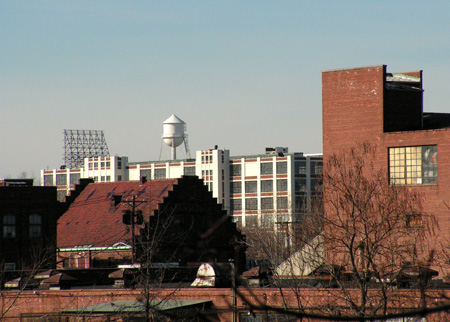
This is what America looked like maybe 50 or 60 years ago; this is where America once worked. But now the factories and watertanks and smokestacks are getting quite rare; mostly just reminants from the a different industrial era. Here are some views of what’s left of the old industrial zone in Dundee (Passaic) NJ, along the Passaic River. This is where my grandparents worked after they came over from Poland around 1912. This is what America looked like to them. Not exactly breathtaking, but compared to war and agrarian poverty in Russian or Austrian-controlled Poland, it probably looked just fine. And it probably looks pretty good to the Mexicans and Dominicans who hold down what few jobs are left here.

◊   posted by Jim G @ 4:09 pm       Read Comments (2) / Leave a Comment
 
 
Thursday, January 22, 2009
Philosophy ... Spirituality ...

Now that my mother is feeling a bit better, I can get back down to some abstract thinking (on a recreational basis; hey, whatever floats your boat, right?). My topic for today is one I’ve pondered in various ways over the past few years; and that is whether we humans are purely physical phenomenon; or is there an additional ontological dimension to the universe, which somehow weaves its way into us and thus makes us something more? The whole question seems to revolve around “being” and our awareness and love of being (and our usual fear of the opposite). “Being” seems so simple at first; it merely means “in a state of existence”. But then what is “existence”? Ultimately it means . . . . to be. It all gets a bit circular. The only thing that breaks the short circuit is our own awareness of being, and our desire and struggle to maintain and preserve our own being.

The evolutionists (and I generally consider myself an evolutionist; I’m not a fan of so-called “creation science”) say that our “desire to be” (aka “will to live”) isn’t hard to explain. They explain that it couldn’t have been otherwise; by some trial-and-error process over the multi-billion year history of life on earth, living systems with the most propensity to struggle for survival became the ones to propagate the genetic accidents that gave them their zest for life. Creatures born without the drive to fight and survive didn’t contribute much to the genetic pool.

But a problem arises when we humans act in ways that run counter to the “stay alive at all costs” heritage of the simple Darwinian rationale for our “being fetish”. Perhaps it’s just a quirk, but over the centuries, those having perhaps the greatest appreciation and love for “being” (not just self-being, but the being of the community, of society, and of the world) have at times offered up their own being as to protect the “higher” principals of “being”. You wouldn’t think that a purely Darwinian machine would even have the capacity to ponder such a “higher principal”, as it wouldn’t be expected to enhance survival and reproduction. (Unless you argue, as some evolutionists do, that the capacity to think and act socially was “selected” by the process in highly developed species like humans because such cooperation enhances the survival of the species as a whole; much lower life forms, like ants and termites, had also developed extremely social forms. However, such behavioral programming did not carry forward into the mammals and higher primates, for whatever reason).

In my opinion, humans are able to comprehend “being” beyond what a Darwinian machine would be expected to do, even granting that evolution sometimes creates superfluous abilities and interesting side-effects in its products. We are able to appreciate the nature of “being” far more than any other combination of matter, energy and information could. And it is that appreciation that drives us crazy. It makes us depressed, it makes us kill others and kill ourselves, it makes us into artists and musicians. And on rare occasion, it makes us into saints. It makes it equally foreseeable that humankind will eventually wipe itself out, and that humankind will eventually find the key to peace, harmony and balance for everyone.

The game that our species is playing seems well beyond anything that Darwin and his successors described. Evolution certainly did get us this far, but something else kicked-in somewhere along the road. The scientists have no way right now of getting a handle on this with their present means of measurement and analysis, so they deny that it exists. Religious people believe that it does exist, but are too tied up in ancient myths to do any fresh thinking about it. And the philosophers, who traditionally tried to walk the fine line between these two groups, now seem extremely fearful of criticism by the empiricists. So it’s hard to find a good, honest discussion on the subject (and admittedly, it’s harder still to get a grasp on it!).

But hey — ya can’t give up. “The Principal of Being”, in the broad sense of a universal force or fundamental dimension, is a “know it when you see it” proposition. And I recently saw my mother struggle back from a near-deadly medical condition; I have no doubt that I was viewing the power and reality of whatever this “BEING PRINCIPAL” is.

◊   posted by Jim G @ 8:44 pm       Read Comments (2) / Leave a Comment
 
 
Monday, January 19, 2009
Photo ...

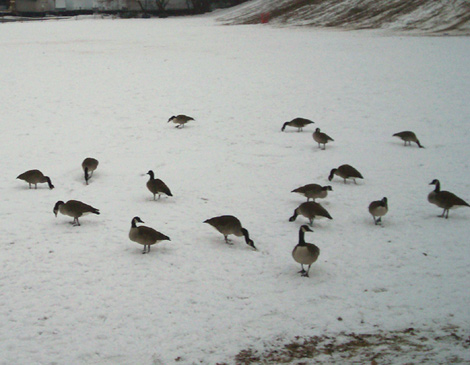
I’m trying to get things back to normal here. And I see that I haven’t posted a picture in a while. So here’s a picture, a winter picture. Just some geese on a snow-covered field on a gray January afternoon.

◊   posted by Jim G @ 2:06 pm       Read Comments (2) / Leave a Comment
 
 
Sunday, January 18, 2009
Medicine ...

As noted in my last two or three entries, I haven’t been writing much lately due to an illness in the family. My mother was in the hospital since Dec. 9 following a respiratory arrest. The medical people weren’t very optimistic about her chances at first, but God and my mother conspired to beat the odds. So she went home yesterday, 39 days after her “lung attack” (it was similar to a heart attack in many ways; in fact, her heart had stopped during the incident).

Thirty-nine days . . . . which is just shy of 40 days, recalling Jesus’s fast in the desert, Jonah’s timeline for the destruction of Ninevah, and Ezikiel’s sufferings for the sins of Judah. Yes, this incident was almost “Biblical in scope”.

The doctors never did give us a good explanation of what happened to my mother. In the end, we had to settle for the fact that the airway passages in her lungs got severely inflamed for awhile and nearly choked her. They couldn’t pin it on an infection, an environmental exposure like smoking or asbestos, or some other medical condition. I myself still think it was an autoimmune reaction. My mother never had a major immune disease (like lupus, MS, Crohn’s Disease, Guillain-Barre Syndrome, Type 1 Diabetes, etc.). However, she has had rheumatoidal arthritis for a while now; not surprising for someone in their mid-eighties. So she has had some autoimmune activity in her body.

Another little factoid from her hospital stay: on her fourth day in the intensive care unit, my mother’s blood hemoglobin levels were found to be critically low, so the doctors ordered a blood transfusion. Following medical protocol, they performed a Coombs test to search for any antibodies in her blood that might interfere with the new blood. And they found them! They asked my brother and me whether she had any previous transfusions; we and her doctor had no such recollection. The hospital where she had a cancer operation eight years ago also had no record of any transfusions. So — why all the killer antibodies in her blood? Maybe they were the same antibodies that had attacked her lungs (and her kidneys, which were also in trouble for a while there)? The doctors brushed my suggestion off, of course.

Nonetheless, there is a lot of interest today in autoimmune disease in the medical research field. Some people feel that what we presently know about autoimmune disease is just the tip of an iceberg. I.e., the medical establishment knows a lot about the most apparent autoimmune conditions (again, like lupus and MS and now arthritis), and has come up with some treatments. However, medicine is not even close to coming up with a cure; the immune system is an extremely complex thing, second only to the brain. In effect it has a “mind of its own”, as it monitors, responds and learns from changing body conditions and internal threats that come from germs and other bad stuff (including when our own cells go awry, i.e. cancer). We don’t understand it, and thus can’t do much to put it right when it makes its own mistakes.

Over the past 30 years, the government and private funders have put millions, maybe billions, into finding the cause for cancer and then finding a cure. It’s starting to seem to me that this is like a child trying to dance or ice skate before it knows how to walk. There’s something we need to get a grip on before we take on cancer, and I’m now thinking that a thorough understanding of the immune system is a big part of it. Immune disease isn’t very “sexy” right now, because it seems so limited; only a relatively small percentage of people will develop one of the known forms of serious autoimmune disease. But again, that turns out to be just the tip of the iceberg. We’re now starting to see just how tied-in the immune system is to all sorts of disease, ranging from cancer itself, to pandemic infections (i.e., immune system response is what make bird flu such a threat), to heart disease, to the aging process.

Ah yes, the aging process — that’s where my mother comes into the picture. I’m getting the feeling that many sorts of illness and breakdowns in old age are related to immune system failures, but are analyzed and treated on a more immediate, localized basis (e.g., heart condition, liver condition, lung condition, etc.). Since we are only starting to understand the immune system and what happens when age or environmental factors (toxins, pollution, smoking, viruses, etc.) mess it up, there are few or no practical therapies, never mind any cures. Most doctors probably don’t even want to talk about it (my mother’s doctors included). It’s frustrating to me, thinking that my mother has a condition that medicine is just not ready for yet.

SIDENOTE: Many of the classic autoimmune diseases are NOT old-age related; they manifest earlier in life, when the immune system is most potent. However, the control mechanisms for the immune system clearly deteriorate with age. So, if a person still has a strong immune response in their later years, as my mother does, the chance that their strength will turn against them increases.

I took a look on Google and the Amazon to see if there are any other autoimmune disciples out there. There does seem to be one; her name is Donna Jackson Nakazawa. She has a book out titled “The Autoimmune Epidemic: Bodies Gone Haywire in a World Out of Balance”. I’ve just ordered a copy of it; given my mother’s recent experience, I will give it priority over the many other interesting books stacked up in my apartment waiting to be read. The reviews and previews for Ms. Nakazawa’s book indicate that she focuses a lot on environmental factors, e.g. pollution and toxins in the air and water and our foods. She is mainly concerned about the possibility that a lot of people in their prime, and even children, are becoming weak and even sick before their time because of non-specific (and thus-far non-diagnosed) autoimmune processes triggered by these poisons.

My mother is now 86 and was fairly healthy most of her life. So, I can’t complain that the high levels of nasty stuff that we live with here in northern New Jersey prematurely robbed her of her vitality. But still, it’s a shame to think that perhaps she could have been up and kicking even longer if our industrial economy had done more to keep its noxious by-products from mucking up our planet (and if we knew how to eat the right things and avoid the wrong things so as to strengthen ourselves against it — which Ms. Nakazawa dwells on in her book).

And also if our medical establishment had not tried to jump over the immune system in its attempt to deal with cancer. Hopefully, the public and the political process will someday learn that medical researchers would do better right now by focusing on intermediate topics like the immune system; and thus stop throwing so much tax money at a problem that we just don’t have the tools yet to deal with (i.e., cancer). Let’s take a decade or two to develop those tools; that’s what make sense to me. But the researchers don’t want to say that out loud for fear of losing government and foundation grants. Oh well, such is the way of the world. I wish Ms. Nakazawa much success, but for now she seems to be a prophet crying out in the desert. Ah yes, back to the “40 days” theme!

◊   posted by Jim G @ 12:31 pm       Read Comments (2) / Leave a Comment
 
 
TOP PAGE - LATEST BLOG POSTS
« PREVIOUS PAGE -- NEXT PAGE (OLDER POSTS) »
FOR MORE OF MY THOUGHTS, CHECK OUT THE SIDEBAR / ARCHIVES
To blog is human, to read someone's blog, divine
NEED TO WRITE ME? eternalstudent404 (thing above the 2) gmail (thing under the >) com

www.jimgworld.com - THE SIDEBAR - ABOUT ME - PHOTOS
 
OTHER THOUGHTFUL BLOGS:
 
Church of the Churchless
Clear Mountain Zendo, Montclair
Fr. James S. Behrens, Monastery Photoblog
Of Particular Significance, Dr. Strassler's Physics Blog
Weather Willy, NY Metro Area Weather Analysis
Spunkykitty's new Bunny Hopscotch; an indefatigable Aspie artist and now scholar!

Powered by WordPress